
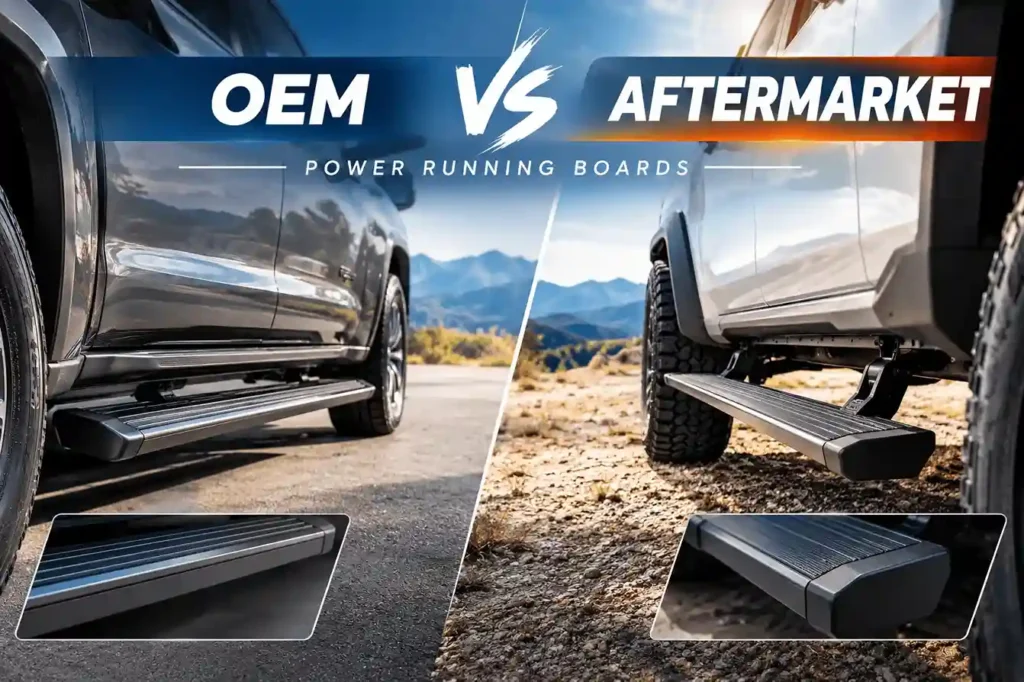
Every truck and SUV owner considering aftermarket power running boards eventually faces the same question: OEM or aftermarket?
OEM power running boards come with the vehicle from the factory. They offer vehicle-specific fitment, a factory appearance, and direct integration with the vehicle’s electronics. Owners can also get support from the vehicle dealer. However, OEM power running boards are not available on every trim or vehicle configuration. In many cases, buyers must choose them when they order the vehicle. Adding them later can also require extra OEM parts and dealer labor.
Aftermarket power running boards give owners another option after they buy the vehicle. They offer more retrofit choices, wider vehicle and trim coverage, and more options for step height and drop. Depending on the system, the owner, an auto shop, or a dealer can install them. A truck owner may also choose aftermarket boards months or even years after buying the vehicle. However, fitment, mounting quality, electrical connection, weather protection, warranty, and replacement support can vary by manufacturer.
This article compares OEM and aftermarket power running boards based on cost, technology, durability, step height and size, ground clearance, installation, fitment, warranty, and support. The right choice depends on the vehicle, when you plan to install the running boards, and what you need from them.
Key Takeaways
- OEM availability: OEM power running boards offer factory integration and vehicle-specific fitment, but trim and factory configuration can limit availability.
- Factory option vs. retrofit: Choosing OEM running boards with a new vehicle can reduce added costs, while an OEM retrofit may need extra parts, programming, and labor.
- Aftermarket flexibility: Aftermarket power running boards can be added after purchase and often offer more vehicle, trim, step height, and drop options.
- Aftermarket quality: Mounting design, electrical integration, weather protection, durability, warranty, and replacement support can vary between manufacturers.
- Choose for your use case: Compare step height, step size, ground clearance, installation, fitment, and long-term support before choosing a system.
Cost of OEM vs Aftermarket Power Running Boards
Money is often where the OEM vs aftermarket decision starts.
If you order a new truck or SUV with OEM power running boards as a factory option, the added cost can be reasonable. The vehicle is already prepared for the system, and the factory installs the required parts during production. You also avoid a separate retrofit job after delivery.
The price can change a lot if you decide to add OEM power running boards later. An OEM retrofit may require the running boards, brackets, wiring harnesses, control modules, sensors, programming, and dealer labor. You are no longer paying for the running boards alone. You are also paying to add the factory system to a vehicle that was not originally built with it.
Aftermarket power running boards are built for this type of retrofit. You can buy the vehicle first and add the boards later without choosing a specific factory trim. At MAX Running Boards, our power running boards typically cost USD 550–650 per set, depending on the vehicle model and fitment. Shipping and installation are separate costs.
For many applications, this can make aftermarket a cost-effective choice compared with an OEM retrofit. The final price still depends on the vehicle, installation method, and electrical requirements.
| Cost factor | OEM retrofit | Aftermarket |
|---|---|---|
| Product | OEM running board system | Aftermarket running board system |
| Extra parts | May be required | Depends on the system |
| Programming | May be required | Depends on the vehicle and system |
| Installation | Often dealer or shop | DIY, shop, or dealer |
| Trim restrictions | Usually higher | Usually broader |
If you are ordering a new vehicle and the OEM option is available, factory installation can be the simplest route. If you already own the vehicle, aftermarket can provide a more practical and cost-effective retrofit option. MAX Power Running Boards is also worth considering if you want a vehicle-specific aftermarket solution.
Deployment Speed and Technology: How Do OEM and Aftermarket Systems Work?
Both OEM and aftermarket power running boards use the same basic process:
Vehicle signal → Control module → Motor → Running board
When the door opens, the system reads the vehicle signal. The control module processes it and activates the motor. The running board deploys for entry. When the door closes, the system retracts the board under the vehicle.
The main difference is how the system reads the vehicle signal and connects to the vehicle.
OEM vs Aftermarket: How the System Connects
OEM power running boards are built into the vehicle’s original electrical system. The factory controls the wiring, control modules, and software used by the system.
Aftermarket power running boards are added after the vehicle is purchased. They need to connect to the vehicle and identify the required door or vehicle signals. The connection method can vary by vehicle and system.
| Factor | OEM | Aftermarket |
|---|---|---|
| Signal source | Factory vehicle system | Depends on vehicle and system |
| Integration | Factory-integrated | Retrofit integration |
| Signal methods | Factory architecture | CAN, dedicated connection, magnetic sensing, etc. |
| Vehicle flexibility | Limited by factory configuration | Usually broader |
This gives aftermarket manufacturers more flexibility. They can choose a signal-reading method that fits the specific vehicle instead of using one solution for every application.
Vehicle Signal Connections
CAN bus is one common way to read vehicle information. It allows different vehicle modules to communicate with each other.
Some aftermarket systems can also use the OBD-II port to access vehicle signals. Other systems use vehicle-specific connectors or dedicated signal connections.
Magnetic sensing is another option for detecting door movement. It can be suitable for applications where a simple door-position signal is preferred.
The best method depends on the vehicle. The important point is whether the system can read the vehicle status reliably and control the running board consistently.
MAX Signal Clamp
On supported applications, MAX uses a dedicated signal clamp to access the vehicle’s communication signal.
The clamp makes contact with the communication conductor through the wire insulation. This allows the control system to read the required vehicle signal without cutting or splicing the factory communication wire.
For a retrofit product, this can be a practical solution. Some factory connectors can be difficult to access, physically large, or costly to source. A dedicated signal clamp can simplify the connection while reducing changes to the original wiring.
MAX does not use one signal-reading method for every vehicle. Depending on the application, we can use communication signals, dedicated connections, or magnetic sensing.
2–3 Seconds for Daily Use
MAX power running boards typically deploy or retract in about 2–3 seconds, depending on the specific vehicle and system.
That is fast enough for normal daily use. Open the door, step out, and the board is ready to support your foot. You do not need an ultra-fast deployment for normal driving.
For power running boards, speed is only one part of the user experience. Consistent deployment, stable retraction, and reliable signal detection also matter because the system may operate many times every day.
OEM systems have the advantage of factory integration. Aftermarket systems have more flexibility in how they connect to the vehicle. The better choice depends on the vehicle, the connection method, and how well the complete system is developed for that application.
Which Is More Durable in Real-World Driving?
Is OEM automatically more durable than aftermarket? Not necessarily. A power running board faces repeated movement, heavy loads, water, dust, road salt, and temperature changes. Its durability depends on the complete product design and how well it has been tested.
The mounting structure is one part of that equation. More mounting bolts do not automatically mean a stronger system. Bracket design, mounting points, load distribution, material thickness, and hardware all affect how the running board handles load over time.
Weather resistance also matters. MAX power running boards use 6063-T5 aluminum alloy panels, stainless steel shafts, and IP67-rated motors for protection against dust and water. We also conduct up to 720 hours of salt-spray testing to check corrosion resistance.
For long-term use, repeated-cycle testing provides another useful reference. MAX power running boards are tested for up to 80,000 operating cycles. Our systems also meet relevant E-mark and EMC requirements, supporting stable electrical operation across supported vehicle applications.
One important detail is that an IP rating applies to the component that has been tested. An IP67-rated motor does not mean the entire running board is IP67-rated. Buyers should always check which part the rating covers.
OEM systems have the advantage of factory integration, but that alone does not prove higher durability. A well-developed aftermarket system can also deliver long-term reliability when its structure, materials, environmental protection, electrical design, and testing are properly addressed.
How Do Step Height, Step Size and Ground Clearance Compare?
Step height, step size, and ground clearance all affect how a power running board works in daily use. OEM and aftermarket systems can both provide a lower step, but their available dimensions and vehicle coverage can differ.
Step Height and Daily Accessibility
MAX power running boards typically provide a 9–10.5-inch drop, depending on the vehicle application. A deeper drop can make entry easier on lifted trucks, vehicles with larger tires, and for shorter passengers.
OEM power running boards are designed around the original vehicle configuration, so their step height is usually fixed for that specific application. Aftermarket systems can offer different drop options for vehicles with different ride heights or lift setups.
A deeper drop is not automatically better. If the board sits too low, it can become more exposed to obstacles. The goal is a practical drop height that makes entry easier without placing the board unnecessarily low.
Step Size and Usable Foot Area
OEM boards are sized and positioned around the vehicle’s original door openings and body structure. Aftermarket boards can use different panel dimensions depending on the vehicle and product design.
MAX power running boards use a 6063-T5 aluminum alloy step panel that is approximately 13.6 cm wide and rated to support up to 300 kg.
The size of the board is only part of the equation. The usable stepping area also needs to sit in a practical position relative to the door opening. For daily entry, driver use, and rear passengers, a stable and easy-to-reach step matters more than simply having the largest board.
Retracted Position and Ground Clearance
Retracting the running board does not increase the vehicle’s chassis, differential, or suspension clearance. It does not raise the vehicle’s factory ride height.
OEM and aftermarket retractable boards work on the same basic principle: the board moves closer to the vehicle body when retracted. What changes is how much of the step assembly remains exposed below the vehicle.
The actual retracted clearance depends on the board, brackets, mounting position, and vehicle structure. For lifted trucks and off-road vehicles, this distinction matters: a retractable running board can reduce the board’s exposure below the vehicle, but it does not increase the vehicle’s actual ground clearance.
Which Is Easier to Fit and Install?
Ever found the perfect truck or SUV, only to discover that the factory power running boards were never offered for your trim? This is where OEM fitment can become a limitation.
Factory power running boards are built around specific vehicle configurations. If the option was not available for your model or trim, you cannot simply add it as a factory feature. A later OEM retrofit may also require the correct running board assembly, brackets, wiring, control module, programming, and dealer or technician labor.
Aftermarket systems are built for a different use case: adding power running boards after the vehicle is already on the road. MAX covers 500+ vehicle applications across popular vehicle brands, including Toyota, Jeep, Nissan, Ford, GMC, Chevrolet, Ram, Mitsubishi, and Isuzu. Our fitment range includes popular models such as the Toyota Hilux, Land Cruiser 250, Ford F-150, Nissan Frontier, GMC Sierra 1500, and Isuzu D-MAX, with additional applications across different model years and configurations.
On supported applications, MAX power running boards use vehicle-specific mounting points and bolt-on installation. Typical installation takes about 1–2.5 hours when the vehicle and kit are correctly matched.
Fitment still needs to be checked before ordering. Make, model, year, trim, cab configuration, and body style are the starting points. Modified vehicles, different exhaust layouts, factory side steps, or suspension lifts may require additional confirmation.
So the question is not simply which system is easier to install. It is also whether the system is actually available for your vehicle in the first place.
What Warranty and Support Do You Get?
What happens if the running board stops working after installation? Warranty coverage matters, but so does the support behind the product.
OEM Warranty and Dealer Support
A factory-installed power running board is supported through the vehicle manufacturer’s warranty and dealer network, subject to the brand’s warranty terms. If something goes wrong while the vehicle is still covered, having the running board supported within the same service system can be convenient.
The exact coverage varies by vehicle brand, configuration, and situation, so OEM warranty should always be checked against the actual vehicle warranty.
Aftermarket Warranty and Replacement Parts
Aftermarket coverage depends on the manufacturer. MAX Running Boards provides a 2-year warranty for our power running boards, covering issues within the applicable warranty terms.
But warranty length is only part of the picture. If a motor, controller, wiring harness, LED, or bracket needs attention, access to replacement parts and technical support can make a real difference.
MAX supports customers with replacement parts, fitment confirmation, installation guidance, and troubleshooting. This means a problem with one component does not necessarily mean replacing the entire running board system.
Whichever option you choose, check the warranty terms and keep the purchase and installation records. They can make the support process much easier if you ever need to make a claim.
OEM vs Aftermarket Power Running Boards: What Are the Real Differences?
Choosing between OEM and aftermarket power running boards is easier when you compare the specifications side by side. The table below looks at availability, deployment, step height, materials, load capacity, weather protection, installation, and warranty to show where factory systems and MAX aftermarket power running boards differ.
Comparison Table
| Feature | OEM Power Running Boards | Aftermarket (MAX Running Boards) |
|---|---|---|
| Availability | Limited to factory-supported vehicle configurations | 500+ vehicle applications across popular vehicle brands |
| Deployment | Integrated with the vehicle’s factory system | Typically 2–3 seconds, depending on vehicle and system |
| Step Drop | Fixed by the factory application | Typically 9–10.5 inches, depending on vehicle |
| Step Panel | Vehicle-specific factory design | 6063-T5 aluminum alloy, approx. 13.6 cm wide |
| Load Capacity | Not always published in consumer specifications | Rated to support up to 300 kg |
| Weather Protection | Factory-specific | IP67-rated motors; up to 720 hours of salt-spray testing |
| Durability Testing | Factory-specific | Tested for up to 80,000 operating cycles |
| Installation | Factory or dealer installation | Vehicle-specific bolt-on installation; typically 1–2.5 hours |
| Warranty & Support | Vehicle manufacturer and dealer network | 2-year warranty, replacement parts and technical support |
OEM power running boards focus on factory integration and vehicle-specific engineering. MAX aftermarket power running boards focus on retrofit flexibility, broader vehicle coverage, and clearly defined product specifications. The right choice depends on whether you are ordering a new vehicle with a factory option or adding power running boards to a vehicle you already own.
Which Aftermarket Power Running Boards Supplier Should You Choose?
There is no single answer for every truck or SUV. The right choice depends on whether you are buying a new vehicle, adding running boards to a vehicle you already own, and how much flexibility you need.
When OEM Makes More Sense
OEM power running boards make the most sense if:
- You are buying a new vehicle
- The factory option is available for your trim
- Factory integration and appearance matter
- Dealer support is important to you
- The factory step height and configuration meet your needs
- You do not need additional configuration options
If the factory option is available and meets your needs, OEM is the straightforward choice. The system is built around the vehicle from the start, without the need for a separate aftermarket retrofit.
When Aftermarket Makes More Sense
Aftermarket power running boards make more sense if:
- You already own the vehicle
- Your trim never offered factory power running boards
- OEM retrofit costs are high
- OEM parts are difficult to source
- You want to add running boards later
- You need a different step drop
- Your vehicle has been lifted or modified
- You need broader vehicle coverage
- You want more configuration choices
If the vehicle is already in your driveway, aftermarket gives you a practical way to add power running boards without changing the vehicle itself.
How to Compare Aftermarket Manufacturers
Once you choose aftermarket, the supplier becomes an important part of the decision. Price is only one factor. Before ordering, check whether the manufacturer can support your exact vehicle configuration and provide support after installation.
1. Fitment coverage
Check the model, year, trim, cab configuration, and wheelbase. A supplier that lists only the vehicle name may not cover every version of that vehicle.
2. Installation and integration
Look for vehicle-specific mounting points and a clear electrical connection method. Bolt-on installation and a suitable vehicle signal connection can make a retrofit much easier.
3. Step configuration
Compare the step width, drop, height, and retracted position. This is especially important for lifted trucks, larger tires, or vehicles with other modifications.
4. Product protection and testing
Check the motor protection, corrosion testing, durability testing, and other published specifications. Clear test data gives you something concrete to compare between suppliers.
5. Warranty and parts support
Check the warranty period, but also ask whether the supplier can provide replacement motors, controllers, brackets, wiring, and technical support. Long-term parts availability can matter just as much as the original warranty.
MAX covers 500+ vehicle applications across popular vehicle brands, including Toyota, Jeep, Nissan, Ford, GMC, Chevrolet, Ram, Mitsubishi, and Isuzu. Popular applications include the Hilux, Land Cruiser 250, F-150, Frontier, Sierra 1500, and D-MAX. For buyers whose vehicles did not come with factory power running boards, this broader fitment coverage can make aftermarket a much easier option to consider.
If aftermarket is the better fit for your vehicle, you can also see our guide to the top 7 power running boards manufacturers to compare different suppliers, product capabilities, and fitment coverage.
Conclusion
Before ordering power running boards, confirm your vehicle make, model, year, trim, cab or body configuration, current side step setup, and desired step height or drop. If your vehicle has been lifted, modified, or has a different exhaust configuration, include those details as well. These details help confirm the correct fitment before you place an order.
Not sure which configuration fits your vehicle? Contact MAX and send us your vehicle model, year, trim, and current step setup. Our team can check the available fitment and help you choose the right power running board configuration for your vehicle.
References
[1] Ford Transit USA Forum: “Running Boards: Is OEM or After Market a Better Choice?” – https://www.fordtransitusaforum.com/threads/running-boards-is-oem-or-after-market-a-better-choice.86447/
[2] Ford Tremor Forum: “Aftermarket AMP vs Factory Powered Running Boards” – https://www.fordtremor.com/threads/aftermarket-amp-vs-factory-powered-running-boards.1716/
[3] Piloteers.org: “OEM vs Aftermarket Running Boards / Side Steps” – https://www.piloteers.org/threads/oem-vs-aftermarket-running-boards-side-steps.5511/
[4] 4Runner6G Forum: “Power Running Boards: OEM or Aftermarket?” – https://www.4runner6g.com/forum/threads/power-running-boards-oem-or-aftermarket.6728/
