
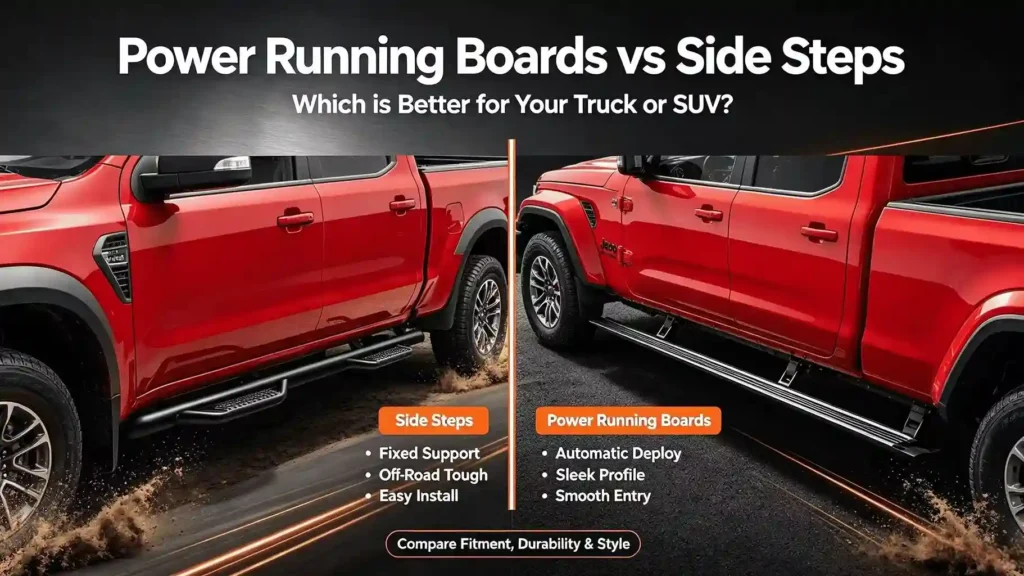
Shopping for side steps for your truck or SUV? You’ll quickly run into two popular options: traditional fixed side steps and estribos eléctricos.
Both options make it easier to get in and out of your vehicle, but they work in very different ways. Fixed side steps stay in place along the vehicle’s rocker panels. Power running boards extend when you open the door and retract when you start driving. This difference can affect more than convenience.
Before you choose, it is worth looking at ground clearance, convenience, installation, maintenance, durability, appearance, and price. A pickup used for off-road driving may need a different setup than a family SUV used for daily trips.
This guide breaks down the differences between power running boards and side steps so you can choose the right setup for your vehicle and driving style.
Power Running Boards vs Side Steps: What’s the Difference?
The main difference is how each type works on your truck or SUV. Fixed side steps stay in one position along the side of the vehicle. Power running boards use a motorized system to move in and out when you open or close the doors.
What Are Power Running Boards?
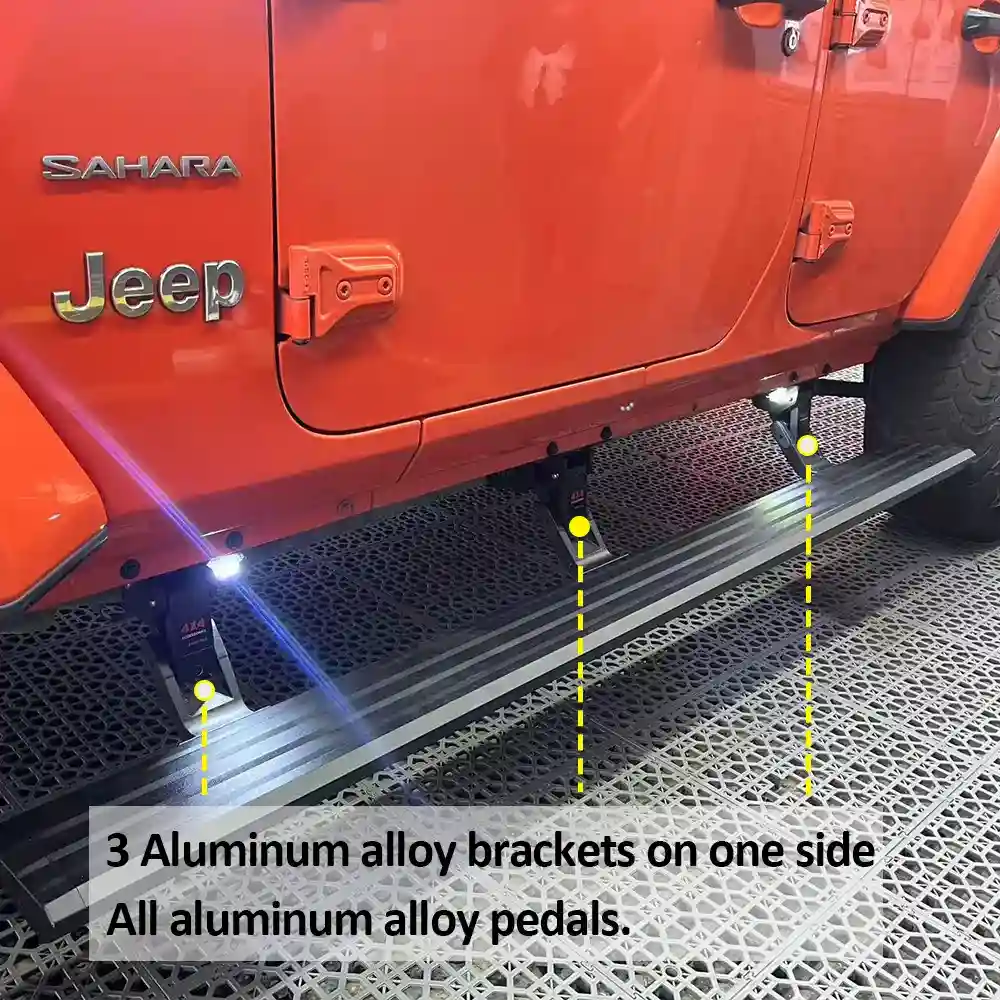
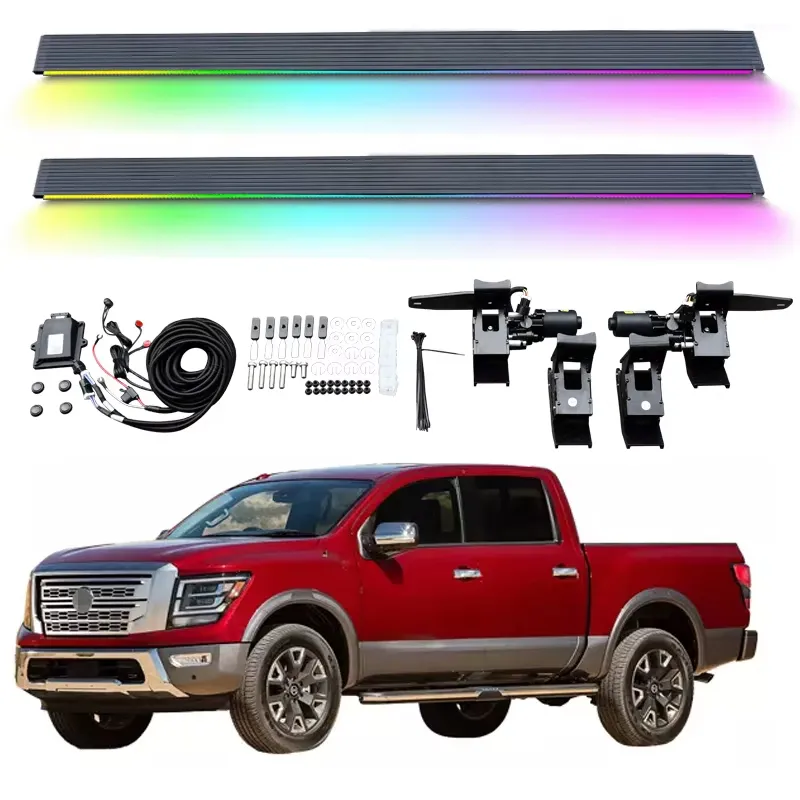
Power running boards are motorized, retractable steps designed to make it easier to get in and out of a truck or SUV. You may see them listed under several different names, including power running boards, electric running boards, electric side steps, automatic running boards, and retractable running boards. These terms often describe the same basic type of step: a motorized board that moves automatically with the vehicle doors.
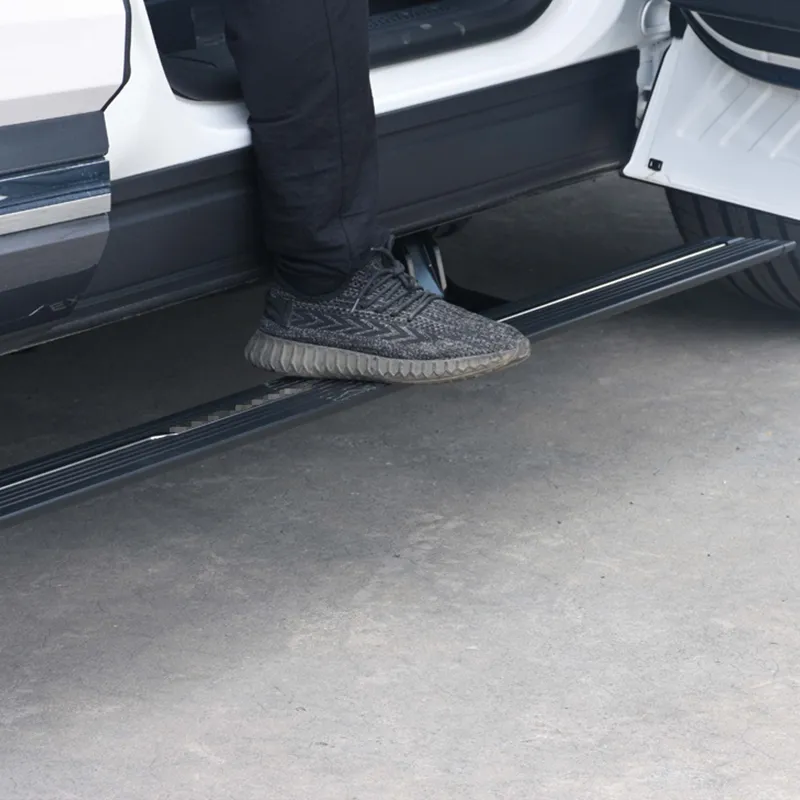
When you open a door, the running board automatically deploys and creates a step below the door. When you close the door, it retracts back under the vehicle. This door-triggered system gives you a wide step when you need it and keeps the board tucked away when you drive.
Unlike traditional side steps, power running boards stay tucked against the vehicle when you’re driving. This can help keep the steps away from rocks, mud, and other obstacles, especially on rough roads.
Most power running boards are vehicle-specific. The mounting brackets, step length, electrical connections, and control system are designed for specific truck and SUV models. For this reason, always check vehicle fitment before buying.
What Are Side Steps?
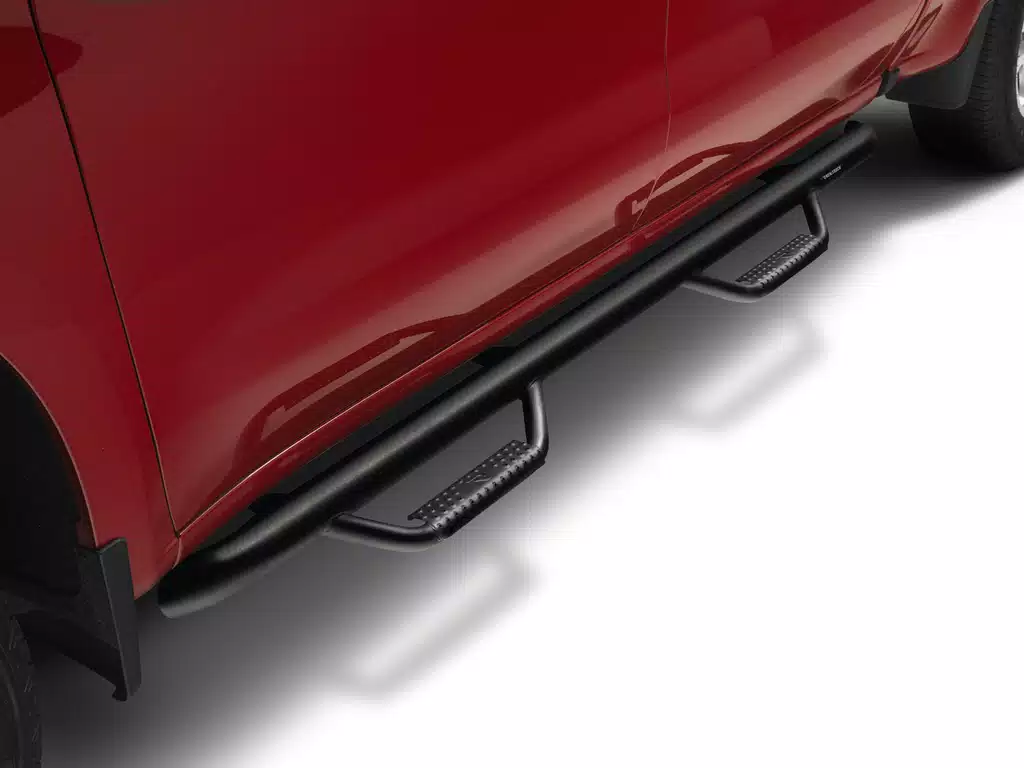
Side steps is a broad term for products that help you step into and out of a truck or SUV. It does not refer to one specific product design. Depending on the vehicle and how you use it, side steps can come in several different forms.
Common types include:
- Fixed side steps: These stay in place along the side of the vehicle. They offer a simple design and are often easy to use and maintain.
- Nerf bars: These are usually narrow, tubular steps that run along the rocker panels. They are common on pickup trucks and off-road vehicles.
- Drop steps: These use a lower step section to make it easier to enter taller trucks and SUVs.
- Running boards: These have a wider stepping surface and can make entry easier for passengers of different heights.
- Electric or power side steps: These use a motorized system to extend when the door opens and retract when the door closes.
This is an important point when shopping for side steps. A product labeled as a “side step” may work very differently from another product with the same general name. Before you compare prices, look at the step design, mounting position, ground clearance, and how the step operates.
Are Power Running Boards Considered Side Steps?
Yes. Power running boards are a type of side step, but not every side step is a power running board.
The term “side steps” covers a wide range of products that help passengers get in and out of a truck or SUV. Some stay fixed in place, while others use a motorized system to move automatically.
Power running boards are different because they combine the function of a side step with an automatic retracting system. They extend when you open the door and retract when you close it. This gives you a step when you need it while keeping the board tucked under the vehicle when you drive.
So, when comparing these products, think of side steps as the larger category. Fixed side steps, nerf bars, drop steps, running boards, and power running boards can all fall under this category, but their designs and features are not the same.
Power Running Boards vs Side Steps at a Glance
If the basic differences still feel unclear, the table below gives you a quick way to compare the two most common options.
| Característica | Power Running Boards | Fixed Side Steps |
|---|---|---|
| Deployment | Automático | Corregido |
| Distancia al suelo | Retracts when driving | Always exposed |
| Instalación | More involved | Simpler |
| Cableado | Obligatorio | No es obligatorio |
| Mantenimiento | More components | Minimal |
| Convenience | Excellent | Bien |
| Typical Product Price | $800–$2,000+ | $150–$400 |
Prices are typical aftermarket ranges and can vary by vehicle, material, brand, size, and features. Installation is usually a separate cost. A basic fixed side step can be much less expensive because it does not require motors, wiring, or electronic controls.
Power running boards cost more because they combine mechanical and electrical components. In return, they provide automatic deployment, a cleaner side profile, and less exposed step hardware when retracted.
For buyers comparing the two, the key question is not simply which product costs less. It is whether the extra cost of power running boards provides enough convenience and clearance for the way the truck or SUV is used.
Which Side Steps Are Better for Daily Driving and Off-Roading?
The better choice depends on where the truck or SUV spends most of its time. A vehicle used for commuting, family trips, and weekend adventures may need a different setup from a dedicated off-road truck.
Power running boards and fixed side steps can both work well, but their strengths are different.
For Daily Driving
Power running boards can be a strong choice for daily-driven trucks and SUVs, especially when the vehicle sits high off the ground.
Tall trucks, full-size pickups, lifted vehicles, and large SUVs can be difficult to enter for some passengers. A retractable board creates a lower stepping point when the door opens, making it easier to get in and out.
This can be especially useful for:
- Family members and frequent passengers
- Children and shorter passengers
- Older passengers
- Lifted trucks and SUVs
- Full-size pickups with high entry points
LED step lighting can also improve visibility at night. A lit stepping area can be helpful in parking lots, driveways, work sites, and campgrounds.
Appearance is another advantage. When the doors close, the boards retract under the vehicle. This creates a cleaner side profile than many fixed side steps.
For a daily driver, the combination of easy entry, automatic operation, lighting, and a clean appearance can make power running boards more convenient than traditional fixed steps.
For Off-Road Driving
Off-road use puts more attention on ground clearance and exposed hardware.
Fixed side steps remain in place while the vehicle moves. Depending on their design and mounting position, they can sit closer to rocks, deep ruts, mud, and other trail obstacles.
Power running boards retract when the doors close, leaving less of the stepping surface exposed while driving. This can be useful for trucks that move between paved roads and off-road trails.
However, the retractable design does not make a vehicle immune to trail damage. Motors, hinges, brackets, and electrical components still need protection from mud, water, rocks, and impacts.
For light or moderate off-road use, a well-designed retractable system can offer a useful balance between daily comfort and trail clearance. For very demanding trails, the vehicle should be evaluated as a complete system rather than based on the running board alone.
Power Running Boards vs Rock Sliders
Power running boards and rock sliders serve different purposes.
Power running boards are designed primarily for vehicle access and convenience. They extend to provide a step and retract when the vehicle is moving.
Rock sliders are designed to protect the rocker panels and lower body from rocks and other hard obstacles during off-road driving.
Power running boards should not be treated as a replacement for dedicated rock sliders.
For a daily-driven truck that also sees occasional trails, power running boards can provide a practical mix of convenience and retractability. A truck built for serious rock crawling may need dedicated rocker protection in addition to, or instead of, a running board system.
What to Expect During Installation
Installation is another important difference between fixed side steps and power running boards. A fixed step usually has a simple mechanical design, while a power running board combines mechanical and electrical components.
Installing Fixed Side Steps
Fixed side steps are usually straightforward to install. Many vehicle-specific kits use the vehicle’s existing mounting points, so there is little or no drilling required.
Most installations only need basic tools and the supplied mounting hardware. Since fixed side steps do not use motors or electrical controls, there is usually little or no wiring involved.
For a vehicle with accessible mounting points and a well-matched kit, the installation process can be relatively simple.
Installing Power Running Boards
Power running boards involve a few more installation steps because the system includes brackets, motors, wiring, and a control system.
A typical installation may involve:
- Soportes de montaje
- Electric motors
- Wiring connections
- Door or vehicle signals
- Deployment and retraction testing
The exact process depends on the vehicle and the running board system. After the boards are mounted, the wiring needs to be connected correctly so the system can respond to the vehicle signals.
MAX Running Boards offers vehicle-specific power running boards designed around the mounting points and door configuration of supported trucks and SUVs. Many applications use a bolt-on design with no drilling required, allowing the brackets to attach to existing mounting points.
This vehicle-specific approach can make installation more straightforward. It also avoids unnecessary modifications to the vehicle and can make future removal or replacement easier.
For buyers who want the convenience of power running boards but are concerned about installation, the product design is worth checking before purchase. A well-designed, vehicle-specific system can reduce installation work without removing the benefits of automatic deployment.
How Do Power Running Boards Work?
Power running boards may look simple from the outside, but several components work together to make the board move automatically. The vehicle sends a signal, the control system processes that signal, and the motor moves the board into the correct position.
What Happens When the Door Opens?
When a vehicle door opens, the running board system detects the door signal. The control system then sends a command to the motor.
The motor moves the running board outward and downward until it reaches the deployed position. The board is then ready to support the passenger as they step into the vehicle.
In simple terms:
Door opens → signal detected → control system activates → motor moves → board deploys
The exact response can vary by vehicle and running board design, but the basic process is similar.
What Happens When the Door Closes?
When the door closes, the system detects the new signal and tells the motor to move in the opposite direction.
The motor reverses its movement and pulls the running board back toward the vehicle. The board then retracts under the vehicle and stays in the tucked position while driving.
El proceso básico es el siguiente:
Door closes → signal detected → motor reverses → board retracts
This automatic movement is what separates power running boards from traditional fixed side steps. A fixed step stays in the same position, while a power running board changes position based on the vehicle’s operating signals.
How Do Power Running Boards Connect to the Vehicle?
Power running boards do not move on their own. They need information from the vehicle or a dedicated control system to determine when the board should deploy or retract.
Depending on the vehicle and product design, the system may use:
- Door signals
- Body Control Module (BCM) signals
- OBD-II connections
- Vehicle-specific control methods
The exact connection method varies between vehicles and running board systems. Modern trucks and SUVs use different electronic platforms, so one control method may not work the same way on every application.
This is why vehicle-specific design matters. The running board control system needs to communicate correctly with the vehicle so the board can deploy and retract at the right time.
For consumers, the important point is simple: power running boards are controlled by vehicle signals and an electronic control system. The motor responds to those signals to move the board, rather than the board simply “moving by itself.”
What Should You Look for When Buying Side Steps?
Buying side steps is not only about choosing a style that looks good. The right product should fit the vehicle, provide a safe stepping area, handle regular use, and match the driving conditions.
Whether the choice is fixed side steps or power running boards, a few basic factors are worth checking before placing an order.
Compatibilidad con vehículos
Start with exact vehicle fitment. Side steps and power running boards are not universal products.
Check the:
- Make
- Modelo
- Año
- Configuración de la cabina
- Door configuration
A truck can have different mounting points or body dimensions between model years or cab configurations. A running board designed for one version may not fit another version correctly.
Vehicle-specific fitment also affects step position, door clearance, bracket placement, and automatic deployment. Always confirm the exact application before buying.
Step Width, Height, and Traction
The stepping area affects how comfortable and safe the product feels in daily use.
A wider board can provide more room for the foot, which can be helpful when getting into tall trucks and SUVs. Step height also matters because a lower stepping point can make entry easier.
Traction becomes even more important in wet conditions. Rain, mud, and snow can make a smooth surface slippery.
Look for a step with:
- A practical stepping area
- Comfortable entry height
- A secure anti-slip surface
- Good traction in wet conditions
A step should feel stable under normal use, not just look good on the vehicle.
Load Capacity and Construction
Load capacity depends on more than the board itself. The board construction, brackets, hardware, and vehicle mounting points all play a role.
When comparing products, check:
- Board construction
- Diseño de soportes
- Mounting points
- Stated load capacity
- Hardware quality
A higher load rating can be useful, but the rating should be supported by a suitable mounting system. The connection between the step and the vehicle is just as important as the stepping surface.
Motor, Weather Protection, and Durability
For power running boards, the motor and moving components deserve extra attention.
The system may operate several times a day, so motor quality and durability can have a direct effect on long-term use. Weather protection also matters because the components are exposed to road spray, rain, mud, dust, and temperature changes.
Important factors include:
- Motor quality
- Waterproofing
- Corrosion resistance
- Pruebas cíclicas
- Protection of electrical components
MAX Running Boards focuses on vehicle-specific fitment, durability testing, weather-resistant components, and long-term product support. These factors are especially relevant for power running boards because the system needs to work reliably through repeated deployment and retraction.
Warranty and Replacement Parts
A power running board has more components than a fixed side step, so after-sales support is worth considering before purchase.
Check whether replacement parts are available for key components such as:
- Motor
- Controller
- Cableado
- Soportes de montaje
- Other hardware
Warranty coverage is also important. A clear warranty can provide more confidence if a component needs attention after installation.
For dealers and installers, replacement parts can be even more important because a serviceable product is easier to support over its lifetime.
The best side steps are not always the most expensive option. A better approach is to compare fitment, stepping comfort, construction, durability, support, and total ownership cost. This gives a clearer picture of the product’s value before making a decision.
How Much Do Power Running Boards Cost, and Are They Worth It?
Price is one of the first things most buyers compare when shopping for side steps. Fixed side steps can cost much less than power running boards, but the price difference comes from the technology and components used in each system.
For a typical aftermarket setup, fixed side steps may cost around $150–$400, while power running boards commonly range from $800–$2,000 or more. Installation can add another $100–$500, depending on the vehicle and system.
The better question is not simply, “Why are power running boards more expensive?” It is, “What does the extra money actually provide?”
Why Fixed Side Steps Cost Less
Fixed side steps have a relatively simple construction. The step usually consists of a board or tube, mounting brackets, and hardware.
There is no motorized mechanism to operate the step, so the system does not need:
- A motor
- A control module
- Electrical wiring
- A retractable mechanism
- Multiple moving components
This simpler design helps keep both the product price and installation cost lower. It can also make maintenance easier because there are fewer components that can wear or fail.
For a basic work truck or a vehicle that mainly needs a permanent step, fixed side steps can provide good value without adding unnecessary technology.
Why Power Running Boards Cost More
Power running boards have a more complex system. The board needs to move automatically, which requires several components to work together.
The additional cost can come from:
- Electric motors
- Control systems
- Cableado
- Retractable mechanisms
- Vehicle-specific engineering
- Mounting brackets and application-specific hardware
The engineering also goes beyond the physical step. The system needs to communicate with the vehicle and deploy at the right time when a door opens.
That is why power running boards cost more than a basic fixed step. The buyer is paying for automatic movement, electronic control, retractability, and vehicle-specific integration rather than simply paying for a more expensive stepping surface.
When Are Power Running Boards Worth the Extra Cost?
Power running boards can be worth the extra cost when their features solve a real problem in daily use.
They can be especially useful for:
- Lifted trucks with higher entry points
- Tall SUVs and full-size pickups
- Vehicles carrying frequent passengers
- Daily driving where easy entry matters
- Mixed street and light off-road use
- Drivers who prefer a cleaner vehicle appearance
Consider a lifted truck that is used for commuting during the week and weekend trips on rough roads. Fixed side steps provide a permanent entry point, but the exposed step stays below the vehicle while driving. Power running boards provide the step when the door opens and retract it when the vehicle is moving.
That extra function is what the higher price pays for.
On the other hand, a simple work truck that stays on paved roads may not need automatic deployment or a retractable design. In that situation, fixed side steps may offer better value.
The right choice depends on how often the added convenience will be used. If the power running board deploys several times every day, the convenience can become a meaningful part of the vehicle experience rather than just an extra feature.
Power Running Boards vs Side Steps: Which One Should You Choose?
There is no single best side step for every truck or SUV. The right choice depends on the vehicle, driving conditions, budget, and features that matter most.
Power running boards focus on convenience and retractability. Fixed side steps focus on simple operation, lower cost, and easy maintenance.
Choose Power Running Boards If…
Power running boards may be the better choice when the following features are important:
- Easy daily entry and exit
- Automatic deployment
- Retractable design
- Better clearance when the board is retracted
- Frequent family or passenger use
- A clean, premium appearance
They are especially useful for tall trucks, lifted vehicles, and full-size SUVs where the extra step makes daily entry more comfortable.
Choose Fixed Side Steps If…
Fixed side steps may be the better choice when simplicity and cost are the main priorities.
They can make sense when there is a need for:
- A lower purchase price
- Simple installation
- Minimal maintenance
- A vehicle used mostly on paved roads
- A step that remains available at all times
- No need for a retractable design
For a basic work truck or a daily driver that does not need advanced features, fixed side steps can provide a practical and cost-effective solution.
Quick Decision Guide
| Your Priority | Better Choice |
|---|---|
| Lower price | Fixed Side Steps |
| Simple installation | Fixed Side Steps |
| Automatic deployment | Power Running Boards |
| Retractable design | Power Running Boards |
| Passenger convenience | Power Running Boards |
| Mixed street/off-road use | Power Running Boards |
The choice becomes much easier when the priorities are clear. Fixed side steps are a strong option for simple, budget-friendly setups. Power running boards make more sense when automatic operation, retractability, passenger comfort, and a clean appearance are worth the additional cost.
If power running boards are the right fit for your truck or SUV, MAX Running Boards offers vehicle-specific applications for a wide range of popular pickups and SUVs.
Conclusión
Fixed side steps are a simple, affordable choice, while power running boards offer more convenience, automatic deployment, and a cleaner look when retracted. The right option depends on the vehicle, budget, driving conditions, and how the side steps will be used.
For daily-driven trucks and SUVs, power running boards can make getting in and out easier while keeping the step tucked away during driving. Fixed side steps can be a better fit for buyers who prefer a lower price, simple installation, and minimal maintenance.
If you choose power running boards, proper vehicle fitment is key. MAX Running Boards offers vehicle-specific, bolt-on designs for many trucks and SUVs, with no-drill installation on selected applications.
Send us your make, model, and year, and we’ll help you find the right fit.
Artículos relacionados
Choosing between different running board options is only part of the decision. You may also want to understand installation, product quality, long-term value, and potential problems before choosing the right setup for your truck or SUV.
