
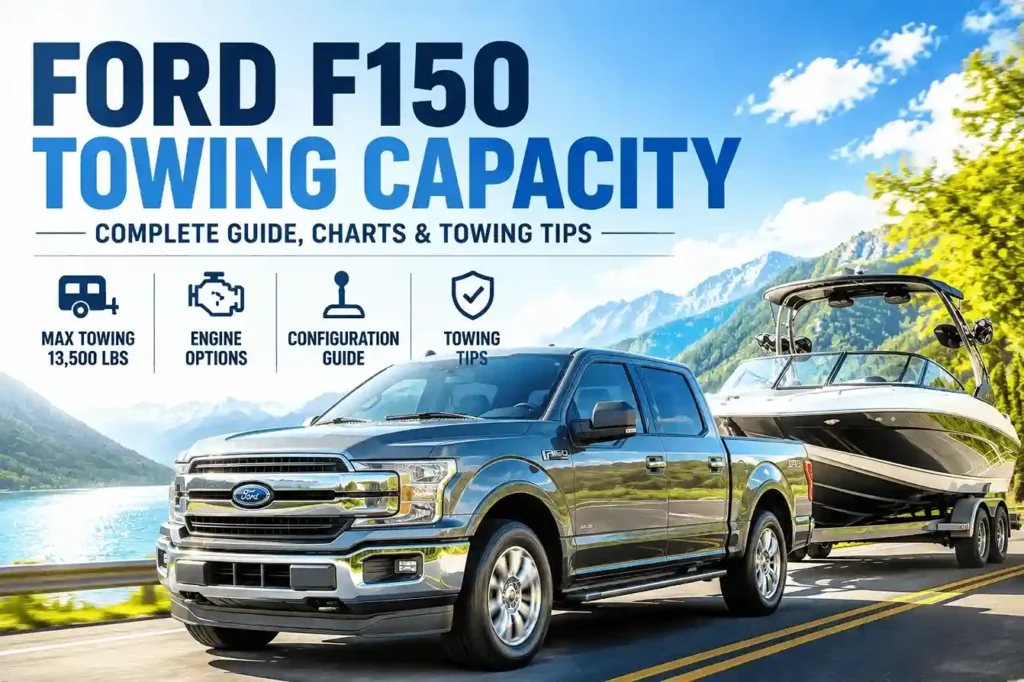
The Ford F150 towing capacity depends on the model year, engine, drivetrain, cab style, and towing equipment. Recent Ford F-150 models can tow up to 13,500 lbs with the right configuration and available towing package. This maximum rating applies to specific setups, not every F-150 truck.
Many F-150 owners see the highest advertised towing number and assume their truck can handle the same load. However, the actual F150 towing capacity can be lower based on the truck’s equipment and weight limits. Checking the exact specifications of your vehicle is important before towing a trailer, boat, or work equipment.
In this guide, we will explain F150 tow capacity by year, compare engine options, and explain how payload affects towing performance. You will also learn how to match your F-150 with the right trailer and how to check the true towing capacity F150 rating for your own truck.
Ford F150 Towing Capacity Quick Answer
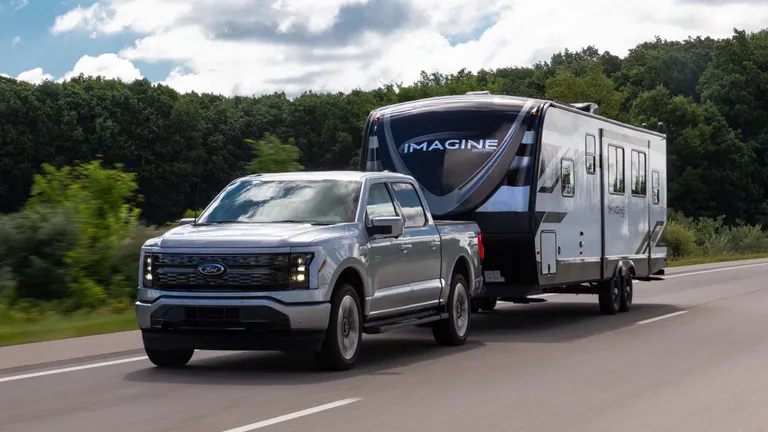
The Ford F-150 towing capacity ranges from about 5,000 lbs to 13,500 lbs depending on the model year, engine, drivetrain, cab and bed configuration, axle ratio, payload, and factory towing equipment. Recent models with the right setup, especially the 3.5L EcoBoost V6, can achieve the highest towing ratings.
The maximum towing number is only a reference point. Before towing a trailer, always verify the exact rating of your F-150 based on the vehicle label, VIN/build information, and factory specifications.
Ford F150 Towing Capacity by Year: Maximum Ratings and Configurations
The F150 towing capacity changes between different generations and configurations. A truck with the same engine may have a different rating because of differences in drivetrain, wheelbase, axle ratio, payload, and towing packages.
| Tahun Model | Maximum Available Conventional Towing Capacity | Engine Typically Linked to Maximum Rating | Key Configuration Factors | What This Means for Owners |
|---|---|---|---|---|
| 2026 | Up to 13,500 lbs | 3.5L EcoBoost V6 | Cab, bed, axle ratio, drivetrain, factory tow equipment | The highest rating applies only to specific configurations |
| 2024–2025 | Up to 13,500 lbs | 3.5L EcoBoost V6 | Axle ratio, towing equipment, vehicle build | Check VIN and vehicle labels before towing |
| 2021–2023 | Up to 14,000 lbs | 3.5L EcoBoost V6 | Model-year-specific towing setup | Maximum ratings require the correct package and configuration |
| 2018–2020 | Up to 13,200 lbs | 3.5L EcoBoost V6 | Engine, cab, axle ratio, tow package | Actual towing capacity may be lower than the maximum rating |
| 2015–2017 | Up to 12,200 lbs | Depends on year and configuration | Original equipment and hitch rating | Check factory specifications and current equipment |
| 2009–2014 | Up to 11,300 lbs | Depends on year and configuration | Truck condition, tires, hitch, axle | Used trucks need extra checks before heavy towing |
Table note: Maximum available ratings do not represent the towing capacity of every F-150. Drivers should check the door label, VIN/build data, owner’s manual, hitch rating, and loaded trailer weight before towing.
For example, a Ford F-150 used for local deliveries may handle a smaller utility trailer easily, but a heavier trailer with outdoor furniture, equipment, or commercial cargo requires a full weight check before driving.
Ford F150 Towing Capacity by Engine
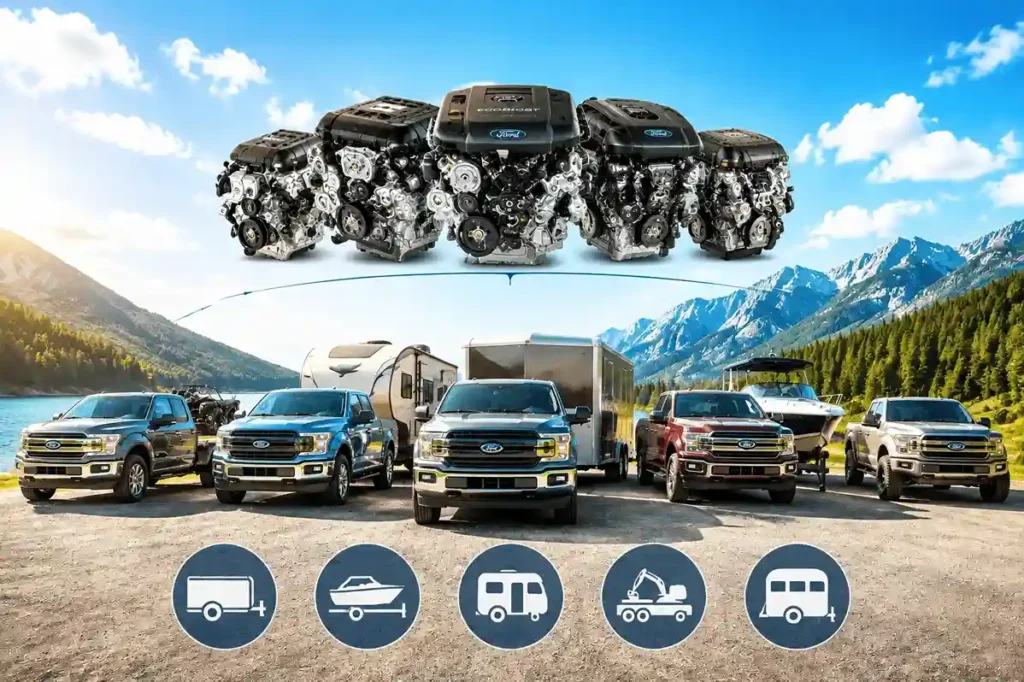
The engine affects the potential towing ability of a Ford F-150, but the engine alone does not determine the final towing rating. The actual F150 towing capacity also depends on the drivetrain, cab style, bed length, axle ratio, payload, and factory towing equipment.
The best engine choice depends on your trailer type and how often you tow. A driver who occasionally pulls a small trailer may not need the highest-rated engine. A driver who regularly moves heavy trailers should choose a configuration that matches the required weight.
| Mesin | Maximum Available Towing | Best Trailer Match | Paling Cocok Untuk | Must Verify |
|---|---|---|---|---|
| 2.7L EcoBoost V6 | Up to 8,400 lbs | Utility trailers, ATVs, small boats, lighter campers | Occasional light towing and daily driving | Payload, cab/bed configuration, hitch rating |
| 5.0L Ti-VCT V8 | Up to 12,800 lbs | Heavier conventional trailers | Drivers who prefer a V8 and tow often | Axle ratio, factory tow equipment, payload |
| 3.5L EcoBoost V6 | Up to 13,500 lbs | Equipment trailers, larger travel trailers | Drivers who need maximum conventional towing capability | Exact configuration, tongue weight, payload |
| 3.5L PowerBoost Hybrid V6 | Varies by configuration | Boats, campers, work trailers with power needs | Drivers who need towing plus onboard power | Payload and available equipment |
| Raptor-specific engines | Varies by trim | Recreational and off-road trailers | Drivers who prioritize off-road performance | Tow rating may be lower than towing-focused F-150 builds |
Which Ford F-150 Engine Is Best for Towing?
For lighter trailers, the 2.7L EcoBoost V6 can be a practical choice when the trailer weight stays within the truck’s rating. It works well for occasional towing tasks such as small utility trailers, ATVs, and smaller boats.
For frequent medium or heavy towing, the 5.0L V8 and 3.5L EcoBoost V6 are common choices. The better option depends on the trailer weight, payload requirement, fuel preference, and how often the truck is used for towing. The 3.5L EcoBoost usually provides the highest conventional towing rating when the truck has the correct equipment.
For drivers who tow and need power at a campsite or job site, the 3.5L PowerBoost Hybrid V6 offers useful onboard power features. However, it should be selected based on the complete vehicle setup, not only the towing number.
A Raptor’s off-road performance does not automatically make it the best F-150 towing choice. Its design focuses on off-road capability, so buyers should check the specific tow rating before choosing it for heavy trailer use.
What Determines F150 Towing Capacity?
The Ford F150 towing capacity depends on more than the engine. Several vehicle factors work together to determine the final towing rating. Before choosing a trailer, check these key areas:
| Faktor | Why It Changes Towing Capacity | What the Reader Should Do |
|---|---|---|
| Mesin | Determines available power and potential tow rating | Compare ratings for the exact model year and engine |
| Cab and bed | Changes vehicle weight, wheelbase, and payload | Confirm the exact cab and bed configuration |
| Sistem Penggerak | 2WD and 4WD models may have different towing ratings | Check the original vehicle specifications |
| Rasio poros | Some higher towing ratings require specific axle ratios | Verify through VIN or factory build information |
| Factory tow package | Adds equipment needed for certain towing ratings | Confirm the truck has the required towing equipment |
| Passengers, cargo, and accessories | Reduce available payload and towing margin | Include all added weight in your towing plan |
| Hitch and trailer setup | The lowest-rated towing component limits the system | Check hitch, receiver, ball mount, and trailer labels |
Understanding these factors helps drivers avoid using the maximum advertised number as a general rating. The correct towing capacity belongs to the specific truck, not the entire F-150 lineup.
What Does “Properly Equipped” Mean?
When Ford lists a maximum towing rating, “properly equipped” means the truck has the required equipment for that rating. This may include the correct engine, axle ratio, cab and bed configuration, drivetrain, receiver, wiring, brake-control equipment, cooling system, and factory towing package.
A Tow/Haul button alone does not mean the truck can reach the highest towing number. The vehicle must have all required hardware and meet the correct weight limits. Drivers should check the VIN, factory build sheet, and vehicle labels before towing heavy loads.
Ford F-150 Towing Capacity vs. Payload
Many F-150 owners ask the same question: “Why can’t I tow a trailer that is below my truck’s advertised towing capacity?” The answer is payload. Towing capacity and payload are two different limits, and both must be within range before towing is safe.
A truck may have a high towing rating, but the available payload can become the limiting factor. This happens often with travel trailers, fifth-wheels, and heavy cargo setups because the truck carries part of the trailer’s weight.
Towing Capacity vs. Payload: What Is the Difference?
Towing capacity is the maximum trailer weight a truck can pull under specific conditions. It focuses on the trailer being moved behind the vehicle.
Payload is the weight the truck itself carries. It includes passengers, cargo, accessories, hitch equipment, and the trailer’s tongue weight or king-pin weight.
For many F-150 owners, payload becomes the limit before reaching the advertised towing capacity. A travel trailer may stay below the truck’s maximum tow rating but still add too much tongue weight to the truck bed and rear axle. Fifth-wheel trailers can use payload even faster because their pin weight transfers directly onto the truck.
| Berat Barang | Counts Against Payload? | Mengapa Hal Ini Penting |
|---|---|---|
| Driver, passengers, and pets | Ya | Reduces the available capacity for trailer weight |
| Cab and bed cargo | Ya | Tools, luggage, coolers, and camping gear add weight |
| Truck accessories | Ya | Toolboxes, tonneau covers, and running boards increase truck weight |
| Hitch equipment | Ya | Ball mounts and weight-distribution hitches add load |
| Conventional trailer tongue weight | Ya | Part of the trailer weight transfers to the truck |
| Fifth-wheel or gooseneck pin weight | Ya | Pin weight can reduce payload capacity quickly |
How to Calculate Remaining F-150 Payload Before Towing
Before towing, start with your truck’s actual payload rating. You can find this number on the yellow Tire and Loading Information label located on the driver-side door jamb.
Use this simple calculation:
Remaining Payload = Door-Label Payload – Passengers – Cargo – Accessories – Hitch Equipment
The remaining payload must be enough to support the trailer’s actual tongue weight or pin weight. Do not use only the trailer’s dry weight because the loaded weight can be much higher after adding water, supplies, equipment, and personal items.
Example: Why a 10,000-lb Trailer Can Still Overload an F-150
A trailer can stay below the advertised F150 tow capacity and still exceed the truck’s payload limit. Here is a simple example:
| Barang | Contoh Bobot |
| Door-label payload | 1,650 lbs |
| Driver and passengers | 450 lbs |
| Cargo and gear | 250 lbs |
| Hitch equipment | 100 lbs |
| Remaining payload for trailer tongue weight | 850 lbs |
In this example, the truck has 850 lbs of available payload left for the trailer tongue weight. A loaded 10,000-lb trailer may create more tongue weight than this truck can support, even if the truck’s maximum towing rating is higher than 10,000 lbs.
The best way to confirm towing limits is to use actual scale weights. Trailer dry weight alone does not show the real load during a trip.
Do Power Running Boards Affect Ford F-150 Payload?
Power running boards do not increase or reduce the Ford F-150 manufacturer-rated towing capacity or the payload number shown on the truck’s door-jamb label. However, the installed weight of the system, including the boards, motors, brackets, wiring, and control components, adds to the truck’s total weight.
When towing close to the payload limit, owners should include the weight of power running boards along with passengers, cargo, hitch equipment, and trailer tongue or pin weight. These added items reduce the remaining payload available for towing.
For easier cab access during hitch checks, loading, and towing-day preparation, explore MAX Ford F-150 Power Running Boards.
Can a Ford F150 Tow Your Trailer?
The Ford F-150 can tow many different trailer types, but the right match depends on the trailer’s loaded weight, hitch setup, and the truck’s specific ratings. Drivers should check the real towing conditions instead of comparing only the trailer’s empty weight.
| Jenis Trailer | Typical Planning Range | Hidden Weight to Include | Main Limit to Check | F-150 Suitability |
|---|---|---|---|---|
| Trailer serbaguna | 1,500–5,000 lbs | Tools, ramps, fuel | Hitch and brake setup | Often suitable when properly loaded |
| Boat or pontoon | 3,000–7,000 lbs | Trailer, fuel, batteries, gear | Loaded trailer weight and trailer brakes | Often suitable; confirm total on-road weight |
| Trailer wisata | 5,000–12,000+ lbs | Water, propane, batteries, luggage, bikes | Payload and tongue weight | Match by loaded weight, not dry weight |
| Car hauler | 5,000–10,000+ lbs | Vehicle, winch, straps, tools | Axle load and trailer balance | Verify cargo placement and actual axle weight |
| Equipment trailer | 6,000–13,500+ lbs | Attachments, fuel, ramps, tools | GCWR, rear axle, payload | Avoid frequent operation near maximum limits |
| Fifth-wheel or gooseneck | Varies widely | Pin weight, hitch hardware, bed cargo | Payload, rear GAWR, hitch compatibility | Confirm all ratings before purchase or towing |
Can a Ford F-150 Tow a Travel Trailer?
Yes, many Ford F-150 configurations can tow travel trailers. However, owners should use the trailer’s loaded weight and actual tongue weight when making a decision.
A travel trailer’s dry weight does not include common camping items such as water, propane, batteries, food, luggage, and outdoor equipment. These items can add significant weight during real trips.
Trailer dry weight alone does not show the real load during a trip. RV owners should consider water, propane, batteries, and other equipment when calculating actual towing weight. Industry resources such as RV towing safety standards can help owners better understand trailer weight and safety requirements.
Before towing a travel trailer, check the available payload and make sure the remaining payload can support the trailer’s actual tongue weight.
Can a Ford F-150 Tow a Fifth-Wheel or Gooseneck?
Some Ford F-150 configurations can handle fifth-wheel or gooseneck trailers, but these setups require careful checking. Owners must consider pin weight, rear axle rating, bed and hitch compatibility, and the specific vehicle ratings.
The conventional F150 tow capacity should not be treated as automatic approval for fifth-wheel or gooseneck towing because these trailer types place weight differently on the truck.
F-150 vs. Super Duty: When Should You Upgrade?
The Ford F-150 works well for many towing needs, including utility trailers, boats, campers, and light equipment trailers. However, some towing situations require a heavier-duty truck.
Consider upgrading to a Super Duty if:
- Your loaded trailer regularly approaches the F-150’s maximum towing rating.
- Your trailer tongue weight or fifth-wheel pin weight uses most of your available payload.
- You frequently tow long distances, drive through mountains, tow in hot weather, or use the truck for work.
- You need to tow a larger fifth-wheel or gooseneck trailer.
- You want more capacity for passengers, cargo, braking performance, and future towing needs.
For occasional towing, a properly equipped F-150 can be a practical choice. For frequent heavy towing near the truck’s limits, a Super Duty can provide more capacity and a larger operating margin.
How to Find Your Exact Ford F150 Towing Capacity
The advertised F150 towing capacity is only a general reference. Your actual truck rating depends on the specific build, equipment, and weight limits. Use these steps to find the real towing ability of your Ford F-150.
1. Check the Driver-Side Door Labels
Start with the labels on the driver-side door jamb. Find the yellow Tire and Loading Information label to check the vehicle’s payload rating.
Also review the GVWR and GAWR information. These numbers show the maximum weight limits for the entire truck and each axle.
2. Confirm Factory Equipment by VIN or Window Sticker
Use your VIN or original window sticker to confirm the factory equipment on your F-150.
Check important towing-related items, including:
- Rasio poros
- Paket penarik pabrik
- Receiver
- Trailer wiring
- Brake controller
- Other original towing equipment
The same engine can have different towing ratings because the factory configuration changes.
3. Check Hitch and Receiver Ratings
The hitch system must support the trailer load. Check the ratings for:
- Receiver
- Ball mount
- Trailer ball
- Weight-distribution hitch components
Always use the lowest applicable component rating. A higher truck towing rating does not increase the limit of a lower-rated hitch component.
4. Weigh Your Loaded Truck and Trailer
Actual weight is the best way to confirm your towing setup.
Follow these steps:
- Weigh the truck by itself with passengers, cargo, fuel, and towing equipment loaded.
- Weigh the complete truck-and-trailer combination.
- Record front axle, rear axle, and trailer axle weights when available.
- Compare each result with the vehicle labels and component ratings.
This process helps confirm that your Ford F-150 stays within its towing, payload, and axle limits before you tow.
Ford F150 Tow Package and Essential Towing Features
Many F-150 owners confuse towing equipment with towing ratings. Some features help the truck tow more effectively, but they do not automatically increase the vehicle’s maximum towing capacity.
| Barang | Fungsinya | Can It Raise the Truck’s Rating? |
|---|---|---|
| Factory tow package | May include equipment required for certain towing ratings, such as a receiver, wiring, cooling, and brake-related equipment | Sometimes, but only when Ford specifies a higher rating for that exact configuration |
| Tow/Haul mode | Adjusts transmission shifting and downhill engine braking behavior when towing | Tidak |
| Integrated trailer brake controller | Helps control compatible trailer brake response | Tidak |
Tow/Haul Mode vs. Tow Package
Tow/Haul mode and a tow package serve different purposes. Tow/Haul mode is a driving setting that changes how the truck manages shifting and braking during towing.
A tow package is physical vehicle equipment that may support specific towing configurations. Having Tow/Haul mode does not mean the truck has every component required for the highest F150 tow capacity.
Do You Need a Weight-Distribution Hitch?
A weight-distribution hitch (WDH) may help improve weight balance between the truck and trailer. Whether you need one depends on the F-150 configuration, receiver rating, trailer requirements, hitch manufacturer instructions, and local rules.
A WDH can improve load distribution, but it cannot increase the truck’s payload, axle rating, vehicle rating, or hitch rating. Always stay within the lowest applicable limit.
Ford F150 Power Running Boards for Towing and Daily Use
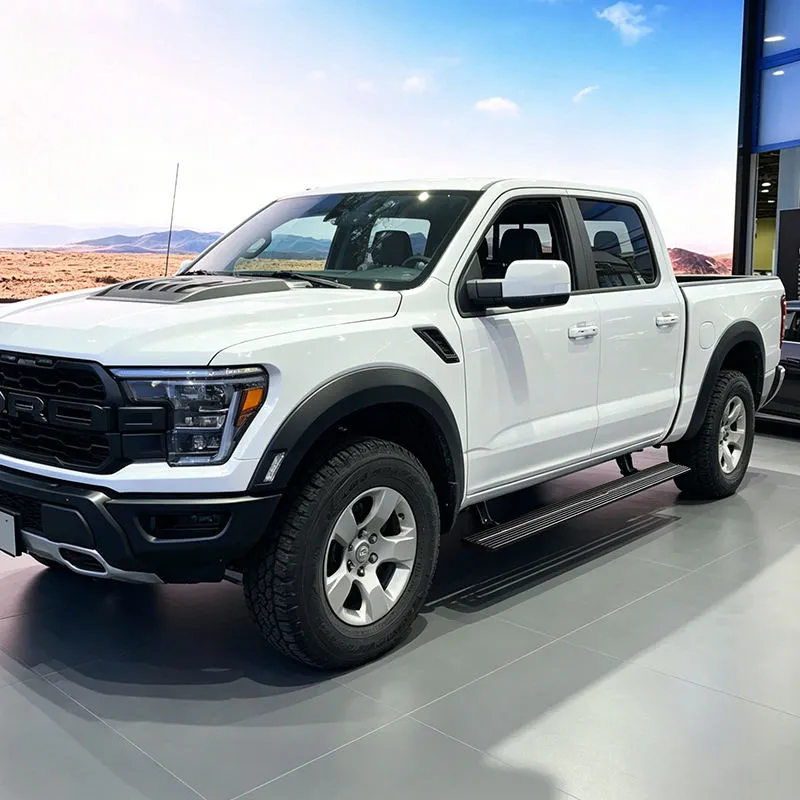
When towing with a Ford F-150, drivers often need to get in and out of the cab to check mirrors, trailer connections, brake settings, lights, and cargo. Power running boards provide a stable step that makes these tasks easier for drivers, passengers, and work crews.
For lifted F-150 trucks, a power running board can provide easier access while keeping a clean side profile. The boards extend when the door opens and retract when the door closes, helping maintain ground clearance during daily driving and towing.
For towing, outdoor work, and everyday use, choose a vehicle-specific system with a wide non-slip stepping surface, strong mounting brackets, and corrosion-resistant materials. A reliable running board should handle different conditions, including rain, snow, road salt, and jobsite environments.
Explore MAX Ford F-150 Power Running Boards to find a suitable solution for your cab configuration.
Kesimpulan
The Ford F-150 towing capacity depends on the engine, model year, configuration, payload, and towing equipment. The highest towing number is only for specific builds, so always check your truck’s real rating before towing.
Whether you use your F-150 for trailers, outdoor projects, work, or daily driving, choosing the right equipment helps create a safer and more convenient experience. MAX Electric Running Boards provides durable Ford F-150 Power Running Boards with vehicle-specific fitment, strong construction, and reliable performance.
Ready to upgrade your Ford F-150? Contact MAX Running Boards today for OEM solutions, wholesale support, and the right running board option for your market.
Related Truck Towing Capacity Guides
- Toyota Truck Towing Capacity: Tacoma, Tundra, and More
- Chevy Silverado 1500 Towing Capacity: Complete Guide and Towing Chart
- GMC Sierra 1500 Towing Capacity: Engine, Trim, and Configuration Guide
- RAM 1500 Towing Capacity: Complete Chart and Real-World Guide
- Nissan Frontier Towing Capacity: Complete Guide by Year and Configuration
