
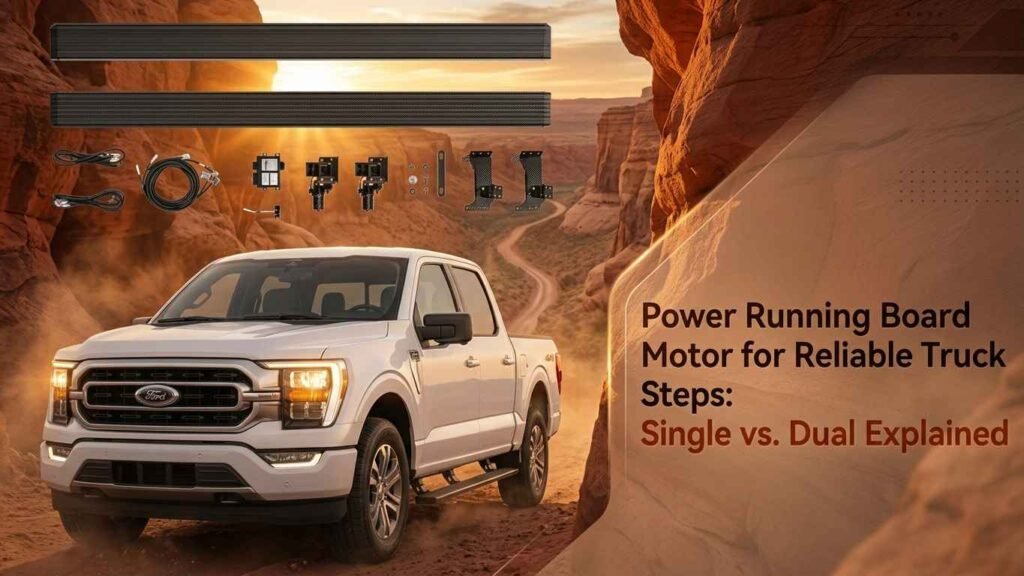
Choosing a power running board motor involves more than checking how many motors a system uses. Buyers want running boards that extend and retract smoothly, work reliably in rain and mud, and fit their vehicle correctly. A single-motor system uses one motor to drive the running board mechanism, while a dual-motor system uses two motors to power the movement. However, motor count alone does not determine system reliability. Motor quality, water protection, corrosion resistance, mechanical design, and control systems also affect performance. This guide compares single-motor and dual-motor designs and explains which factors buyers should check, including operating noise, protection ratings, and test data, before choosing electric running boards.
Single vs. Dual Power Running Board Motors: What’s the Difference?
The main difference between single-motor and dual-motor power running boards is how the motors drive and coordinate the step mechanism. A single-motor system uses 1 motor to drive the mechanism, while a dual-motor system uses 2 motors that may drive each side independently.
Motor count affects the drive architecture, synchronization method, and maintenance requirements. However, it does not determine reliability on its own. The mechanical design, component quality, and control system also influence how the complete running board operates.
How Single-Motor Power Running Boards Work
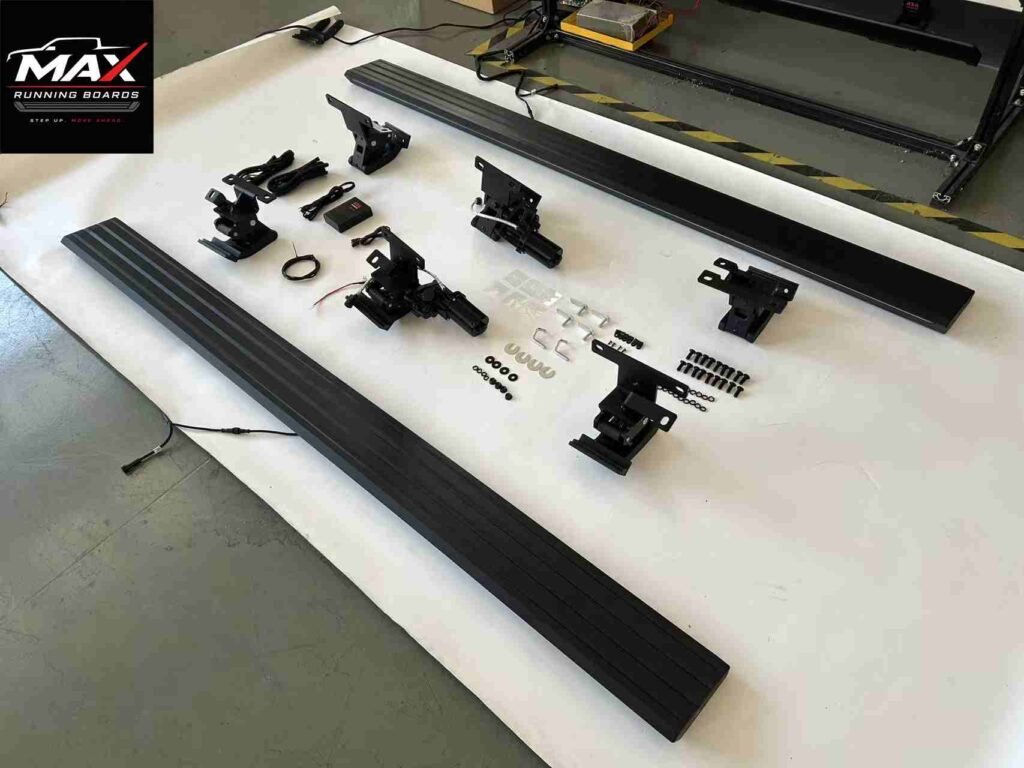
A single-motor power running board uses 1 motor to drive the step mechanism. Depending on the design, a mechanical transmission shaft or linkage transfers driving force to both sides, allowing them to move together.
- Drive layout: One motor powers the mechanism, which may use a shared mechanical transmission to operate both sides.
- Synchronization: A mechanical connection can coordinate both sides without requiring separate electronic control of 2 motors.
- Design considerations: The motor, shaft, gears, and linkages must handle the required load and maintain alignment throughout repeated operation.
The exact layout varies by product. Some single-motor systems use different transmission arrangements, so buyers should check the manufacturer’s technical information.
How Dual-Motor Power Running Boards Work
A dual-motor power running board uses 2 motors to drive the step mechanism. In some designs, each motor drives one side of the board, providing separate drive points rather than relying on a shared transmission shaft.
- Drive layout: Each motor can supply driving force to its respective side.
- Synchronization: The control system coordinates both motors to help the sides extend and retract together.
- Design considerations: Motor coordination, control logic, wiring, and the mechanical components on each side all affect movement.
Independent drive points can offer flexibility in system design, but both sides still need to move in a coordinated way. The quality of the synchronization system and the overall mechanical design remain important.
Single-Motor vs. Dual-Motor Power Running Boards: Key Differences
| Comparison | Single-Motor Design | Dual-Motor Design | Mengapa Hal Ini Penting |
|---|---|---|---|
| Motor Configuration | Uses 1 motor | Uses 2 motors | Determines the number of drive units |
| Drive Architecture | May use a shared shaft or linkage to drive both sides | May use 1 motor to drive each side independently | Determines how driving force reaches each side |
| Synchronization | Often relies on a mechanical connection between both sides | Often relies on electronic control to coordinate both motors | Affects how the board maintains coordinated movement |
| System Complexity | Depends on the transmission and control design | Depends on the motor arrangement and synchronization system | Determines the mechanical and electrical components involved |
| Maintenance Considerations | Inspection may focus on the motor, shared transmission, gears, and linkages | Inspection may involve both motors, their connections, control components, and side-specific mechanisms | Helps identify which components may need inspection or service |
Both configurations have different engineering requirements. A single-motor system may use fewer drive units, while a dual-motor system may provide independent drive on each side. Neither design is automatically more reliable or easier to maintain.
When comparing power running boards, buyers should examine the actual drive architecture, synchronization method, component quality, and maintenance instructions rather than judging the system by motor count alone.mance, and test results before making a decision.
What Makes a Power Running Board Motor Reliable?
A reliable power running board motor must handle repeated use, moisture, dirt, and changing road conditions. However, reliability also depends on the transmission, hinges, seals, electrical connections, control system, and installation conditions. Buyers should evaluate the complete system, not just the motor specifications.
Waterproof Protection for Rain, Snow, and Mud
Water and dust can damage motors, connectors, and controllers. Check the IP rating and confirm which components the test covers.
| IP Rating | Perlindungan |
|---|---|
| IP67 | Dust-tight and protected against temporary water immersion under specified conditions |
| IPX7 | Protected against temporary water immersion; dust protection is not specified |
A motor’s IP rating does not automatically apply to the complete running board assembly. Review the relevant test report before comparing products.
Corrosion Resistance for Long-Term Use
Road salt and moisture can corrode shafts, brackets, and fasteners. Stainless steel and protective surface treatments can improve corrosion resistance, depending on the materials and conditions.
MAX uses a stainless steel shaft and has a reported 500-hour salt spray test result. Buyers should check the test standard, tested components, and report results. Salt spray testing does not directly predict service life on the road.
Low-Noise Operation and Everyday Comfort
Noise can come from the motor, gears, hinges, linkages, or mounting points. MAX product data states a noise level below 45 dB(A), measured at 12.6 V and 300 mm. Buyers should confirm the test method and compare measurements taken under similar conditions.
Electrical Compatibility and Product Testing
Confirm the required voltage, wiring, fuse protection, control signals, and vehicle fitment before ordering.
| Document | Tujuan |
|---|---|
| EMC test report | Evaluates electromagnetic emissions and immunity |
| E-Mark / ECE R10 | Covers applicable automotive electromagnetic compatibility requirements |
| CE documentation | Addresses applicable EU product legislation |
| RoHS documentation | Addresses restrictions on certain hazardous substances |
These documents serve different purposes and do not independently prove motor reliability. MAX has E-Mark and ECE R10-related documentation; buyers should confirm the scope of each document.
Ultimately, reliable power running boards require sound mechanical design, suitable protection, compatible controls, correct installation, and verified test results.ion resistance, noise, electrical compatibility, and verified test results all help buyers assess product quality. No single specification or motor configuration can prove overall reliability.
Why Do Pickup Truck Owners and 4×4 Shops Prefer Single-Motor Systems?
A single-motor power running board uses 1 motor to drive the step mechanism. Some designs use a mechanical transmission to move both sides together. This layout can reduce the number of independent drive units and simplify system design.
However, reliability depends on the complete system, not just motor count. The right choice also depends on road conditions, usage frequency, and product testing.
Daily Driving on Paved Roads
For daily driving, running boards should extend and retract smoothly. A single-motor system with mechanical synchronization can move both sides through a shared transmission.
This design may simplify maintenance, but motor capacity, load distribution, and transmission quality still determine performance.
Light Off-Road Driving on Gravel and Dusty Roads
Gravel and dusty roads expose running boards to vibration, dirt, and mud. A single-motor design may use fewer independent motors and electrical connections.
However, off-road reliability also depends on brackets, bearings, linkages, connectors, and protective covers. Motor count alone cannot predict performance.
Driving in Snow, Rain, and Road Salt
Rain, snow, and road salt can affect electrical connections and metal components. Buyers should check connector protection, corrosion resistance, and the motor’s operating temperature range.
For cold-weather use, ask for test results that identify the temperature, test conditions, and specific product. Do not assume every single-motor system performs equally well in winter.
Work Trucks with Frequent Door Cycles
Service trucks often extend and retract their running boards many times a day. These applications require a drive system that can handle repeated movement and regular loads.
A single-motor design may reduce the number of independent drive units. Buyers should still check cycle test results, rated load capacity, maintenance requirements, and replacement part availability.
Why Single-Motor Designs Appeal to 4×4 Workshops
A single-motor system may offer a simpler drive layout and fewer independent motors. Depending on the design, it may also reduce wiring and control requirements.
For installers, vehicle fitment, installation steps, fault diagnosis, and spare parts matter just as much. Distributors should also check product consistency, test reports, and supplier support.
Which Single-Motor Applications Make the Most Sense?
| Application | Potential Advantage | Hal-hal yang Perlu Diperiksa |
|---|---|---|
| Berkendara sehari-hari | Simple drive layout for regular entry and exit | Smooth movement and load capacity |
| Gravel and dusty roads | Fewer independent drive units | Dust protection and mechanical strength |
| Snow and road salt | A suitable system can support use in harsh weather | Corrosion resistance and operating temperature |
| Truk kerja | Fewer independent motors to maintain | Cycle test results and replacement parts |
| 4×4 workshops | Potentially simpler installation and servicing | Vehicle fitment, wiring, and fault diagnosis |
A single-motor power running board can suit many pickup trucks and light off-road applications. Buyers should compare the complete system’s design, test results, and vehicle compatibility before making a decision.
How to Maintain an Electric Running Board Motor
Regular maintenance helps keep an electric running board moving smoothly and reduces problems caused by dirt, corrosion, and component wear. Because the system operates repeatedly and is exposed to road debris and moisture, simple preventive care can help maintain reliable performance.
3 Routine Maintenance Habits
- Keep the mechanism clean. Remove mud, sand, leaves, and road debris from around the running board and moving joints. Follow the manufacturer’s cleaning instructions and avoid directing high-pressure water at electrical connectors or seals unless permitted.
- Check movement and listen for unusual noise. Observe the running board as it extends and retracts. Watch for uneven movement or noticeable changes in operating noise. If something seems abnormal, stop repeated operation and follow the manufacturer’s inspection guidance.
- Follow the manufacturer’s maintenance instructions. Lubrication, fastener checks, and inspection schedules vary by product. Use only approved lubricants and follow the specified maintenance intervals. Do not disassemble a sealed motor unless the manufacturer instructs you to do so.
What Are the Signs of a Failing Power Running Board Motor?
A failing power running board motor can cause slow movement, incomplete extension, or unusual noise. However, these symptoms can also result from mechanical obstructions, wiring faults, or control system problems. Check the complete system before replacing the motor.
The Running Board Moves Slowly or Stops Partway
A power running board may move more slowly than usual, stop before fully extending, or fail to retract. Possible causes include:
- Dirt or debris blocking the mechanism
- Excessive resistance in hinges, linkages, or brackets
- Low voltage or wiring problems
- Faulty sensors or control modules
- Motor wear or damage
Observe whether the problem affects one side or both sides, and whether it happens during extension, retraction, or both. These details can help narrow down the cause, but they do not confirm motor failure.
The Running Board Makes Unusual Noise
A failing motor may produce unusual humming, grinding, or strained operating sounds. However, similar noises can come from dry or worn linkages, loose brackets, mounting points, or other moving parts.
Check when the noise occurs and whether the running board moves normally. Follow the manufacturer’s troubleshooting instructions before attempting repairs. Do not disassemble the motor without the proper technical guidance.
When Should You Inspect the System?
Follow these steps when a power running board behaves abnormally:
- Check for visible obstructions. Remove loose dirt or debris only when it is safe to do so.
- Observe the movement. Note whether the board moves slowly, stops partway, or makes unusual noise.
- Check the electrical system. Follow the manufacturer’s instructions for inspecting the power supply, wiring, sensors, and controller.
- Contact a professional if the problem persists. An installer or supplier can help identify whether the motor, drive mechanism, or control system needs repair or replacement.
For more troubleshooting advice, read the MAX guide to Masalah pada Power Running Boards. Find the relevant guide on the website for additional checks before replacing parts.
Key point: Slow movement, incomplete extension, and unusual noise can indicate a motor problem, but they do not prove the motor has failed. Check the complete power running board system before deciding which component needs repair.
Why Consider MAX Single-Motor Power Running Boards?
MAX provides electric running board solutions for a range of pickup trucks and SUVs. Buyers can explore vehicle applications, check product specifications, and discuss OEM/ODM options for their target markets. For individual vehicle owners, the key is confirming fitment for the exact model year and version. For distributors and 4×4 workshops, product coverage, load capacity, protection ratings, and customization options also matter.
Single-Motor Power Running Boards for Popular Pickup Trucks and SUVs
MAX’s product range covers multiple vehicle brands, including Toyota, Ford, RAM, Chevrolet, GMC, Jeep, and GWM. The following table highlights popular vehicle applications to help buyers identify relevant products.
| Truck / SUV Brand | Popular Models | Kapasitas Muatan | Motor Configuration & Protection |
|---|---|---|---|
| Toyota | Hilux / Tacoma / Tundra / Land Cruiser 100-300 Series | Over 300 kg per side | Single motor, IP67 |
| Lexus | LX 600 / GX 460 / GX 550 | Over 300 kg per side | Single motor, IP67 |
| Land Rover | Defender 110 / Defender 130 | Over 300 kg per side | Single motor, IP67 |
| Jeep | Gladiator JT / Wrangler JL | Over 300 kg per side | Single motor, IP67 |
| Nissan | Navara / Frontier / Titan | Over 300 kg per side | Single motor, IP67 |
| RAM | RAM 1500 | Over 300 kg per side | Single motor, IP67 |
| Ford | Ranger / F-150 / F-250 / F-350 | Over 300 kg per side | Single motor, IP67 |
| GMC | Sierra 1500 / Sierra HD | Over 300 kg per side | Single motor, IP67 |
| Chevrolet | Silverado 1500 / Silverado HD | Over 300 kg per side | Single motor, IP67 |
| Volkswagen | Amarok | Over 300 kg per side | Single motor, IP67 |
| Mitsubishi | Triton / L200 | Over 300 kg per side | Single motor, IP67 |
| Isuzu | D-Max | Over 300 kg per side | Single motor, IP67 |
| BYD | Shark / Shark 6 | Over 300 kg per side | Single motor, IP67 |
| GWM | Poer / Cannon / King Kong Poer | Over 300 kg per side | Single motor, IP67 |
Vehicle fitment, motor configuration, load capacity, and IP67 protection should be confirmed against the specifications for each individual product. Availability may vary by model year, trim, and vehicle configuration.
Custom Single-Motor Power Running Boards for Your Brand
MAX supports OEM/ODM projects for businesses that want to expand their own electric running board product lines. Customization options may include adding a customer’s brand name and logo, as well as developing products for specific pickup truck or SUV applications.
Businesses can discuss existing product options or submit requirements for a new vehicle application. Development feasibility, technical specifications, minimum order quantity, and lead time depend on the project.
For brands entering a new market, starting with an existing product can help simplify product selection. Custom development can then address specific vehicle requirements or branding needs.
Single-Motor Power Running Board Solutions for Distributors, Importers, and 4×4 Workshops
MAX works with B2B customers looking for electric running boards for local distribution, vehicle upgrades, and custom builds.
- Distributors and importers: Review product coverage, vehicle applications, specifications, and purchasing options for the target market.
- 4×4 workshops: Confirm vehicle fitment and obtain product specifications and installation information for customer projects.
- Private-label businesses: Discuss brand name and logo customization, along with vehicle-specific development.
- New business partners: Standard products are available from 1 set. Custom development projects require separate MOQ confirmation.
- Ongoing supply: Confirm warranty terms, spare parts availability, product specifications, and after-sales support before ordering.
Whether you are purchasing for a personal vehicle or sourcing products for a business, confirming the exact vehicle application is the first step.
Kesimpulan
Choosing between single-motor and dual-motor power running boards is only one part of the buying decision. Buyers should also consider mechanical design, vehicle fitment, driving conditions, verified test results, and after-sales support. The right system depends on the vehicle and its intended use. Explore MAX Electric Running Boards atau contact the MAX team to confirm fitment for your vehicle and discuss OEM customization for your brand.
Daftar Pustaka
[1] MAX Running Boards: “The Best Electric Running Boards” – https://maxrunningboards.com/the-best-electric-running-boards/
[2] MAX Running Boards: “How Do Power Running Boards Work?” – https://maxrunningboards.com/how-do-power-running-boards-work/
[3] MAX Running Boards: “OEM vs. Aftermarket Power Running Boards” – https://maxrunningboards.com/oem-vs-aftermarket-power-running-boards/
[4] Ford Expedition Forum: “Power Running Board Repair Thread and Workaround” – https://www.expeditionforum.com/threads/power-running-board-repair-thread-and-work-around.45279/
[5] Ram Forum: “Retractable Running Boards Motor Issue” – https://www.ramforum.com/threads/retractable-running-boards-motor-issue.206430/
[6] International Electrotechnical Commission (IEC): “Ingress Protection (IP) Ratings” – https://iec.ch/ip-ratings
