
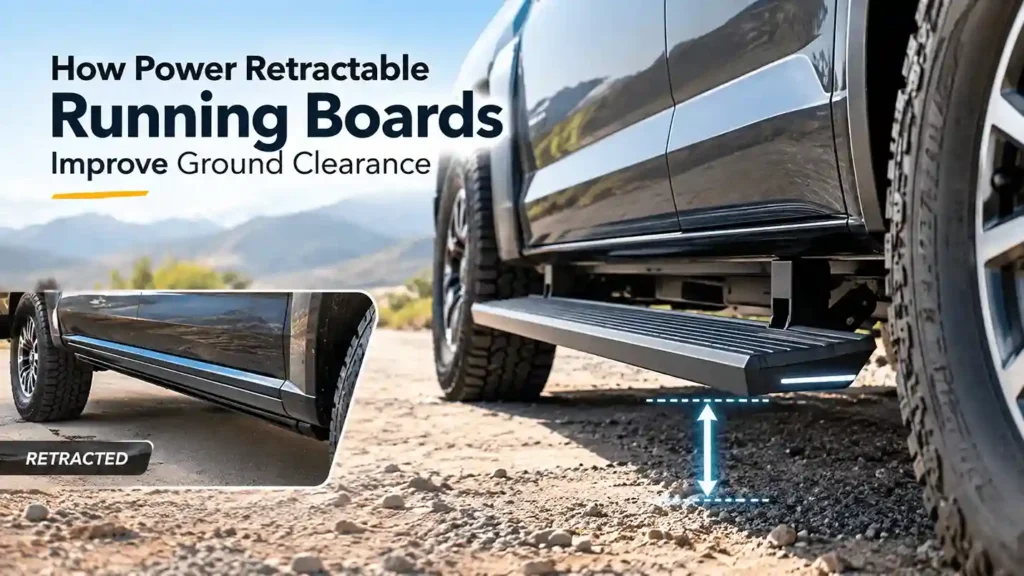
Power running boards ground clearance can be confusing because retractable steps do not actually increase a vehicle’s factory ground clearance. The vehicle keeps the same clearance from the ground. Instead, power retractable running boards change how much space the running board uses under the vehicle.
When the doors open, the boards extend outward and down. This position creates a lower stepping surface and makes it easier to enter or exit a truck, SUV, or 4×4. When the doors close, the boards retract closer to the vehicle body. This position keeps the steps higher and reduces their exposure below the rocker panels.
This design can matter more on lifted trucks and off-road vehicles. These vehicles may have more ground clearance, but a large running board can still become a low point under the vehicle. Retractable running boards help reduce this issue without changing the vehicle’s factory ground clearance.
What Is Ground Clearance?
Ground clearance is the distance between the ground and the lowest point of a vehicle. This measurement matters when a vehicle travels over rocks, steep ramps, uneven roads, or other obstacles. SAE J1100 defines standard procedures for measuring motor vehicle dimensions and states that ground-related dimensions are measured relative to the ground.
Three terms often cause confusion:
| Término | Meaning |
|---|---|
| Distancia al suelo | Distance from the ground to the vehicle’s lowest point |
| Step height | Distance from the ground to the top of the deployed running board |
| Drop height | Distance the running board moves downward from its stored position |
These measurements describe different parts of the vehicle and running board. A lower step height can make entry easier, but it does not automatically increase ground clearance. Comfort and off-road clearance are two different goals.
For more technical information on standardized motor vehicle dimensions and measurement procedures, see SAE J1100 — Motor Vehicle Dimensions
Do Power Retractable Running Boards Actually Increase Ground Clearance?
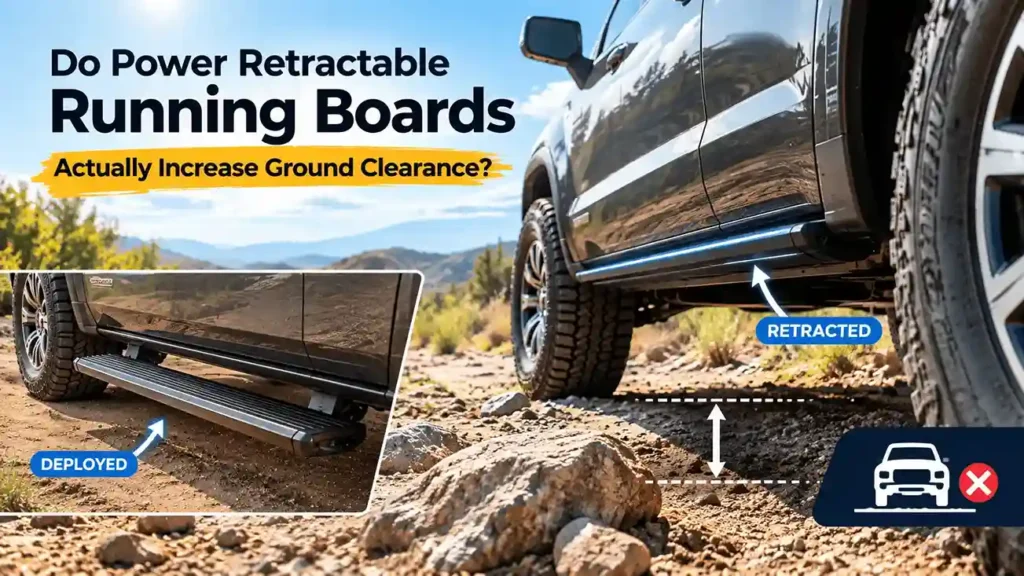
No. Power retractable running boards do not raise the vehicle or increase its factory ground clearance. The suspension, tires, and chassis keep the same position relative to the ground.
The main difference is the position of the running board.
Estribos fijos
Fixed running boards stay below the vehicle body. They occupy the same space whether the vehicle is parked or moving. On an off-road vehicle, the board can become a low point under the rocker panel. A large obstacle may contact the board before it reaches other parts of the vehicle.
Estribos retráctiles
Retractable running boards change position with the doors. When a door opens, the board deploys to provide a lower step. When the door closes, the board retracts closer to the rocker panel.
This movement reduces the amount of running board exposed below the vehicle during driving. The board takes up less space than it does in the deployed position.
La clave es sencilla: power retractable running boards do not add chassis ground clearance. They reduce running board exposure when the vehicle is moving. This difference matters on trucks, SUVs, 4x4s, and lifted vehicles that travel on uneven terrain.
| Característica | Estribos fijos | Power Retractable Running Boards |
|---|---|---|
| Position while driving | Stays below the vehicle | Retracts closer to the rocker panel |
| Position when doors open | Stays in place | Deploys outward and down |
| Running board exposure | Más alto | Lower when retracted |
| Factory ground clearance | Does not change | Does not change |
| Clearance benefit | No reduction in board exposure | Reduces board exposure while driving |
| Acceso por escalones | Fixed step position | Lower step when deployed |
How Retractable Running Boards Help Preserve Clearance
Retractable running boards can help preserve usable clearance by changing their position when the vehicle moves. They do not raise the chassis or increase the vehicle’s factory ground clearance. Instead, they reduce how far the running board extends below the vehicle.
1. The Board Moves Closer to the Body
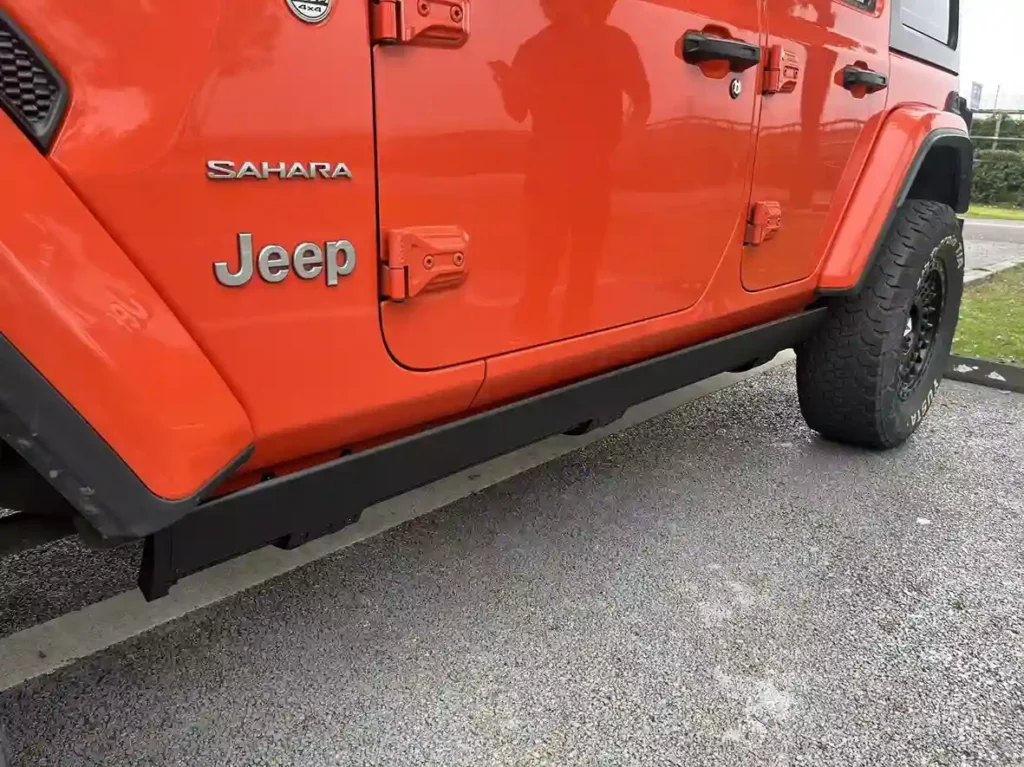
When the running board retracts, it moves closer to the rocker panel. The board has less projection below the vehicle than it has in the deployed position. This leaves more open space around the lower side of the vehicle.
2. The Running Board Is No Longer Permanently Exposed
A fixed running board stays below the vehicle during every drive. It remains exposed even when the driver does not need a step.
A power retractable running board works only when a step is needed. The board deploys when the door opens and retracts after the door closes. This reduces the time that the step remains exposed under the vehicle.
3. Less Exposure Can Help on Uneven Terrain
The difference becomes more useful when a vehicle travels on uneven surfaces. Gravel roads, dirt roads, ruts, steep transitions, and small obstacles can change the angle and position of the vehicle. A running board that stays low can become an exposed point under the rocker panel.
A retractable design moves the board closer to the body during driving. This can reduce the chance of the running board becoming the first part to contact an obstacle.
The actual clearance depends on the vehicle and the running board design. Vehicle height, suspension setup, tire size, board position, and retracted height all affect the available space.
What Happens When Power Running Boards Retract?
When a power running board retracts, the visible step board moves closer to the vehicle body. However, the step board is only one part of the complete system. To understand the actual running board clearance, you need to check the entire assembly.
The main components include:
- Estribo
- Soportes de montaje
- Enlace
- Motor housing
- Mounting hardware
The lowest component of the complete system determines the actual running board clearance.
This point matters because the visible board may sit higher after retraction, while another component remains lower. Depending on the vehicle and mounting design, a bracket or linkage component may sit slightly lower than the retracted board. The motor housing or mounting hardware can also affect the lowest point.
For normal road use, this difference may have little practical impact. For off-road use, it deserves more attention because rocks, ruts, and steep transitions can contact components below the vehicle.
For off-road use, check the complete assembly instead of judging clearance from the visible board alone.
Retractable Running Boards Ground Clearance for Off-Road Driving
Retractable running boards can help reduce running board exposure when a truck, SUV, or 4×4 travels off-road. The board retracts closer to the vehicle after the doors close, leaving less of the step below the rocker panel. However, retractable running boards do not increase the vehicle’s factory ground clearance. The actual clearance depends on the vehicle, mounting position, and complete running board assembly.
| Driving Situation | Ground Clearance Consideration |
|---|---|
| Conducción diaria | Board retracts closer to the vehicle |
| Camiones con suspensión elevada | Vehicle lift does not automatically raise the running board |
| Todo terreno ligero | Retraction reduces running board exposure |
| Serious off-road | Lowest point of the complete assembly matters |
Conducción diaria
During normal road driving, the running board stays in its retracted position after the doors close. This position keeps the board closer to the vehicle and reduces how far it extends below the rocker panel. The vehicle’s factory ground clearance remains unchanged.
Camionetas con suspensión elevada
A suspension lift can raise the vehicle body and increase the distance between the chassis and the ground. However, it does not automatically move the running board higher because the board still follows its mounting points. The retracted position and mounting design determine the running board’s actual clearance. Drop height mainly affects the deployed step position and entry height. See Power Running Board Drop Height for Lifted Trucks for more information.
Light Off-Road
Gravel roads, dirt roads, ruts, and uneven trails can bring the running board closer to obstacles below the vehicle. A fixed running board remains exposed in these conditions. A retractable running board moves closer to the vehicle when retracted, which can reduce the chance of the board becoming a low point.
Serious Off-Road
Deep ruts, rocks, steep transitions, and side obstacles require more attention to the complete running board system. The visible board may retract higher, but brackets, linkage, motor housing, or mounting hardware can still sit lower. The lowest component of the complete assembly determines the actual running board ground clearance.
Retractable running boards are also not automatically rock sliders. A running board provides vehicle access, while a rock slider protects the rocker area. For serious off-road driving, check the complete assembly and its lowest point before entering difficult terrain.
How to Check Running Board Ground Clearance
You can check running board ground clearance with a simple vertical measurement. The goal is to find the lowest part of the complete running board system.
Step 1: Park on Level Ground
Park the vehicle on a flat surface. Keep the vehicle in its normal driving condition.
Step 2: Fully Retract the Running Boards
Close all doors and let the power running boards reach their fully retracted position.
Step 3: Find the Lowest Component
Look under the vehicle and identify the lowest point of the assembly. Check the board, brackets, linkage, motor housing, and mounting hardware.
Step 4: Measure to the Ground
Place a tape measure vertically between the lowest component and the ground. Keep the tape straight for a more accurate measurement.
Step 5: Check Both Sides
Measure both running boards and record the smaller measurement. This number represents the lower clearance point of the running board system.
Always measure the brackets and linkage as well as the visible board. The lowest component determines the actual running board ground clearance.
What Affects Running Board Ground Clearance?
Several factors affect running board ground clearance. The vehicle, running board, brackets, and suspension all influence the final clearance measurement.
Vehicle Design
The vehicle body sets the basic space available for a running board. Rocker panel height, factory mounting points, and available underbody space can affect where the running board sits after installation. Different trucks and SUVs can therefore have different clearance even when they use similar running boards.
Running Board Design
The running board itself also affects clearance. Espesor de la tabla, retracted position, linkage layout, y motor location can change the lowest point of the complete system. A thinner board does not always provide more clearance if the linkage or motor sits lower.
Bracket Design
Bracket shape, mounting position, and bracket height can affect how far the running board assembly sits below the vehicle.
Lift and Suspension
A suspension lift can raise the vehicle body and increase the distance between the chassis and the ground. However, a lift does not automatically change where the running board is mounted. The final clearance still depends on the mounting points and running board design.
Tire Size
Larger tires can increase overall vehicle clearance by raising the vehicle higher from the ground. However, they do not automatically move the running board higher. The running board position still depends on its mounting location and design.
Choosing Power Retractable Running Boards for Your Truck or SUV
Power retractable running boards are available for trucks, Jeeps, SUVs, and other 4×4 vehicles. Vehicle-specific fitment is important because each vehicle has different rocker panel height, mounting points, and underbody space. These differences affect where the running board sits when it is deployed and retracted.
MAX Running Boards develops vehicle-specific electric running boards for popular trucks, SUVs, and 4×4 vehicles. Applications include Toyota Tundra, Land Cruiser 250, Land Cruiser 300, Nissan Frontier&Patrol, Jeep Wrangler, RAM 1500, Ford F-150, GMC Sierra, Chevrolet Silverado, Mitsubishi Triton, y Isuzu D-Max. See the full range of Estribos MAX Power for more vehicle applications.
For less common vehicles, new platforms, or modified applications, MAX also supports OEM and ODM power running board development. Custom development can address vehicle-specific mounting points, board position, and other fitment requirements. Learn more about MAX OEM Services.
Conclusión
Power retractable running boards do not increase factory ground clearance. They help preserve usable clearance by retracting closer to the vehicle when the doors are closed. Actual clearance depends on the vehicle, running board, brackets, linkage, and mounting design.
For trucks, SUVs, and 4x4s, choosing a vehicle-specific system is important for proper fitment, step height, and retracted position.
MAX Running Boards develops premium, vehicle-specific electric running boards for trucks, SUVs, and 4×4 vehicles, with OEM/ODM support for custom applications.
Explore MAX Power Running Boards or contact MAX for your vehicle-specific project.
References
[1] Reddit – r/Silverado: “Power Running Boards and Ground Clearance” – https://www.reddit.com/r/Silverado/comments/1e9kxzz
[2] Reddit – r/FJCruiser: “Retractable Running Boards for Better Ground Clearance” – https://www.reddit.com/r/FJCruiser/comments/1b3ignv
[3] Reddit – r/4Runner: “Running Boards, Off-Road Clearance and Rock Sliders” – https://www.reddit.com/r/4Runner/comments/17fg0e8
