

Side steps for trucks are step systems that help drivers and passengers enter and exit a truck more easily. Pickup trucks and full-size trucks come in different heights, body styles, and chassis designs, so manufacturers offer different types of side steps to match these needs.
Different truck steps can improve several parts of daily truck use. Some provide a lower and wider step for easier cab access. Others keep more ground clearance for off-road driving. Some side steps also protect the rocker panels from rocks and other impacts. LED lighting can make the step easier to see at night. Bed steps serve a different purpose by helping users reach the truck bed.
This guide covers 8 types of side steps for trucks and explains how each type works. Some truck side steps are defined by their physical design, while others are defined by how they operate or what they are designed to access.
How Are Truck Side Steps Classified?
Truck side steps can be classified in more than one way. Some types are named by their physical structure, while others are named by how they operate or what they help users access. One truck step can therefore fit into more than one category.
| Classification | Examples | Main Basis |
|---|---|---|
| By physical design | Running Boards, Nerf Bars, Hoop Steps, Drop Steps, Rock Sliders | Shape, structure, and mounting position |
| By operation or features | Power Running Boards, Lighted Running Boards | Motorized movement or added lighting |
| By access location | Side Steps, Bed Steps | Cab access or truck bed access |
By Physical Design
Some truck steps are classified by their shape, structure, and mounting position. Common examples include:
- Running Boards — wide, flat step surfaces that usually extend along the cab.
- Nerf Bars / Step Bars — tubular bars with one or more stepping areas.
- Hoop Steps — compact individual steps mounted near the cab doors.
- Drop Steps — steps that extend lower than the main mounting position for easier access.
- Rock Sliders — protective side structures that can also provide a stepping surface.
These categories describe the basic physical design of the step.
By Operation or Features
Other side steps for trucks are classified by how they operate or by their added features. These features can combine with the physical designs above.
Por ejemplo:
- Running Board + LED = Lighted Running Board
- Running Board + Motor = Power Running Board
- Power Running Board + LED = Power Running Board with Lighting
A power step and a lighted step are therefore not always separate physical designs. They can describe different features added to the same basic running board structure.
By Access Location
Truck steps can also be classified by where they provide access. Most side steps are designed for cab access, while bed steps are designed specifically for pickup-bed access.
Cab Access
- Running Boards
- Nerf Bars / Step Bars
- Hoop Steps
- Drop Steps
- Power Running Boards
Bed Access
- Bed Steps
Bed steps are included in this guide because truck-step searches can cover both cab and bed access. Their purpose is different from cab side steps: they help users reach cargo in the pickup bed rather than enter the cab.
8 Types of Side Steps for Trucks
Side steps for trucks come in different shapes, sizes, and operating styles. Each type serves a different need, from simple cab access to off-road protection and powered entry. Some truck steps use a fixed structure, while others move or add features such as LED lighting. The best option depends on the truck, step height, ground clearance, and how the vehicle is used.
The eight types below are compared by their key characteristics, pros, cons, and best use cases.
1. Running Boards
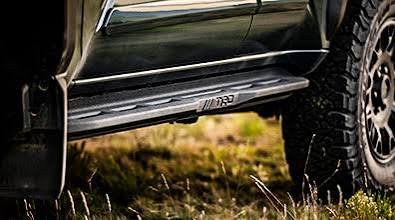
Estribos are wide, flat steps that provide a continuous or near-continuous stepping surface along the truck cab. Their broad platform gives drivers and passengers more room to place their feet than narrow step bars. Running boards are common on pickup trucks and SUVs because they make daily entry and exit easier. They work well for full-size trucks with a higher step-in height.
Key Characteristics
- Wide, flat stepping surface
- Continuous or near-continuous platform
- Cab-length or longer configurations
- Aluminum, steel, stainless steel, or composite construction
- Fixed and retractable versions available
Ventajas
- Wide and stable stepping area
- Comfortable for passengers
- Good choice for families
- Easy everyday access
- Broad vehicle compatibility
Contras
- Fixed boards stay exposed below the cab
- Can reduce usable ground clearance
- More exposed to mud, snow, and trail obstacles
- Wider side profile than narrow step bars
Ideal para
- Daily drivers
- Family trucks
- Work trucks
- Full-size pickups
- Users who want a wide stepping surface
2. Nerf Bars / Step Bars
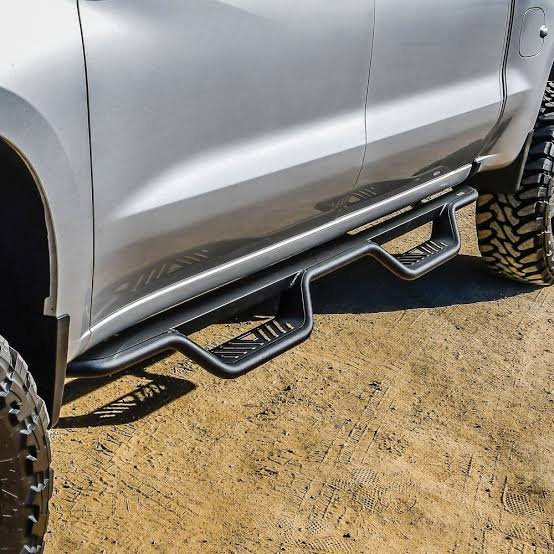
Nerf bars, also called step bars, use a tubular or oval structure with individual stepping pads. They are usually narrower than running boards and have a slimmer side profile. Most designs use fixed mounting. Unlike a running board, a nerf bar usually does not provide one continuous stepping platform. This gives trucks a sportier appearance while still providing a clear step for cab access.
Key Characteristics
- Tubular or oval shape
- Individual step pads
- Steel, stainless steel, or aluminum construction
- Narrow side profile
- Usually fixed
Ventajas
- Sporty appearance
- Slimmer visual profile
- Usually lower cost
- Simple cab access
- Lightweight designs available
Contras
- Smaller stepping area
- Less continuous footing
- Limited rocker protection
- Less comfortable for several passengers
- Can still reduce ground clearance
Ideal para
- Sporty truck builds
- Budget-conscious users
- Users who prefer a slimmer step
3. Hoop Steps
Hoop steps use a tubular main bar with separate drop-down steps near each cab door. Each hoop creates a dedicated stepping point instead of a full-length platform. The step sits lower than many standard step bars, which can make entry easier on lifted trucks. The compact structure also takes up less side space than a full running board. A hoop step gives the user a dedicated lower step at each door instead of a full-length stepping platform.

Key Characteristics
- Individual drop-down steps
- Lower step position
- Tubular construction
- Compact footprint
- Rugged appearance
Ventajas
- Lower step-in point
- Good for lifted trucks
- Compact design
- Good door-area access
- Off-road-friendly design
Contras
- Smaller stepping surface
- No continuous platform
- Less passenger-friendly
- Lower hoops can contact obstacles
Ideal para
- Camiones con suspensión elevada
- Off-road builds
- Overland vehicles
- Users who want a lower step without a full board
4. Drop Steps / Truck Steps
Drop steps use individual stepping points positioned below the truck rocker panel. Many designs use drop brackets or boxed step structures to place the step closer to the ground. Unlike hoop steps, drop steps do not depend on a tubular hoop as the main step structure. Their main purpose is direct door-area access with a compact side profile.
Key Characteristics
- Individual stepping points
- Lower step height
- Drop-down mounting design
- Compact profile
- Multiple shapes and structures
Ventajas
- Easy entry and exit
- Good for taller trucks
- Compact appearance
- Works well with modified trucks
Contras
- Smaller step area
- No continuous platform
- Limited rocker coverage
- Lower position can affect obstacle clearance
Ideal para
- Lifted pickups
- Modified trucks
- Minimalist builds
- Users who want direct door-area access
5. Power / Retractable Running Boards
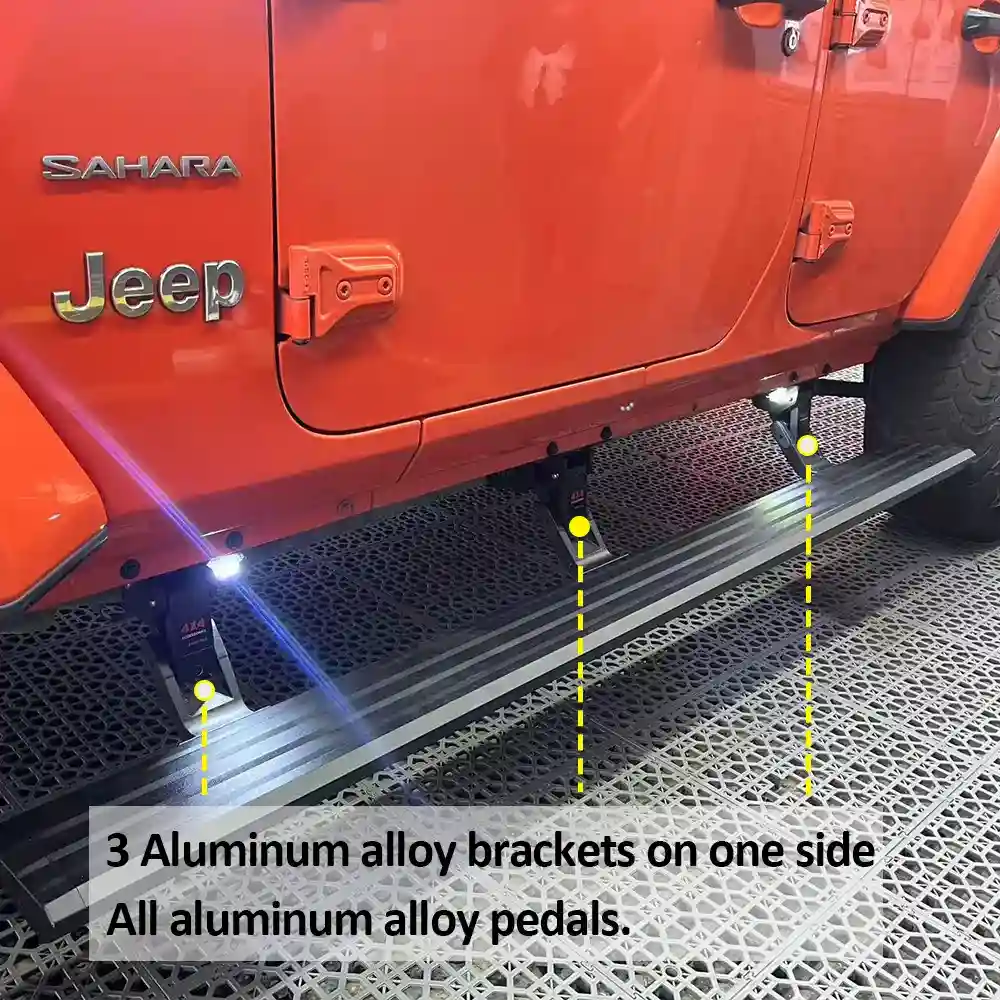
Estribos eléctricos use electric motors to move the step automatically. The board deploys when a door opens and retracts when the doors close. Most designs use a wide stepping platform similar to a running board, but the board stays tucked under the vehicle while driving.For a detailed explanation of the motor, sensors, control module, and deployment process, see How Do Power Running Boards Work?.
This design gives trucks a wide and comfortable step without keeping the full platform exposed all the time. Retracting the board also reduces its impact on ground clearance compared with a fixed running board, although the motor, brackets, and board still occupy space underneath the vehicle.
Key Characteristics
- Automatic deployment when a door opens
- Motorized operation
- Wide stepping platform
- Door sensors and control system
- Vehicle-specific mounting
- Retracted position under the vehicle
- Fixed position while the vehicle is parked or in use
Ventajas
- Wide stepping surface
- Automatic operation
- Cleaner appearance while driving
- Less exposed to road debris and obstacles
- Good for lifted or high trucks
- Comfortable for daily passenger use
Contras
- Higher cost than fixed steps
- More mechanical components
- Electrical installation required
- More moving parts to maintain
- Requires proper vehicle-specific fitment
- Components still occupy space underneath the vehicle
Ideal para
- Full-size pickups
- Camiones con suspensión elevada
- Daily drivers
- Family vehicles
- High step-in trucks
- Users who want both easy access and better clearance than a fixed running board
6. Lighted Running Boards
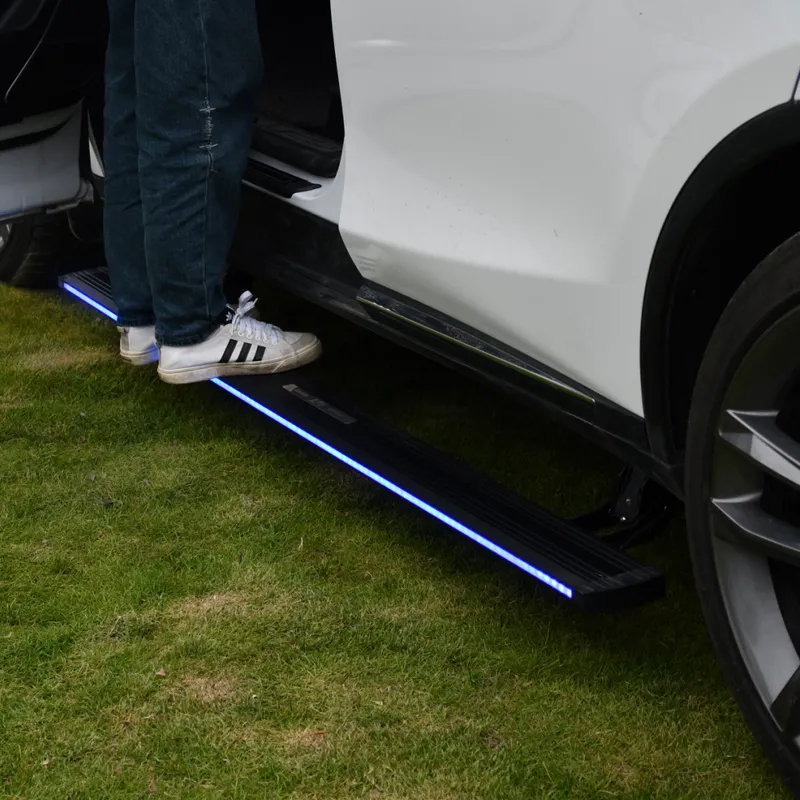
Lighted running boards are a feature-based type of truck step. LED lighting can be added to a fixed running board or a power / retractable running board. The lights help passengers see the step at night, make the step location easier to identify, and add a more distinctive appearance to the truck.
The lighting can activate when a door opens or connect to the vehicle’s lighting system, depending on the design. This makes lighted running boards useful for nighttime driving, camping, overlanding, and other situations where passengers need to enter or exit the truck in low-light conditions.
Key Characteristics
- Integrated LED lighting
- Door-triggered lighting on many designs
- Different LED layouts and positions
- Available on fixed or retractable running boards
- Electrical connection to the vehicle
- Lighting focused on the stepping area
Ventajas
- Better nighttime visibility
- Makes the step easier to locate
- Adds styling to the truck
- Useful at campsites and dark parking areas
- Improves visibility around the entry area
Contras
- Additional wiring
- Additional electrical components
- Higher cost than non-lighted designs
- LEDs and wiring may require maintenance
- Installation requires proper electrical connections
Ideal para
- Night driving
- Camping
- Overlanding
- Work trucks
- Daily drivers
- Users who want both lighting and styling
7. Rock Sliders
Rock sliders are heavy-duty side protection equipment designed primarily for off-road use. They mount to the vehicle frame and help protect the rocker panels from rocks, ledges, and other trail obstacles. Some rock sliders include a step surface or can be used as a step, but passenger access is usually a secondary function.
Unlike most side steps, rock sliders are designed primarily to protect the vehicle rather than provide passenger access. Their high-clearance position and strong construction make them better suited to trucks that regularly face rocks, uneven terrain, and other off-road hazards.
Key Characteristics
- Heavy-duty steel construction
- Frame-mounted design
- High-clearance positioning
- Rocker-panel protection
- Reinforced mounting points
- Off-road-focused design
- Some designs provide a stepping surface
Ventajas
- Excellent rocker-panel protection
- Strong off-road capability
- Helps protect the body from rocks and obstacles
- Good for serious trails
- High-clearance design can reduce exposure to trail obstacles
Contras
- Heavy compared with most side steps
- Less comfortable as a passenger step
- More complex installation
- Higher weight can affect the vehicle
- Usually unnecessary for street-only trucks
Ideal para
- Rock crawling
- Serious off-road driving
- Overlanding
- Trail-focused builds
- Trucks that need rocker-panel protection
8. Bed Steps
Bed steps are designed specifically for pickup bed access. They are usually mounted near the rear wheel, bedside, or rear corner of the truck to create a lower stepping point for reaching cargo. Depending on the design, a bed step can be fixed, folding, or retractable.
A bed step solves a different access problem from a side step: it helps you reach cargo in the bed rather than step into the cab. Unlike cab side steps, bed steps focus on loading, unloading, and accessing items stored in the pickup bed.
Key Characteristics
- Bed access focused
- Compact stepping area
- Fixed, folding, or retractable designs
- Montaje específico para cada vehículo
- Rear or bedside mounting
- Positioned near the pickup bed
Ventajas
- Easier bed access
- Useful for loading and unloading cargo
- Compact design
- Some designs fold away when not in use
- Helpful for frequent bed access
Contras
- Does not replace cab side steps
- Vehicle-specific fitment matters
- Smaller stepping area than most running boards
- Some designs require additional mounting hardware
- Limited use outside bed access
Ideal para
- Work trucks
- Contractors
- Frequent cargo loading
- Pickup owners who regularly use the bed
- Users who need easier access to tools and cargo
Fixed vs. Retractable Side Steps
Another way to classify side steps for trucks is by how they operate. Fixed side steps stay in one position, while retractable side steps move between a deployed position for access and a retracted position while driving. This operating classification can apply to different physical designs, including running boards and step bars.
Fixed Side Steps
Fixed side steps remain in the same position after installation. They are always ready when passengers need to enter or exit the truck, with no motor or deployment mechanism required.
Their simple structure usually means lower cost and easier installation. The main trade-off is that the step stays exposed underneath the truck while driving, where it can collect mud, snow, and road debris or face trail obstacles.
Retractable Side Steps
Retractable side steps deploy when access is needed and retract while driving. This keeps the stepping surface available for passengers while reducing the exposed side profile during normal driving.
Retracting the step can provide better clearance management than a fixed side step, but the board, brackets, motor, and other hardware still occupy space underneath the truck. Powered designs also require electrical connections and vehicle-specific controls.
Where Do Power Running Boards Fit?
Power running boards are best understood as a retractable configuration of running boards, not a completely separate physical category.
“Running board” describes the physical form: a wide stepping platform. “Power” or “retractable” describes how that platform operates. A power running board combines both, using a motorized mechanism to deploy the board when the doors open and retract it when the doors close.
This also explains why some truck steps can belong to more than one category. A fixed running board can become a lighted running board when LED lighting is added. A power running board can also be a lighted running board when it includes integrated LEDs.
For a closer comparison, see power running boards vs. side steps.
Understanding these overlapping categories makes it easier to compare truck steps by both their physical design and operation.
How Different Side Steps Compare
The different types of side steps for trucks vary in step width, clearance, access, protection, and operation. The table below provides a quick comparison of the main differences between each type.
| Type | Step Surface | Distancia al suelo | Cab Access | Off-Road Suitability | Rocker Protection | Funcionamiento |
|---|---|---|---|---|---|---|
| Running Boards | Wide | Medium | Excellent | Low–Medium | Low–Medium | Corregido |
| Nerf Bars / Step Bars | Medium–Narrow | Medium | Bien | Low–Medium | Low | Corregido |
| Hoop Steps | Small–Medium | Bien | Bien | Medium–High | Medium | Corregido |
| Drop Steps | Medium | Medium | Bien | Medium | Low–Medium | Corregido |
| Power Running Boards | Wide | Better when retracted | Excellent | Medium–High | Low–Medium | Automático |
| Lighted Running Boards | Wide | Depends on base design | Excellent | Depends on base design | Depends on base design | Fixed / Power |
| Rock Sliders | Narrow–Medium | Alto | Bien | Excellent | Excellent | Corregido |
| Bed Steps | Small–Medium | N/A | Limitado | Medium | Low | Fixed / Folding / Retractable |
These ratings are general comparisons. Actual ground clearance, protection, and off-road performance depend on the vehicle, mounting position, step dimensions, and suspension setup.
What Makes Different Truck Side Steps Different?
Different side steps for trucks can look similar but perform differently. The main differences come from the stepping surface, ground clearance, step-in height, vehicle protection, and access purpose. These dimensions help explain why one type may work well for a daily pickup while another is better suited to a lifted or off-road truck.
| Comparison Dimension | What It Tells You | Main Differences |
|---|---|---|
| Step Surface | How much stepping area is available | Wide platform vs. individual step pads |
| Distancia al suelo | How the step sits below the truck | Fixed, lower-positioned, retractable, or high-clearance designs |
| Step-In Height | How easy it is to reach the cab | Depends on truck height, lift, and step position |
| Vehicle Protection | How much protection the step provides | Access-focused steps vs. protection-focused rock sliders |
| Access Purpose | Where the step provides access | Cab access vs. pickup bed access |
Step Surface
The step surface is one of the easiest ways to tell truck steps apart.
Running boards provide the widest and most continuous stepping area, making them comfortable for drivers and passengers. Nerf bars and step bars use narrower tubular structures with individual step pads. Hoop steps and drop steps provide separate stepping points near each door instead of a full-length platform.
Rock sliders are different because their main purpose is vehicle protection. Some include a step surface, but passenger access is secondary to protecting the rocker panels.
Distancia al suelo
Ground clearance affects how a side step interacts with the road or trail.
Fixed steps remain below the vehicle while driving, so their position and size can affect clearance. Lower steps can make entry easier, especially on taller trucks, but they also sit closer to rocks, curbs, and other obstacles.
Retractable running boards reduce this exposure by moving the stepping surface closer to the vehicle when stored. Rock sliders are also positioned with off-road clearance in mind, combining a higher mounting position with rocker-panel protection.
Step-In Height
Step-in height refers to the distance passengers must cover when entering the cab. A stock truck, lifted truck, and tall full-size pickup can have very different entry heights.
Hoop steps and drop steps place the stepping point lower than many standard side steps, which can help on lifted trucks. A wide running board may work well on a stock truck or family pickup where passengers need a stable platform.
A lower step is not automatically better. The ideal step position depends on vehicle height, suspension setup, and the distance between the ground, step, and cab floor.
Vehicle Protection
Side steps can provide some protection for the lower side of a truck, but their primary purpose varies.
Access-focused: Running boards, nerf bars, hoop steps, drop steps, and power running boards mainly help passengers enter and exit the cab.
Protection-focused: Rock sliders are built primarily to protect the rocker panels from rocks and trail obstacles. Their frame-mounted construction and high-clearance position make them different from typical passenger steps.
Side steps may provide some rocker coverage, but they are not equivalent to frame-mounted rock sliders.
Access Purpose
The final difference is where the step is meant to provide access.
Cab Access
- Running Boards
- Nerf Bars / Step Bars
- Hoop Steps
- Drop Steps
- Power Running Boards
These types are mainly designed for entering and exiting the truck cab.
Bed Access
- Bed Steps
Bed steps are designed for reaching cargo in the pickup bed rather than entering the cab.
This distinction helps separate cab-access steps from bed-access steps.
Which Type of Side Step Is Right for Your Truck?
The right side steps for trucks depend on how you use the vehicle and what matters most for daily driving, access, or off-road performance. If you are comparing step height, board width, ground clearance, vehicle fit, and other buying factors, see the How to Choose the Right Running Boards.
If easy passenger access is the priority, running boards provide a wide and stable stepping surface. Power running boards offer a similar wide step with automatic deployment and retraction, making them a practical choice for full-size or lifted trucks. If you prefer a slimmer profile, nerf bars or step bars provide a more compact option.
Lifted and modified trucks may benefit from hoop steps or drop steps because they provide a lower stepping point near each door. For serious off-road driving, rock sliders are a better choice when rocker-panel protection and ground clearance are more important than passenger comfort.
If nighttime visibility is important, lighted running boards add step-area lighting. For frequent loading and unloading, a bed step makes it easier to reach the pickup bed.
For trucks that need a wide stepping surface with automatic deployment, power running boards offer a practical combination of accessibility, clearance, and everyday convenience.
Conclusión
The right side steps for trucks depend on how the vehicle is used, the desired step surface, ground clearance, step-in height, and level of vehicle protection. Fixed steps provide simple access, while retractable designs offer a wide stepping surface with less exposure while driving.
For trucks that need comfortable cab access with automatic deployment, power running boards offer a practical combination of accessibility, clearance, and everyday convenience. Lighted options can also improve step visibility in low-light conditions.
MAX Running Boards provides vehicle-specific electric running boards for pickups, SUVs, and 4×4 vehicles, with options for different vehicle platforms and custom requirements. Ponte en contacto con MAX Running Boards to find the right electric running board for your vehicle.
