
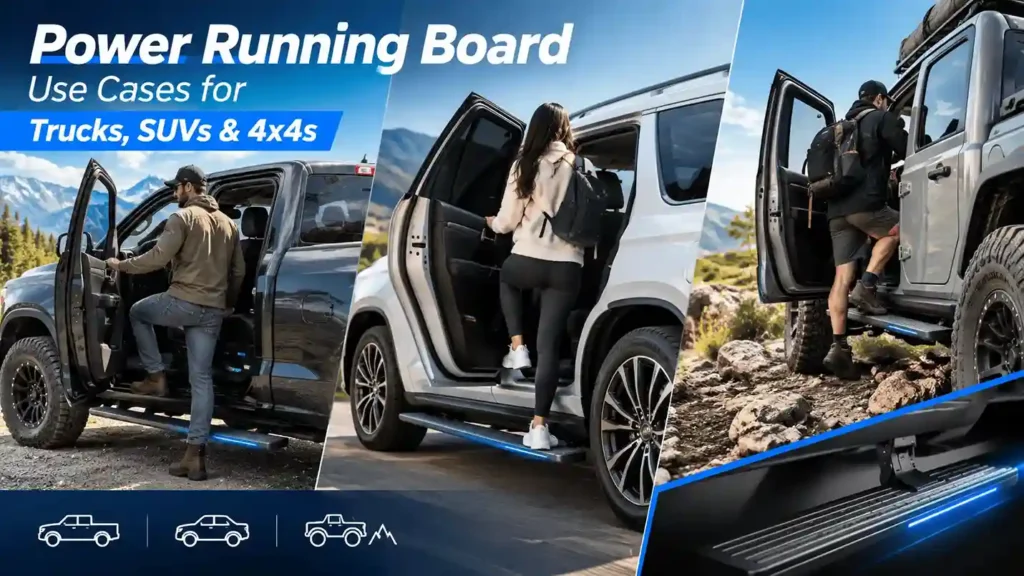
Power Running Board Use Cases become clear when a truck or SUV needs easy access without losing ground clearance. A tall vehicle can make entry harder, especially for children and older passengers. A lifted truck can make the step even higher.
A large truck or SUV needs a lower step for easy access, but it does not always need that step hanging below the rocker panel while driving.
Power running boards solve both needs with one moving step. The board deploys when a passenger opens the door and needs access. It retracts after the door closes. This gives passengers a practical step without keeping a fixed bar below the vehicle.
This setup works well for trucks and SUVs used for daily driving, lifted builds, trails, and rough roads. Electric running boards and retractable running boards can make entry easier while helping the vehicle keep its clearance.
The basic idea is simple:
Access when parked, clearance when driving.
Power Running Board Use Cases at a Glance
Power running boards are most useful when a vehicle combines increased ride height, frequent passenger access, off-road use, outdoor gear, or repeated entry and exit. Different vehicles may have different needs, but the basic benefit stays the same: provide a step when people need it and keep the step out of the way when the vehicle moves.
| Use Case | Main Need | Why Power Running Boards Help |
|---|---|---|
| Lifted Trucks | Lower entry height | Provides a lower step without keeping it exposed |
| Daily Driving | Frequent entry and exit | Deploys automatically when passengers enter |
| Families | Easier passenger access | Makes tall vehicles easier for children and shorter passengers |
| Off-Roading | Ground clearance | Retracts when the vehicle is moving |
| Overlanding | Access + clearance | Helps with cabin and gear access while keeping a clean side profile |
| Work & Service Vehicles | Frequent access | Reduces the effort of repeated entry and exit |
The common factor is simple: power running boards provide a step when the vehicle is being accessed and retract it when the vehicle is moving.
What Makes Power Running Boards Useful?
Power running boards are especially useful in situations where a vehicle needs both easier access and good clearance. This is common with tall trucks, large SUVs, lifted 4x4s, and vehicles that see regular off-road use. The main benefit is not simply adding a step. It is having a step when passengers need one without keeping a permanent step below the vehicle.
Easier Vehicle Access
The higher a vehicle sits, the greater the step-in height becomes. Lifted trucks, full-size pickups, large SUVs, vehicles with larger tires, and modified 4x4s can all make it harder to reach the cabin.
For passengers, the difference can be noticeable every day. A taller step can make entry harder for children, older passengers, and shorter adults. A deployed power running board lowers the actual stepping height and gives passengers a more natural place to step.
The basic relationship is simple. A higher vehicle creates a higher step-in height, which can make entry harder. A lower deployed step reduces the height passengers need to climb, making vehicle access easier.
Ground Clearance When You Need It
Easy access is only part of the requirement. A vehicle used on trails also needs enough space around the rocker area and below the body.
Fixed running boards stay exposed all the time. They sit below the rocker area and may reduce clearance in some off-road situations. They can also become an obstacle when a truck passes through deep ruts or narrow trails.
Retractable running boards provide a different balance. The board extends for passenger access and retracts after the door closes. When the vehicle is moving, the board stays closer to the body and leaves more side clearance.
This creates a practical balance between access and clearance.
Automatic Access Without a Permanent Step
The benefit becomes even more useful when passengers enter and exit the vehicle many times during the day. Open the door, the step appears, and the passenger gets in. Close the door, and the board retracts.
This simple experience works well for family vehicles, daily drivers, and work vehicles. Parents can use the step when helping children into a tall SUV. Drivers can use it every time they enter a lifted pickup. Workers can also benefit when they need to climb in and out throughout the day.
This is why power running boards are different from simply adding a fixed step: they provide easier access without requiring a permanent step to stay exposed.
Power Running Boards for Lifted Trucks
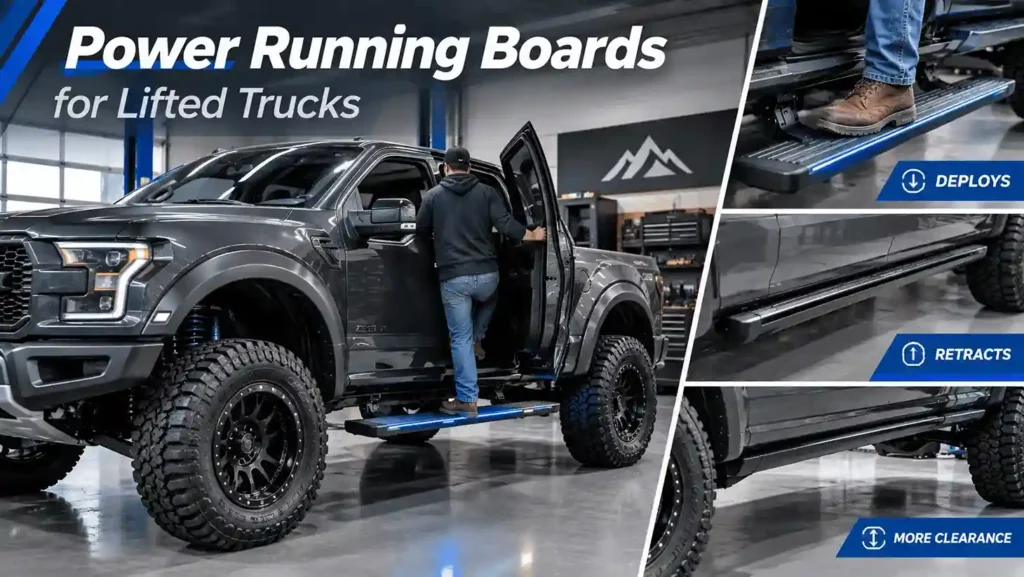
Lifted trucks are one of the clearest use cases for power running boards. Lift kits and larger tires increase ride height and ground clearance, but they also raise the cabin floor and increase the step-in height. A lower stepping point can make daily access easier while keeping the truck ready for off-road use.
Why Lifted Trucks Need a Lower Step
A lift kit raises the truck’s body, while larger tires can add even more height between the ground and the cabin. As the vehicle sits higher, passengers have more height to climb before reaching the cab.
This is easy to notice with full-size pickups and heavily modified 4x4s. The driver may need to climb higher every time they enter the truck, while children, older passengers, and shorter adults may find the extra height even more difficult.
The problem can be described simply:
Higher ride height → higher cabin floor → higher step-in height → harder access → need for a lower stepping point
A power running board provides that lower stepping point when passengers enter the truck. Instead of climbing directly from the ground to the cabin, they can use the deployed board as an intermediate step.
Access Without Sacrificing Clearance
A fixed running board can also lower the entry height, but it remains exposed along the side of the truck. For a lifted truck that also sees trails, this creates a practical trade-off. The step helps passengers, but the board stays below the rocker area while the truck is driving.
Power running boards offer a different balance. The board deploys when passengers enter and retracts after entry. When the truck is moving, the board stays closer to the body and out of the way.
| Fixed Running Board | Power Running Board | |
|---|---|---|
| Entry | Permanent step | Step appears when needed |
| Driving | Always exposed | Retracts |
| Side clearance | May reduce clearance | More clearance when retracted |
| Off-road use | Step remains exposed | Step stays out of the way |
This combination is especially useful when a lifted truck travels through deep ruts, uneven ground, rocks, or narrow trails. The truck can keep the added clearance from the lifted setup while still providing a practical step for passengers.
MAX Vehicle Examples
Lifted and modified trucks do not all have the same chassis or side-step mounting points. Vehicle-specific brackets are important because the available mounting space and rocker area can vary between models.
MAX retractable running boards applications include popular pickups and 4×4 platforms such as the Ford F-150, RAM 1500, Toyota Hilux, Nissan Frontier, and Toyota Land Cruiser. MAX also works with Land Cruiser 70 Series applications, including the LC70, LC76, and LC79.
These vehicles cover different markets and different types of use. A full-size pickup may need a lower step for daily driving, while a Land Cruiser or Hilux may need the same access benefit on a vehicle that also sees off-road or overlanding use.
For modified trucks, the right fit starts with the vehicle itself. Bracket position, rocker shape, wheel size, suspension changes, and available side clearance can all affect the running board application.
For brands, distributors, and 4×4 shops that need vehicle-specific applications, MAX also provides OEM and ODM support for custom power running boards..
Power Running Boards for Daily Driving
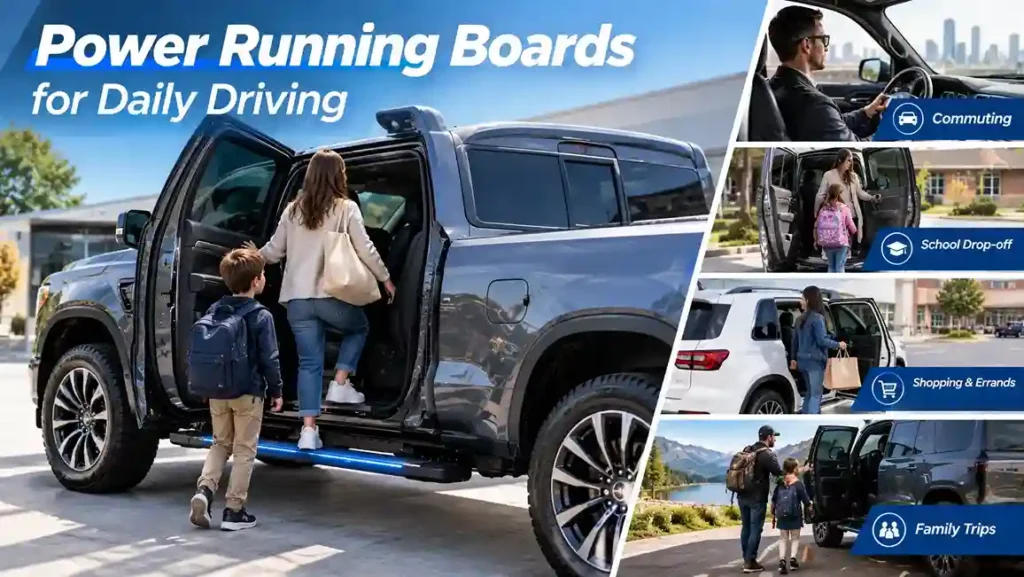
Power running boards can be useful for daily driving when passengers enter and exit a tall vehicle several times a day. The value is not about making one entry easier. It comes from repeating the same action every day.
Frequent Entry and Exit
Daily driving can involve many short trips and repeated passenger access:
- Commuting to work
- School drop-off and pickup
- Shopping and errands
- Family trips
- Regular passenger use
A driver may enter and exit the vehicle several times during a normal day. Families can add even more entry and exit cycles when children need to get in and out for school, activities, or shopping.
Convenience matters most when the same action is repeated every day. A lower step can make each entry feel easier, especially when the vehicle has a higher step-in height.
The benefit also becomes more noticeable when passengers are not all the same height. Children, older passengers, and shorter adults may appreciate having a lower stepping point instead of climbing directly into a tall truck or SUV.
Large Trucks and SUVs Used Every Day
Daily driving does not require a lifted vehicle. Full-size pickups, large SUVs, and high-riding 4x4s can still have a relatively high step-in height even at stock height.
However, power running boards are not necessary for every vehicle. For a stock-height vehicle that is easy for everyone to enter and is mainly used on paved roads, a fixed running board may already provide enough functionality.
The choice depends on how the vehicle is used, who regularly rides in it, and how much value automatic deployment adds to everyday access.
For a broader cost-and-use assessment, see Are Power Running Boards Worth It?.
Power Running Boards for Families and Passenger Accessibility
Power running boards can be useful for families that regularly use tall trucks, SUVs, and 4x4s. The main benefit is passenger access. Different people may have different needs when getting into the same vehicle, especially when children, older passengers, or people carrying bags use the vehicle every day.
Children and Shorter Passengers
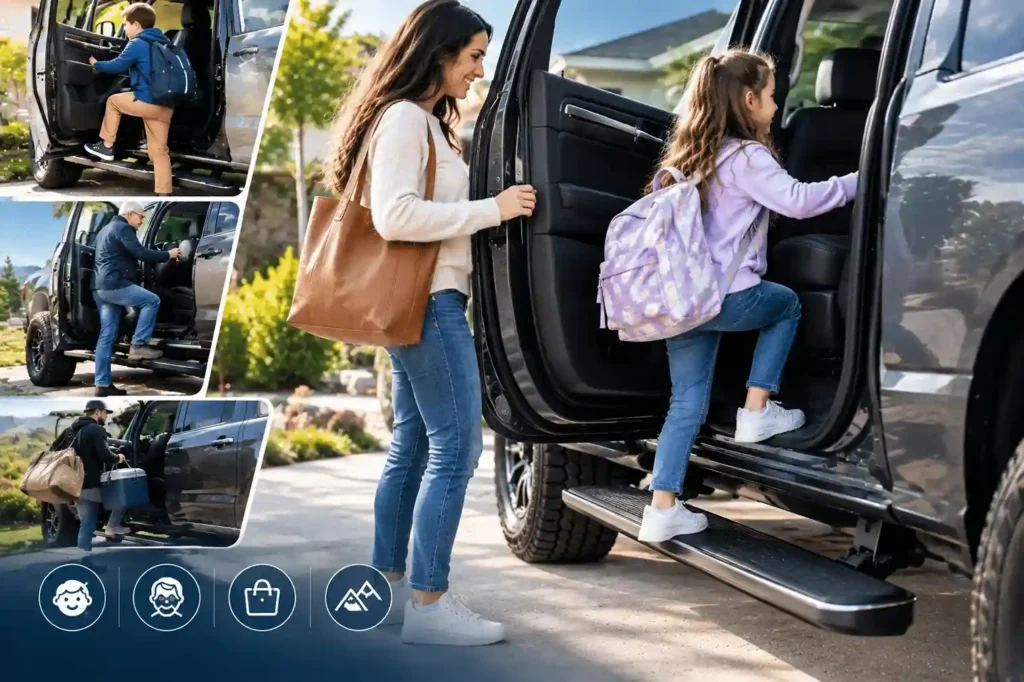
Large trucks and SUVs often have a higher cabin floor and greater step-in height than smaller vehicles. Children and shorter passengers may need to take a larger step to reach the cabin.
A power running board lowers the stepping point and gives passengers an intermediate step between the ground and the vehicle floor. The board appears when the door is opened and retracts after entry.
This can make getting into a tall vehicle easier and more controlled. It is especially useful during school drop-off, family trips, and other situations where children enter and exit the vehicle frequently. Parents should still follow proper child passenger safety practices, including using age- and size-appropriate restraints. NHTSA child passenger safety guidance
Older Passengers
Older passengers may also find a high step-in height less comfortable, particularly when entering and exiting a tall truck or SUV repeatedly.
A lower deployed step provides a more accessible place to put the foot before entering the cabin. It can reduce the height of each step and make vehicle access feel more natural.
The value here is passenger accessibility rather than medical mobility support. If an older passenger can already use a factory step comfortably, a power running board may provide only a small additional benefit.
Carrying Bags, Gear, or Equipment
Passenger access is not only about height. People often enter a vehicle while carrying something, and a higher step can be less convenient when both hands are occupied.
Common situations include:
- Carrying groceries after shopping
- Helping children with backpacks or sports bags
- Loading work equipment into a pickup
- Carrying outdoor or camping gear
- Getting into the vehicle with multiple bags
A lower, automatically deployed step can make entry easier when passengers are carrying something. This is particularly useful for family SUVs and pickups that combine daily transportation with shopping, school activities, work, or outdoor trips.
Power Running Boards for Off-Roading
Power running boards can be useful on off-road vehicles that need easy cabin access without keeping a step exposed along the side. Off-road conditions can change quickly, from smooth gravel roads to uneven trails with rocks, ruts, and steep transitions. In these situations, the position of a running board can matter as much as the step itself.
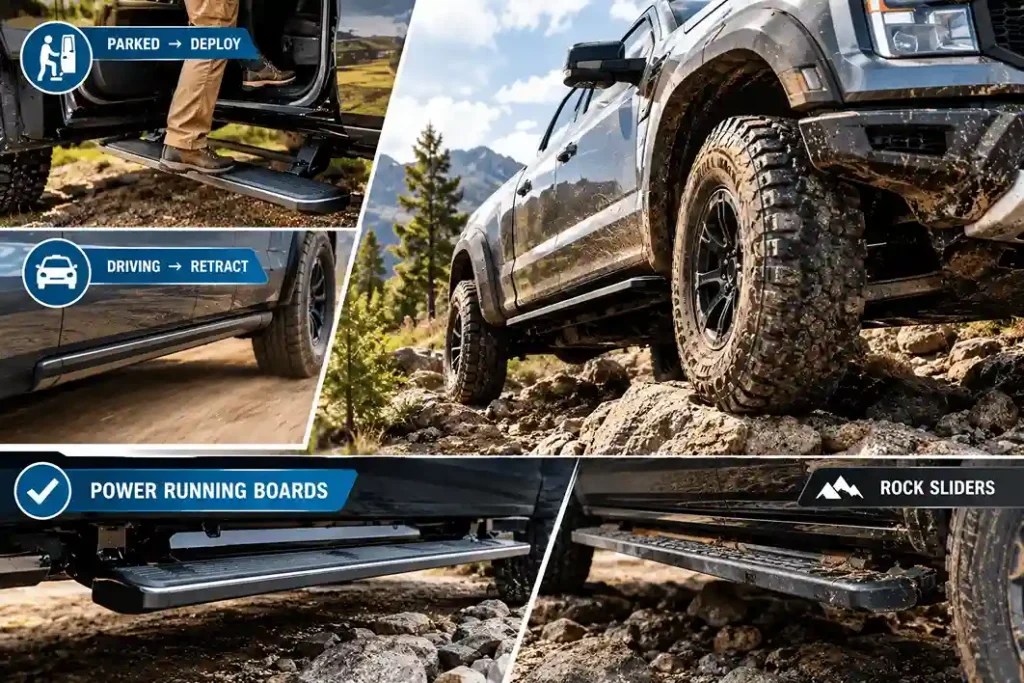
Why Fixed Boards Can Become a Problem Off-Road
Fixed running boards are not automatically a problem for off-road use. They can provide a useful step and work well on vehicles that mainly travel on roads or mild trails.
The limitation appears in certain off-road conditions. Rocks, deep ruts, uneven trails, and steep breakovers can bring obstacles closer to the sides and underside of the vehicle. A fixed board remains in the same position, so it may be more exposed to obstacles when the vehicle moves through difficult terrain.
This can be more noticeable on 4x4s that regularly travel narrow or uneven trails. The running board does not move out of the way when the vehicle no longer needs it as a step.
Retract When You Need Clearance
Power running boards take a different approach by moving out of the way during driving.
When the vehicle is parked, the board deploys and provides a lower stepping point for passengers. Once the vehicle starts moving, the board retracts closer to the body.
The benefit is easy to understand in an off-road situation:
Parked → deploy → easier cabin access
Driving → retract → cleaner side profile and more clearance
This makes retractable running boards a practical option for trucks and SUVs that combine passenger access with off-road use. The vehicle can have a useful step at the trailhead or campsite without keeping the same component fully exposed once driving begins.
The exact clearance benefit depends on the vehicle, running board design, mounting position, and terrain. A retractable board does not turn every vehicle into a more capable off-road machine, but it can reduce the exposure of the step compared with a fixed design.
Power Running Boards Are Not Rock Sliders
Power running boards and rock sliders serve different purposes.
| Power Running Boards | Rock Sliders | |
|---|---|---|
| Main purpose | Passenger access | Side and rocker protection |
| Primary use | Entry and exit | Technical off-road driving |
| Retracts | Yes, depending on design | No |
| Designed for rock contact | No | Yes |
| Replaces the other | No | No |
Power running boards are primarily access equipment. They are not designed to take the same type of rock contact or off-road impact as dedicated rock sliders.
On technical trails, underbody protection and rock sliders may still be more important than a retractable step. For vehicles that face frequent rock obstacles, choosing the right protection equipment should come before treating a power running board as an off-road protection component.
For mixed-use trucks and SUVs, however, a retractable step can provide a useful balance: easier passenger access when parked and less exposed side equipment when driving.
Power Running Boards for Overlanding and Outdoor Use
Power running boards can fit overlanding vehicles that need easy access during long trips while still handling a mix of paved roads, dirt roads, and trails. Unlike a vehicle built mainly for technical off-roading, an overlanding vehicle may spend hours on highways before reaching a campsite. Passenger access and equipment handling can therefore matter as much as ground clearance.
Easier Access to the Cabin and Roof Area
Overlanding vehicles often carry more equipment than a typical daily driver. Roof racks, rooftop tents, camping equipment, cargo, and recovery gear can make access around a tall vehicle more frequent.
A lower deployed step can make it easier to reach and manage equipment around the vehicle. It can also provide a more convenient stepping point when passengers enter the cabin after loading bags or outdoor gear.
A power running board should not be treated as a dedicated roof rack or rooftop tent step. Its primary function is passenger access. However, having a lower step beside the vehicle can make loading and unloading equipment less demanding, especially on taller SUVs and 4x4s.
Road-to-Trail Use
Overlanding is rarely about staying on difficult trails all day. A typical trip may look more like:
Highway → dirt road → campsite → trail → highway
This mixed driving pattern creates a different use case for retractable running boards. The vehicle needs easy access when parked at a campsite, loading equipment, or letting passengers in and out. It may also need more clearance when traveling over rough roads or uneven terrain.
The board can deploy when the vehicle is parked and passengers need a step, then retract during driving. This gives the vehicle a practical access point at camp without keeping a fixed board fully exposed throughout the trip.
For overlanding builds, the value is therefore less about extreme off-road capability and more about combining passenger access, equipment handling, and mixed-road driving in one vehicle.
Power Running Boards for Work and Service Vehicles
Power running boards can be useful for work and service vehicles where drivers and passengers enter and exit the vehicle many times during the day. For contractors, field technicians, service vehicles, mobile work vehicles, and fleet pickups, the value comes from repeated access rather than occasional convenience.
Frequent Entry and Exit
Work vehicles often involve a different pattern from normal daily driving. A technician may drive to a job site, get out to inspect equipment, return to the vehicle for tools, and get out again at the next location.
The same pattern can happen throughout the day. A lower stepping point can make each entry and exit easier, especially on full-size pickups and high-riding work trucks.
Power running boards can be useful in situations such as:
- Contractors moving between job sites
- Field technicians carrying tools
- Service vehicles making multiple stops
- Mobile work vehicles used throughout the day
- Fleet pickups shared by different drivers
When entry and exit happens dozens of times in a workday, even a small improvement in access can become noticeable over time.
Mud, Boots, and Equipment
Work vehicles also operate in conditions that are different from normal road driving. Drivers may enter with muddy boots, carry tools, or work on uneven surfaces where a clear stepping point is useful.
A deployed power running board gives the driver a defined place to step before entering the cabin. This can be helpful when carrying equipment or when the ground around the vehicle is uneven.
The retractable design also has a practical benefit during driving. Retracting the board can reduce its exposure to road spray, mud, and debris while the vehicle is moving.
For work trucks that combine frequent access with demanding job-site conditions, this balance can make power running boards a practical upgrade rather than simply an appearance-focused accessory.
Choosing the Right Power Running Board Use Case for Your Vehicle
The right use case depends on how the vehicle is built and how it is used. The table below gives a quick way to match common vehicle situations with the main reason to consider power running boards.
| Your Vehicle / Situation | Main Reason to Consider Power Running Boards |
|---|---|
| Lifted pickup | Lower step-in height |
| Large SUV | Easier passenger access |
| Family vehicle | Easier access for children and shorter passengers |
| Off-road 4×4 | Access without a permanently exposed step |
| Overlanding vehicle | Cabin and gear access |
| Work pickup | Frequent entry and exit |
If the main requirement is simply having a permanent step on a stock-height vehicle, a fixed running board may be enough. If the vehicle needs both easy access and a cleaner side profile while driving, a retractable design becomes more useful.
Conclusion
The right power running board use case depends on the vehicle and how it is used. A tall vehicle benefits from easier access. A family vehicle can make passenger entry easier, especially for children and shorter passengers. An off-road vehicle can benefit from better clearance when the step is not needed. A work vehicle can make repeated entry and exit easier throughout the day.
The main advantage of a power running board is not simply having a step. It is having the step when you need it and removing it when you do not. This makes retractable running boards useful for vehicles that need both convenient access and a clean side profile while driving.
If you are looking for vehicle-specific electric running boards for pickups, SUVs, or 4×4 vehicles, MAX Running Boards supports OEM, ODM, and private-label programs for distributors, dealers, installers, and automotive brands. Contact MAX Running Boards today to discuss your vehicle application or business requirements.
