
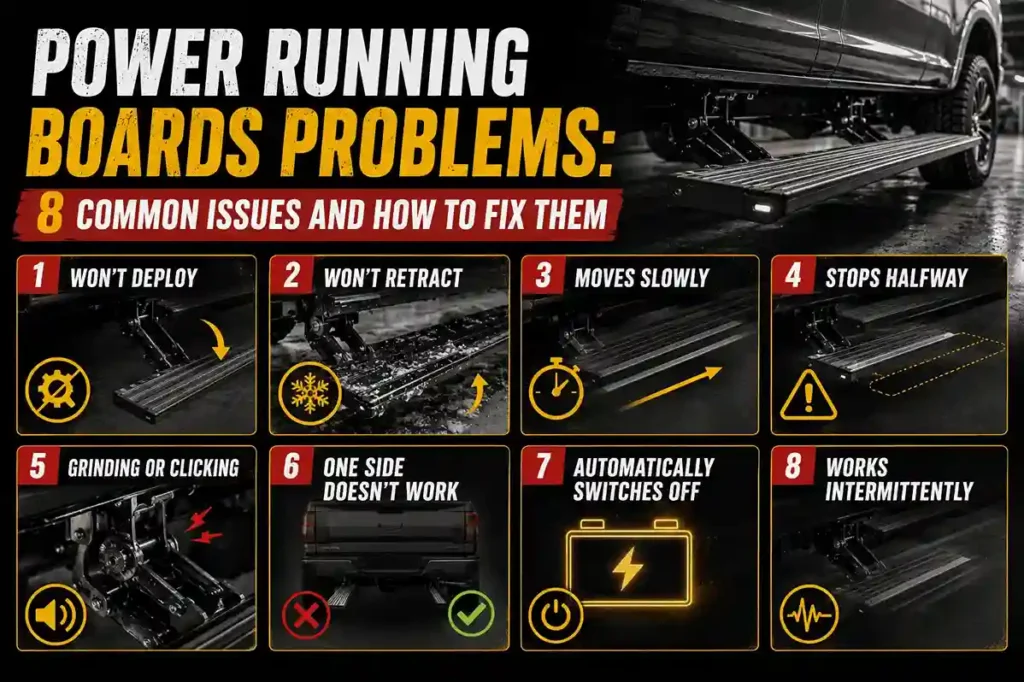
Power Running Boards Problems can make it hard to enter or exit a truck or SUV. Power running boards make daily use easier and give lifted trucks a clean, modern look. However, these systems can develop electrical, mechanical, or sensor problems over time. Mud, road salt, water, and daily use can affect motors, hinges, wiring, and other parts.
These problems can appear in several ways. The boards may not deploy, may not retract, may move slowly, stop halfway, make unusual noises, or work on only one side. Some power running board issues can be diagnosed with basic checks, such as inspecting the fuse, removing debris, and checking visible wiring before you replace expensive parts.
This guide covers 8 common power running board issues, practical troubleshooting steps, vehicle-specific problems, and signs that show when replacement makes more sense than repair.
Why Are My Power Running Boards Not Working?
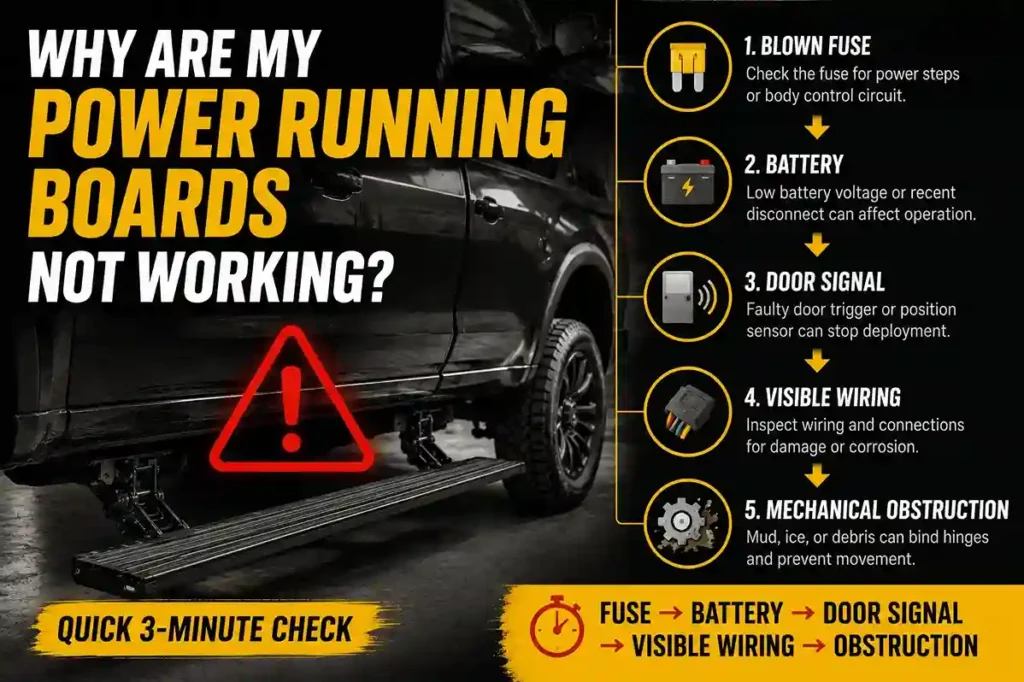
When power running boards suddenly stop working, the cause can be simpler than expected. A low battery, control issue, bad door signal, blown fuse, mechanical blockage, or failed motor can stop the boards from moving. Start with basic checks before testing or replacing major parts.
1. Low Battery Voltage or Recent Battery Disconnect
Low battery voltage can interrupt power running board operation on some vehicles. A recent battery disconnect or recharge can also affect the system during its first operating cycle.
Toyota owner information notes that power running boards may operate abnormally on the first cycle after battery reconnection or charging, then return to normal operation. If your battery was recently disconnected, allow the system to complete a normal cycle before assuming a part has failed.
2. Control Module or System Communication Issue
Modern power running boards use electronic controls to respond to door and vehicle signals. Depending on the vehicle and running board system, a control module may process door status, ignition status, and vehicle speed.
A communication or control glitch can stop the board from deploying or retracting even when the motor and mechanical parts look normal. If basic power and wiring checks pass, the control system may need further diagnosis.
3. Door Trigger or Position Sensor Problem
Depending on the vehicle and running board system, door signals or position sensors tell the control system when to deploy or retract the board. A problem with these signals can stop the system from receiving the expected command.
Dirt, corrosion, damaged wiring, or a faulty sensor can cause this issue. Check the visible sensor area and wiring for damage or contamination before moving to advanced testing.
4. Blown Fuse
A blown fuse cuts power to the running board circuit. It is one of the easiest checks to make when the boards stop working suddenly.
Check the fuse box diagram in your owner’s manual. Look for the fuse labeled for power steps, running boards, or the related body-control circuit. Replace the fuse only with the specified amperage.
5. Mechanical Binding
Mud, road salt, snow, ice, and other debris can restrict running board movement. Corrosion can also affect hinges and linkages.
Hinges and linkages can seize when they collect mud, salt, or ice. This creates extra resistance that the motor may not overcome. Toyota owner information also warns that snow, mud, and ice can prevent power running boards from operating normally.
6. Motor or Actuator Failure
The motor or actuator moves the running board through its deploy and retract cycles. When the fuse, wiring, door signal, and mechanical movement all check out, the motor itself may require further testing.
Listen for motor activity when the door opens or closes. A complete lack of movement or an unusual motor sound can help a technician identify the fault. The motor or actuator may need repair or replacement if testing confirms a failure.
Quick 3-Minute Check
Start with these five checks before moving to advanced diagnosis:
Fuse → Battery → Door signal → Visible wiring → Mechanical obstruction
Power Running Board Troubleshooting: Find the Problem by Symptom
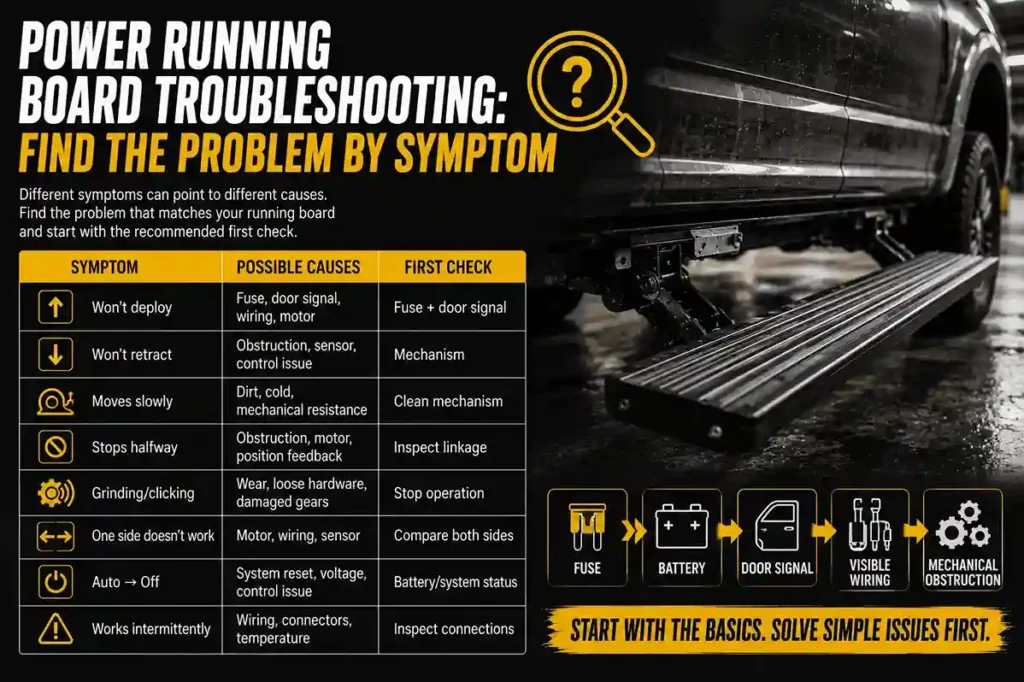
Different symptoms can point to different causes. Use the table below to find the problem that matches your running board and start with the recommended first check. This approach can help you find simple faults before you move to advanced diagnosis.
| Symptom | Possible Causes | First Check |
|---|---|---|
| Won’t deploy | Fuse, door signal, wiring, motor | Fuse + door signal |
| Won’t retract | Obstruction, sensor, control issue | Mechanism |
| Moves slowly | Dirt, cold, mechanical resistance | Clean mechanism |
| Stops halfway | Obstruction, motor, position feedback | Inspect linkage |
| Grinding/clicking | Wear, loose hardware, damaged gears | Stop operation |
| One side doesn’t work | Motor, wiring, sensor | Compare both sides |
| Auto → Off | System reset, voltage, control issue | Battery/system status |
| Works intermittently | Wiring, connectors, temperature | Inspect connections |
Won’t Deploy
If the board does not deploy, check the fuse first. Then verify that the door signal reaches the control system. If both checks are normal, inspect the visible wiring and motor power.
Won’t Retract
Look for mud, ice, snow, or debris around the hinges and linkage. Clean the mechanism and test the board again. Do not force the board if it remains stuck.
Moves Slowly
Cold weather can slow power running boards for a short time. Low temperatures can increase mechanical resistance and make some lubricants thicker. Ice, snow, and packed debris can also restrict movement.
FAQ: Why are power running boards slower in cold weather?
Low temperatures can increase resistance in moving parts. Ice, snow, dirt, and thicker lubricant can make the motor work harder. Clean the mechanism and follow the manufacturer’s instructions for lubrication.
Stops Halfway
A board that stops halfway may have an obstruction in the linkage. A weak motor or a position sensor problem can also stop the board before it reaches its full position.
Grinding or Clicking
Stop operating the board if you hear grinding or repeated clicking. These sounds can indicate worn parts, loose hardware, or damaged gears. Forcing the board can turn a small mechanical problem into a larger failure.
One Side Doesn’t Work
Compare the working side with the side that has stopped. A single-side failure can come from the motor, sensor, or wiring on that side.
FAQ: Why does only one side work?
The fault is often limited to one motor, sensor, or wiring harness. Compare the two sides and inspect the affected side for loose connections or visible damage.
Automatically Switches Off
Check the battery condition and think about any recent battery work. A voltage drop or system reset can affect automatic operation on some vehicles. Check the system status before replacing parts.
Works Intermittently
Intermittent operation can point to a wiring or connection problem. Inspect the wiring harness for chafing and check connectors for corrosion or loose contacts. If the problem changes with temperature, note when the failure occurs and use that information during diagnosis.
5 Steps to Troubleshoot Power Running Board Problems
Follow this systematic 5-step process to diagnose most power running board problems. Start with the simplest checks first. Basic electrical, sensor, and mechanical inspections can often identify the cause without specialized tools or advanced diagnosis. Work through each step in order, then test the running boards again before replacing any parts.
1. Check the Fuse
A blown fuse is the fastest check. Use the fuse diagram in your owner’s manual to locate the fuse labeled for power steps, running boards, or the related body-control circuit. Remove the fuse and inspect the metal strip inside. If the strip is broken, replace the fuse with one that has the exact specified amperage. Do not install a higher-rated fuse, as this can create an electrical safety risk.
2. Check the Door Signal and Sensors
Door trigger or position sensors can stick because of mud, dirt, or corrosion. Locate the relevant switches or sensors around the door jamb and inspect them for visible contamination or damage. If the system uses a physical door switch, press it gently with your finger to make sure it moves freely. You can clean accessible contacts with a dry cloth or an appropriate electrical contact cleaner, following the manufacturer’s instructions.
3. Check the Battery and Recent Battery Work
Power running boards depend on stable vehicle voltage. Check the battery condition and voltage before moving to more advanced diagnosis. If the battery was recently disconnected, replaced, or recharged, the running board system may need to complete a normal operating cycle before it works correctly. Some systems may reset after a battery disconnect, but the procedure varies by vehicle.
4. Inspect Wiring and Connectors
Wiring under the vehicle is exposed to rocks, mud, water, and road salt. Inspect the wiring harness along the rocker panel and underneath the running boards for damaged insulation, loose wires, or signs of corrosion. Check accessible connectors for moisture, dirt, or corroded terminals. If a wire is damaged, avoid simply twisting it back together; use the repair method specified for the vehicle or running board system.
5. Test the Running Boards Again
After completing the basic checks, test the system multiple times. Open and close the relevant doors and confirm that the running boards deploy and retract smoothly and fully. If the problem remains, check the vehicle-specific service information for diagnostic procedures, fault codes, or system reset instructions before replacing the motor, control module, or other major components.
Safety Note: The exact reset procedure varies by vehicle and running board system. Always check the manufacturer’s instructions before disconnecting the battery or changing electrical components.
Common Power Running Board Problems by Vehicle
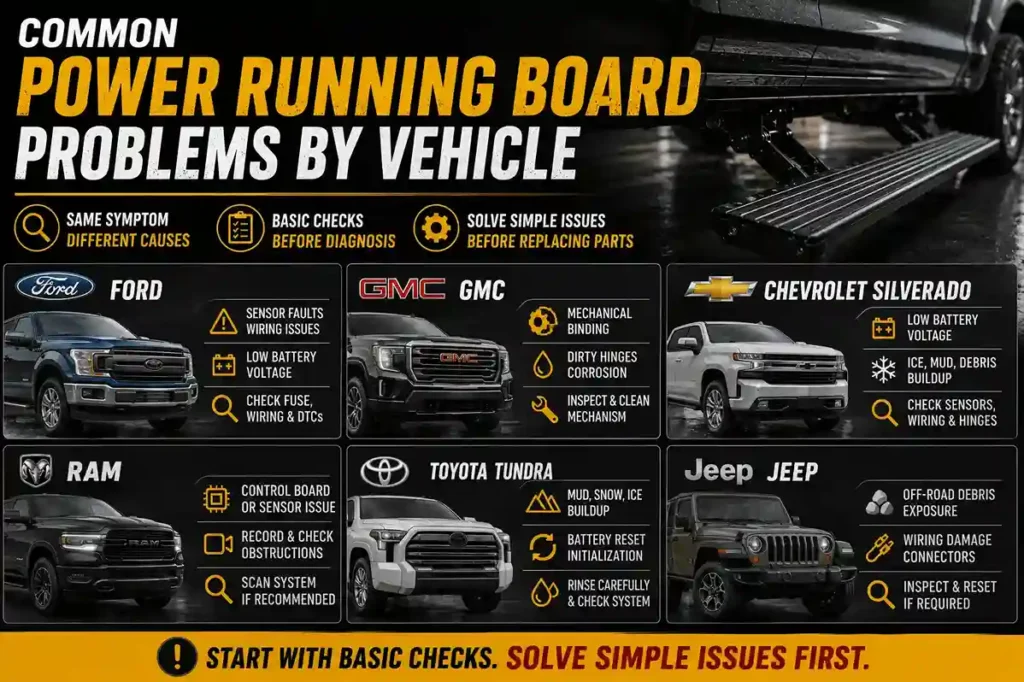
Different vehicles use different power running board designs, control systems, and sensor layouts. As a result, the same symptom can have different causes depending on the vehicle. The following sections cover common symptoms on Ford, GMC, Chevrolet Silverado, RAM, Toyota Tundra, and Jeep models, along with basic checks you can perform before advanced diagnosis.
Ford Power Running Board Problems
Ford trucks with power deployable running boards can develop electrical, sensor, and control-related issues. These problems may appear as intermittent deployment, one side that will not retract, or a system that stops automatic operation. A Ford F-150 power running board troubleshooting discussion provides a real-world example of how sensor faults, wiring issues, and other electrical problems can affect operation.
- Possible causes: Hall-effect sensor faults, a GWM reset, low battery voltage, or Battery Saver mode can affect operation on some Ford models.
- Basic checks: Check the battery condition, inspect visible wiring, and look for diagnostic trouble codes (DTCs). Ford service information may identify specific fuses or Hall-effect sensor-related DTCs, but the fuse number and code depend on the model year and running board system.
- When to seek help: Professional diagnosis is recommended if a DTC remains, wiring is damaged, or the motor receives no voltage.
These checks can help narrow down Ford power running board problems before parts are replaced.
GMC Power Running Board Problems
GMC trucks can use power running boards with electric motors, hinges, linkages, and electronic controls. Common symptoms include slow deployment, grinding sounds, or one side becoming stuck.
- Possible causes: Mechanical binding, incorrect installation, dirty hinges, or motor wear can restrict movement.
- Basic checks: Inspect the hinges and linkage for mud, corrosion, or physical damage. Clean the mechanism and use the lubricant specified by the running board manufacturer. If the system was recently installed, also check the mounting position and wiring.
- When to seek help: Persistent grinding, damaged linkage, or a suspected control module fault requires further diagnosis.
For gmc power running board problems, avoid repeatedly operating a board that makes a strong grinding noise. Continued use can increase mechanical damage.
Chevy Silverado Power Running Board Problems
Chevy Silverado models can use different power running board and control configurations depending on the model year and equipment. Common symptoms include failure to deploy, intermittent operation, and slower movement in cold weather.
- Possible causes: Low battery voltage, corroded door sensors, ice, mud, or debris around the mechanism can affect operation.
- Basic checks: Check the battery condition first. Then inspect accessible door sensors, wiring, hinges, and linkages. Remove dirt or debris before testing the system again.
- When to seek help: If the motor does not respond, a DTC is present, or the wiring harness is damaged, further electrical diagnosis may be needed.
These steps can help identify the cause of Chevrolet power running board problems before replacing the motor or control components.
RAM Power Running Board Problems
RAM trucks equipped with OEM power running boards may show intermittent deployment, slow retraction, or an obstruction warning even when no obvious object blocks the board.
- Possible causes: A control board issue, dirt around the hinges, sensor feedback problems, or motor failure can cause these symptoms.
- Basic checks: Record a short video when the problem occurs, especially if the fault is intermittent. Check for visible obstructions and use a diagnostic scan when vehicle-specific service information recommends it.
- When to seek help: If a dealer cannot reproduce the fault, provide the recorded symptoms and scan results. A technical escalation may be needed when the problem continues without an obvious mechanical cause.
For ram power running board problems, documenting when and how the fault occurs can make intermittent issues easier to diagnose.
Toyota Tundra Power Running Board Problems
Toyota Tundra power running boards need extra attention after off-road driving because mud, snow, and ice can build up around the mechanism. Common symptoms include one side failing to retract, slow movement, or binding after driving on rough or muddy roads. For vehicle-specific operating information and precautions, see the Toyota Tundra Owner’s Manual.
- Possible causes: Debris in the linkage, an initialization issue after battery work, or sensor misalignment can affect operation.
- Basic checks: Carefully rinse the underside and running board mechanism to remove mud and debris. Avoid directing high-pressure water at the motor, electrical connectors, or wiring.
- Toyota guidance: Toyota owner information states that snow, mud, and ice can prevent normal operation. After battery reconnection, the first operation may be abnormal. On applicable systems, the boards automatically stow at approximately 3 mph (5 km/h).
- When to seek help: Persistent binding, no motor voltage, or a stored DTC requires further diagnosis.
Jeep Power Running Board Problems
Jeep vehicles with power running boards can face additional exposure to mud, rocks, water, and other debris during off-road driving. Common symptoms include intermittent operation, slow movement, and unusual noise.
- Possible causes: Off-road debris, wiring harness chafing, damaged connectors, or a control module issue can interrupt operation.
- Basic checks: Inspect the mechanism and wiring after off-road use. Rinse the motor area carefully without directing high-pressure water at electrical components. Follow the vehicle or running board manufacturer’s reset procedure if required.
- When to seek help: Stop testing if the board produces grinding noise, stalls under load, or shows visible wiring damage.
For jeep power running board problems, regular inspection after off-road driving can help catch debris and wiring damage before they cause a complete failure.
AMP Research Power Running Boards Problems
AMP Research power running boards are widely used on trucks and SUVs, but they can develop issues related to installation, wiring, initialization, sensors, and mechanical resistance. The exact cause depends on the vehicle, PowerStep model, and installation setup. Before replacing parts, check the system according to the instructions for the specific application.
Installation-Related Binding
Incorrect bracket positioning or linkage alignment can prevent the running board from moving through its full range. A board may deploy partway, sit unevenly, or feel restricted during movement. Check the installation for visible alignment issues and make sure the linkage can move without interference.
Motor Initialization Issues
After linkage adjustments or other service work, the motor system may need to be reinitialized on some AMP Research applications. An initialization issue can cause the step to stop before reaching its normal position or make one side behave differently from the other. Follow the installation or service instructions for the exact PowerStep model rather than using a generic reset procedure.
Wiring and Connectors
The wiring harness runs close to the vehicle body and mounting points, where movement and road debris can cause wear. Inspect the harness for chafing, damaged insulation, loose connectors, or poorly seated terminals. Pay particular attention to areas around brackets and connectors underneath the vehicle. A real-world AMP Research case involving power running boards problems also shows why switches, wiring, and power connections should be checked before replacing major components.
Sensor Alignment
Door signals and position feedback help the running board system determine when and where the step should move. If a sensor or trigger is misaligned, the board may deploy or retract inconsistently. Check the sensor position and wiring according to the instructions for the specific vehicle and AMP Research system.
Cold-Weather Operation
Cold temperatures can increase mechanical resistance and make a running board move more slowly. Snow and ice can also collect around the linkage and restrict movement. Keep the mechanism clean and use only the lubricant recommended for the specific AMP Research system. Do not force a frozen or restricted board to move.
Obstructions
Mud, rocks, ice, and other debris can collect around the linkage and hinge areas, especially after off-road driving. Inspect the mechanism regularly and remove buildup before testing the board. If the running board remains stuck after cleaning, further inspection may be needed instead of repeatedly cycling the motor.
Key Tip
AMP Research power running boards problems can result from installation, wiring, mechanical resistance, sensor alignment, or system initialization. The exact vehicle and PowerStep model should be identified before replacing components. Always follow the official AMP Research installation and troubleshooting instructions for the specific application, especially when checking wiring or performing system initialization.
How to Prevent Power Running Board Problems
Regular maintenance can prevent many common power running board problems before they develop. Simple cleaning, wiring checks, sensor care, battery maintenance, and proper lubrication can reduce unnecessary wear and help keep the system working smoothly. These checks are especially useful for trucks that are often driven off-road or in wet, muddy, or snowy conditions.
1. Clean Mud and Debris After Off-Road Driving
Mud, rocks, and other debris can collect around hinges, linkages, and motor areas. This buildup can increase mechanical resistance and accelerate wear over time. After off-road trips, rinse the underside and running board mechanism carefully to remove loose dirt and debris.
2. Inspect Wiring and Connectors
Check the wiring harness along the rocker panel and underneath the vehicle for chafing, damaged insulation, corrosion, or loose connectors. Road debris, water, and road salt can affect exposed connections. Catching wiring damage early can help prevent intermittent operation or a complete electrical failure.
3. Keep Door-Related Sensors Clean
Door trigger and position sensors can collect dirt, road salt, or moisture and may stop working correctly. Inspect accessible sensors and switches regularly, especially if the vehicle is frequently driven on dusty or muddy roads. Clean them carefully according to the vehicle or running board manufacturer’s instructions.
4. Avoid Leaving the Vehicle With a Weak Battery
Low battery voltage can interrupt running board operation and cause unusual electrical behavior. Check the battery condition if the vehicle has been sitting for a long time or shows signs of weak starting. If the vehicle will remain unused for several weeks, a suitable battery maintainer can help keep the battery charged.
5. Lubricate Moving Parts According to the Manufacturer’s Instructions
Hinges, pivot points, and other moving parts may need periodic lubrication to maintain smooth movement. Use only the lubricant recommended in your owner’s manual or running board instructions. Avoid choosing a product based only on general automotive advice because different systems may require different lubricants.
When Should You Stop DIY Troubleshooting?
Basic checks can solve some power running board problems, but certain symptoms require professional diagnosis. Continuing to test a damaged system can make the problem worse. Stop DIY troubleshooting if you encounter any of the following situations.
Stop DIY Troubleshooting If:
- You see a running-board-related DTC: A diagnostic trouble code may point to an electrical, sensor, or control issue. Check the exact code in the vehicle’s service information.
- The motor receives no expected power: If voltage testing shows no power at the motor harness, the problem may be in the fuse, wiring, or control module.
- You hear grinding or repeated clicking: These sounds can indicate mechanical damage or excessive resistance. Stop operating the board to avoid further damage.
- One side remains inoperative after basic checks: If the fuse, sensors, and visible wiring check out, the motor, sensor, or control system may need professional testing.
- Wiring or connectors are damaged: Frayed wires, broken insulation, or corroded terminals require proper electrical repair. Do not rely on tape as a permanent fix.
- The reset procedure does not solve the problem: If the recommended reset does not restore normal operation, use vehicle-specific diagnostic information or seek professional help.
Important: Do not repeatedly force a stuck running board to move. Continued operation can turn a simple obstruction or electrical issue into a larger mechanical failure.
Typical Power Running Board Repair Costs
Understanding typical repair costs can help you decide whether to fix the problem yourself, visit an independent shop, or use a dealer. The final price depends on the vehicle, running board brand, replacement parts, labor rates, and your location. A simple fuse or cleaning issue can cost much less than a motor or complete system replacement.
General Cost Estimates
The following figures are general estimates for comparison. DIY costs usually cover parts or basic supplies, while shop and dealer prices can include diagnosis, labor, and installation.
| Repair Item | DIY | Independent Shop | Dealer |
|---|---|---|---|
| Fuse replacement | $10–20 | $30–50 | $50–100 |
| Cleaning and lubrication | $30–50 | $50–100 | $100–200 |
| Door sensor replacement | $50–100 | $150–250 | $300–500 |
| Motor replacement | $250–400 | $400–700 | $700–1,500 |
| Control module replacement | $150–300 | $400–600 | $800–1,200 |
| Complete system replacement | $800–1,500 | $1,500–2,500 | $2,500–4,000 |
Important Cost Disclaimer
These figures are general estimates, not fixed industry prices. Power Running Board Repair Costs can vary widely based on vehicle model, running board brand, parts availability, labor rates, and location. OEM systems and aftermarket systems may also use different parts and repair procedures.
In many cases, early diagnosis can save money. A stuck board caused by mud, a loose connector, or a blown fuse may only require a simple fix. Replacing the motor or control module before checking these basic causes can add unnecessary expense. If the board has severe mechanical damage or repeated electrical failures, compare the repair cost with the price of a new running board system.
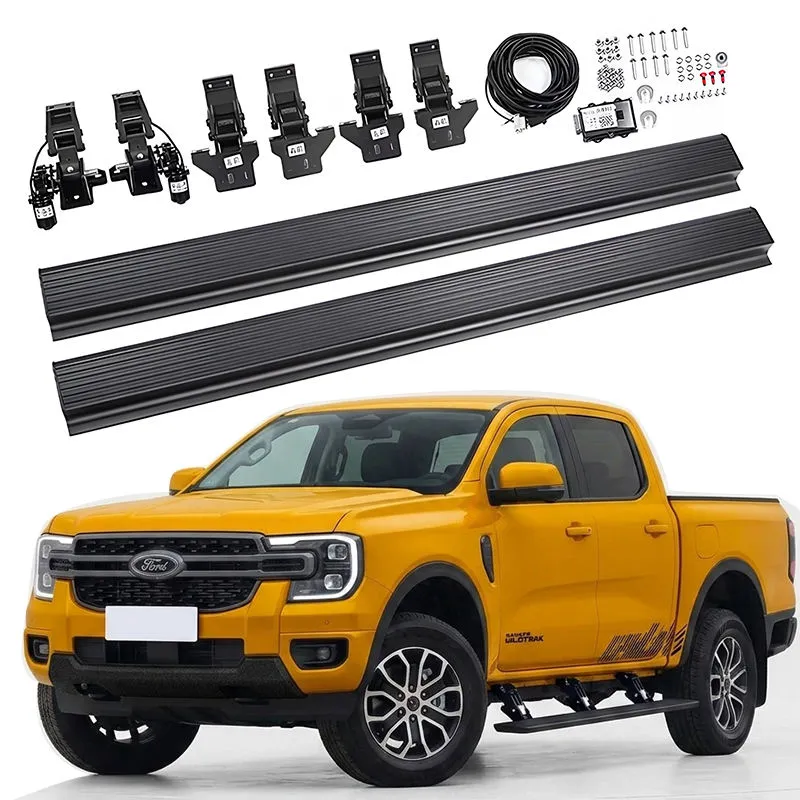
Looking for a Reliable Replacement? Meet MAX Power Running Boards
If your power running boards fail repeatedly or repair costs are close to the price of a new system, replacement may be the more practical option. MAX Power Running Boards provide vehicle-specific fitment, tested durability, and flexible OEM and ODM support for distributors, dealers, and automotive brands.
When Does Replacement Make More Sense?
Repair is not always the best long-term option. Replacement can make more sense when the same failure keeps returning or the existing assembly has major damage.
- Repeated motor failures: Multiple motor replacements may indicate deeper mechanical or electrical problems in the system.
- Repeated electrical problems: Recurring wiring, connector, sensor, or control module failures can make continued repairs costly.
- Expensive repair quotes: If repair costs approach 50% or more of a comparable new system, replacement may offer better long-term value.
- Discontinued replacement parts: Older running boards may use motors, sensors, or control modules that are difficult to source.
- Damaged running board assembly: Bent boards, damaged linkages, broken brackets, or severe corrosion can make repair less practical.
Why Consider MAX Power Running Boards?
MAX Power Running Boards are developed for SUVs and pickup trucks and support vehicle-specific applications across major brands, including Ford, GMC, Chevrolet, RAM, Toyota, Nissan, and Jeep.
- Vehicle-specific fitment: Mounting brackets and board configurations are developed for specific vehicle applications.
- MAX motor: MAX uses motors from established suppliers for power running board applications.
- IPX67-rated motor component protection: The motor components are built for protection against water and dust exposure.
- 80,000-cycle durability testing: MAX systems undergo cycle testing to evaluate long-term operating durability.
- 500-hour salt spray testing: Corrosion resistance is evaluated through a 500-hour salt spray test.
- 300kg+ tested load: Running board systems are tested with loads above 300kg.
- 2-year warranty: Warranty coverage supports long-term use and after-sales service.
- OEM & ODM support: MAX can support custom designs, vehicle applications, and manufacturing requirements.
- MOQ from 1 set: Flexible order quantities make the products suitable for samples, replacement projects, and larger orders.
Explore MAX Power Running Boards by Vehicle
Choose the vehicle-specific page below to review available applications and product information:
- Toyota Power Running Boards
- Ford Power Running Boards
- RAM Power Running Boards
- GMC Power Running Boards
- Chevrolet Power Running Boards
- Nissan Power Running Boards
- Jeep Power Running Boards
- Mitsubishi Power Running Boards
Conclusion
Power running board problems can come from simple issues such as a weak battery, blown fuse, dirt, or loose wiring. Other failures may involve sensors, motors, control modules, or damaged mechanical components. Start with basic troubleshooting before replacing expensive parts, and stop DIY repairs when you find damaged wiring, persistent diagnostic codes, grinding noises, or repeated motor failures.
Repair can be a good choice when the problem is simple and the main components are still in good condition. However, replacement may make more sense when failures happen repeatedly, replacement parts are difficult to find, or repair costs become close to the price of a new system. Choosing a vehicle-specific replacement can also help avoid fitment and installation problems.
If your running boards have repeated failures or major damage, replacement may be more practical than continued repairs. Choose a system that matches your vehicle model and installation requirements.
MAX Running Boards offers vehicle-specific power running boards for Ford, GMC, Chevrolet, RAM, Toyota, Nissan, Jeep, and other popular vehicles. OEM and ODM support is also available, with MOQ starting from 1 set and a 2-year warranty.
Need to check a replacement for your vehicle? Contact MAX Running Boards for fitment, specifications, OEM/ODM projects, or wholesale inquiries.
Related Articles
If you are dealing with power running board issues, it also helps to understand proper installation, compare different running board options, and know what to look for before making a purchase. Explore these related guides:
