

How do power running boards work? These automatic steps extend when a vehicle door opens and retract when the door closes. The system uses electric motors, control modules, sensors, and vehicle signals to control each movement.
Many truck and SUV owners see their power running boards move every day but do not know what happens behind the scenes. The motor creates the movement, the control module manages the operation, and sensors help the system respond at the right time.
In this guide, we will explain how power running boards operate, what components make them work, how different control systems compare, and what factors affect their reliability. Whether you are choosing electric running boards, electric side steps, or retractable running boards for your vehicle, this article will help you understand the complete working process.
What are power running boards?
Power running boards are motorized side steps installed on trucks and SUVs. They use an electric motor and control system to move automatically. When a vehicle door opens, the step extends to help passengers enter and exit the vehicle. When the door closes, the step retracts under the vehicle.
Unlike traditional fixed running boards, power running boards respond to vehicle signals and adjust their position automatically. This retractable design keeps the step hidden while driving and provides a clean look for the vehicle.
Power Running Boards vs Fixed Running Boards
Power running boards and fixed running boards both provide a step for trucks and SUVs. The main difference is how they move, how they affect ground clearance, and how they connect with the vehicle.For a more detailed comparison of features, installation, and real-world use cases, see our guide on Power Running Boards vs Side Steps
| คุณสมบัติ | บันไดข้างแบบไฟฟ้า | บันไดข้างแบบติดตาย |
|---|---|---|
| การติดตั้ง | Automatic, door-triggered operation | Always deployed |
| ระยะห่างจากพื้น | Retracts under the vehicle when driving | Stays exposed below the vehicle |
| การติดตั้ง | Medium difficulty, requires wiring and vehicle connection | Simple bolt-on installation |
| Price range | Usually $800 and above | Around $100–$400 |
| เหมาะที่สุดสำหรับ | Trucks, SUVs, off-road vehicles, and vehicles needing automatic access | Daily vehicles and simple step solutions |
The price difference mainly comes from the extra components used in power running boards. Electric models need motors, sensors, control modules, and wiring systems to manage automatic movement. Fixed running boards use a simple metal structure without electrical parts.
For example, a set of power running boards for a truck includes a motor that drives the step, a control module that processes vehicle signals, and a linkage system that controls extension and retraction. Fixed running boards only provide a permanent stepping surface.
Both options solve the same basic problem, but they use different designs. Power running boards focus on automatic operation and retractable movement, while fixed running boards focus on simple structure and lower cost.
แผ่นก้าวขึ้นลงแบบไฟฟ้าทำงานอย่างไร?
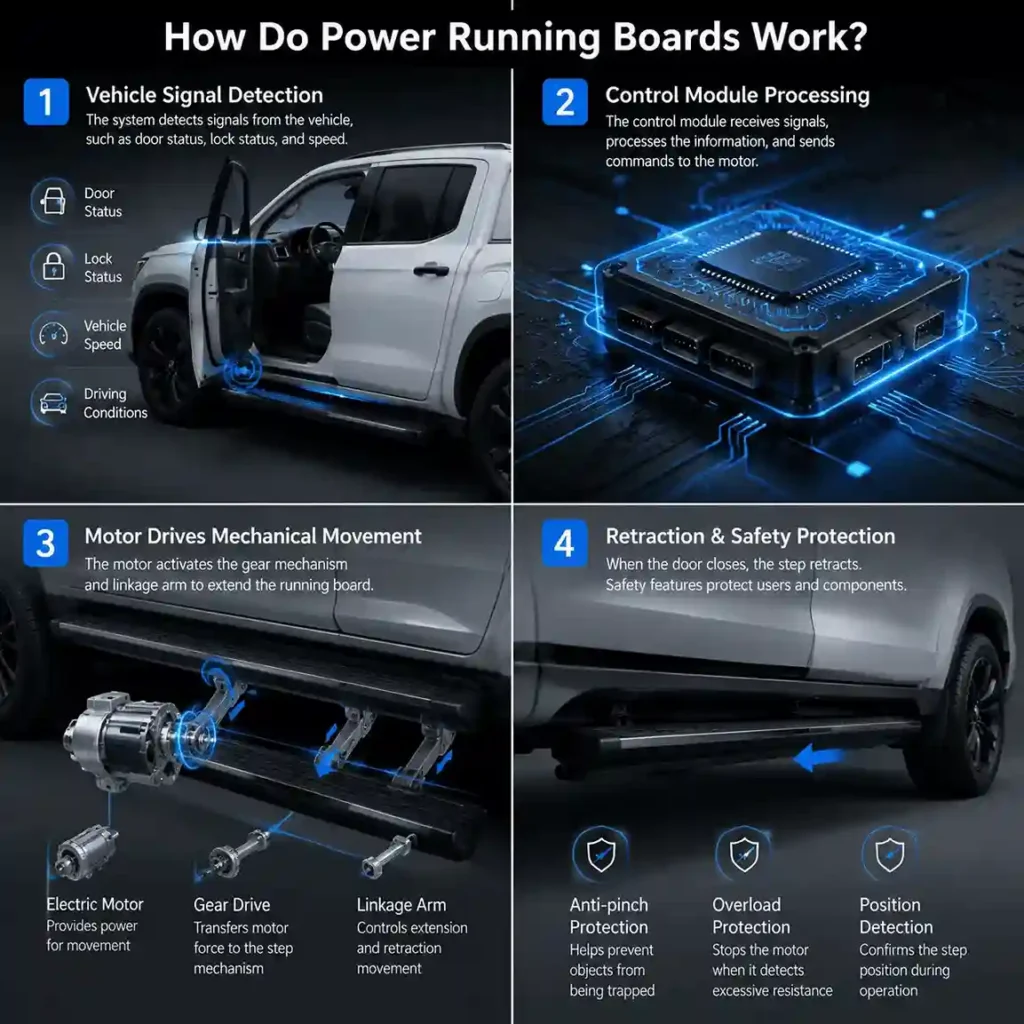
Power running boards work through a combination of vehicle signals, electronic controls, and mechanical movement. When a driver opens a door, the system detects the signal, processes the information, and activates the motor to move the step into position.
The complete process includes signal detection, control module operation, motor movement, and safety protection.
Step 1: Vehicle Signal Detection
The first step starts when the vehicle sends a signal to the running board system. The system needs to know the vehicle status before it moves.
It checks information such as:
- Door opened or closed status
- Vehicle lock status
- Vehicle speed
- Driving conditions
Power running boards receive signals from different vehicle systems, including:
- Door trigger signals
- OBD-II communication
- Body Control Module (BCM)
- CAN-BUS system
For example, when a driver opens the door, the door sensor sends a signal to the running board control system. The system then prepares the step for deployment.
Step 2: Control Module Processing
The control module acts as the brain of the power running board system. It receives vehicle signals and decides when the motor should operate.
The control module performs several functions:
- Receives signals from the vehicle
- Checks current vehicle status
- Sends commands to the motor
- Activates safety functions
The control module helps the system respond at the correct time. It prevents unnecessary movement and helps the running board work smoothly during daily use.
Step 3: Motor Drives Mechanical Movement
After the control module sends a command, the electric motor starts the movement process.
The basic operation follows this path:
Signal → Control Module → Motor → Gear Mechanism → Running Board Extends
The main movement parts include:
| ส่วนประกอบ | Function |
|---|---|
| มอเตอร์ไฟฟ้า | Provides power for movement |
| Gear drive | Transfers motor force to the step mechanism |
| Linkage arm | Controls extension and retraction movement |
The motor turns the gear system, and the linkage arms push the running board outward. This allows the step to extend from under the vehicle and provide access for passengers.
Step 4: Retraction and Safety Protection
When the vehicle door closes, the control module sends another signal to retract the step. The motor changes direction and pulls the running board back under the rocker panel.
The system also includes safety features to protect users and components.
Common safety functions include:
| Safety Feature | Function |
|---|---|
| Anti-pinch protection | Helps prevent objects from being trapped during movement |
| Overload protection | Stops the motor when it detects excessive resistance |
| Position detection | Confirms the step position during operation |
This complete process allows power running boards to provide automatic extension and retraction while maintaining safe and reliable operation. The same working principle applies to many electric running boards, electric side steps, and retractable running board systems used on trucks and SUVs.
Main Components of a Power Running Board System
A power running board system uses several components that work together to control movement. The electronic parts manage signals and operation, while the mechanical parts support movement and load capacity.
Understanding these components helps explain why different power running boards have different prices and performance levels.
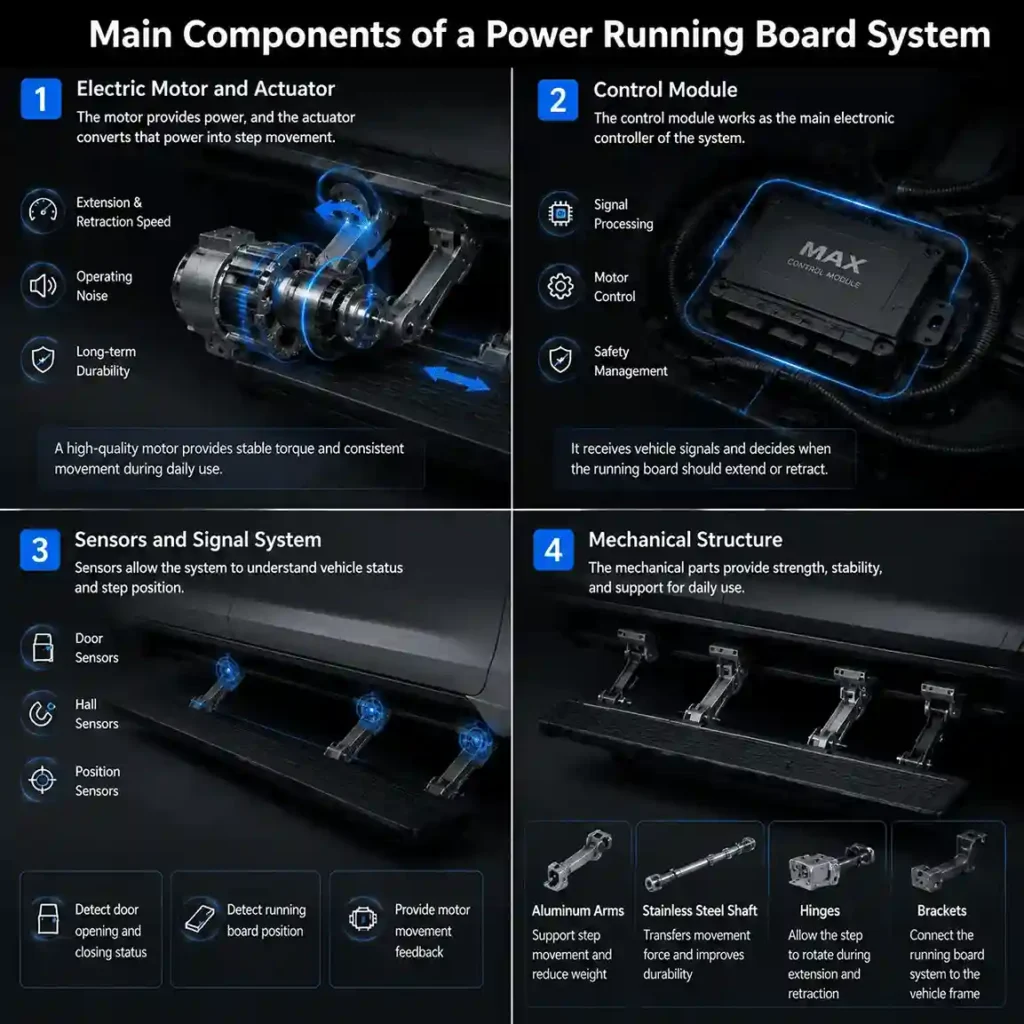
Electric Motor and Actuator
The electric motor and actuator create the movement of the running board. The motor provides the power, and the actuator converts that power into step movement.
The motor affects several key factors:
- Extension and retraction speed
- Operating noise
- Long-term durability
A high-quality motor provides stable torque and consistent movement during daily use. Power running boards for trucks often need stronger motors because they support larger vehicle sizes and frequent operation.
Control Module
The running board control module works as the main electronic controller of the system. It processes vehicle signals and controls motor operation.
The control module manages:
- Signal processing
- Motor control
- Safety management
It receives information from the vehicle and decides when the running board should extend or retract. A reliable control module helps the system respond correctly in different driving conditions.
Sensors and Signal System
Sensors allow the running board system to understand the vehicle status and step position.
Common sensors include:
- เซ็นเซอร์ประตู
- Hall sensors
- Position sensors
These sensors detect:
- Door opening and closing status
- Running board position
- Motor movement feedback
For example, position sensors help the control system know whether the step has fully extended or returned to its original position.
Mechanical Structure
The mechanical structure supports the physical movement and load of the running board. While the electronic system controls the operation, the mechanical parts provide strength and stability.
Common mechanical components include:
| ส่วนประกอบ | Function |
|---|---|
| Aluminum arms | Support step movement and reduce weight |
| Stainless steel shaft | Transfers movement force and improves durability |
| Hinges | Allow the step to rotate during extension and retraction |
| วงเล็บ | Connect the running board system to the vehicle frame |
A strong mechanical design helps the running board handle repeated use and daily loads. This is why materials, structure, and manufacturing quality can create differences between different power running board systems.
Different Power Running Board Control Systems Explained
The control system allows a power running board to communicate with the vehicle. It receives vehicle signals and tells the running board when to extend or retract. Different vehicles need different control methods because their electronic systems, model years, and installation requirements are different.
Modern vehicles usually use advanced electronic communication systems, while older trucks and SUVs may use simpler signal methods. OEM-style running boards and aftermarket systems can also use different solutions based on how they connect with the vehicle.
Common power running board control systems include door trigger control, OBD-II control, BCM control, CAN-BUS control, and magnetic sensor control. Each system has its own working method, advantages, and suitable applications.
Door Trigger Control
Door trigger control is one of the simplest methods used to operate power running boards. It works by reading the vehicle door switch signal and sending that information to the running board controller.
ขั้นตอนพื้นฐานคือ:
Door opens → Signal sent → Controller activates motor → Step deploys
When the door opens, the door switch sends a signal to the controller. The controller then activates the motor, and the running board extends from under the vehicle. When the door closes, the system sends the reverse command, and the step retracts.
This control method does not require advanced vehicle communication systems. It works well for vehicles that do not have modern CAN-BUS networks or accessible OBD communication.
Best Application Example: Older Trucks and SUVs
Door trigger control is often used for older vehicles, classic trucks, and off-road models.
Examples include:
- Toyota Land Cruiser 80 Series
- Nissan Patrol Y60/Y61
- Older pickup trucks
For example, a customer wants to install electric running boards on a classic Toyota Land Cruiser 80 Series. Since the vehicle was built before modern vehicle communication systems became common, a door trigger system can provide automatic step operation without changing the original electronic structure.
Advantages
- Simple wiring
- Reliable operation
- Wide vehicle compatibility
Limitations
- Fewer smart functions compared with CAN-BUS systems
- Limited access to advanced vehicle information such as speed or factory communication data
Door trigger control remains a practical solution for older vehicles and custom installations because it provides automatic operation with a simple connection method.
OBD-II Control
OBD-II control uses the vehicle’s OBD-II port to communicate with the power running board system. Originally developed as an onboard diagnostic system for monitoring vehicle systems and storing diagnostic information, OBD-II provides a standardized interface for vehicle communication. OBD II Systems Fact Sheet – California Air Resources Board
Depending on the vehicle model and software support, the controller can access specific vehicle signals through the OBD-II connection and use this information to control step operation.
ขั้นตอนพื้นฐานคือ:
Vehicle data → OBD-II port → Controller processes signal → Motor activates → Step moves
The OBD-II system can read information such as:
- Door status
- Vehicle speed
- Lock signals
Compared with a door trigger system, OBD-II control can collect more vehicle information through a single connection. This makes the installation process easier because it reduces the need for multiple wire connections to the original vehicle system.
Best Application Example: Modern Aftermarket Installation
OBD-II control is commonly used for modern trucks and SUVs that support aftermarket upgrades.
Examples include:
- Ford Ranger
- โตโยต้า ฮิลักซ์
- RAM 1500
For customers who want a faster installation process, an OBD-II solution can provide a cleaner connection method without cutting factory wires. The installer connects the controller to the OBD-II port, and the system communicates with the vehicle through the existing interface.
Advantages
- Easy installation
- No cutting of factory wires
- Faster aftermarket installation
Limitations
- Depends on vehicle protocol availability
- Some vehicle functions may require specific software support
OBD-II control provides a convenient solution for many aftermarket electric running boards. It offers easier installation while maintaining communication with modern vehicle systems.
BCM Control
BCM control uses the vehicle’s Body Control Module (BCM) to communicate with the power running board system. The BCM is an important electronic module in modern vehicles that manages various body-related functions, including door locks, interior lighting, security systems, and other comfort features. automotive body control module (BCM)
In a power running board system, the controller can use BCM signals to detect vehicle actions, such as door opening and closing, and then send commands to the motor for step deployment or retraction.
ขั้นตอนพื้นฐานคือ:
Vehicle function → BCM receives signal → Running board controller processes data → Motor activates → Step moves
Power running boards can use BCM signals to understand vehicle actions, such as door opening and closing. The system then controls the motor based on the information from the vehicle’s original electronics.
Best Application Example: Premium SUV Integration
BCM control is commonly used for premium SUVs and vehicles that require factory-like integration.
Examples include:
- โตโยต้า แลนด์ครูเซอร์ 300
- Lexus LX600
- Range Rover
For premium vehicles, many owners expect the running board to work naturally with the vehicle. BCM integration allows the electric side steps to respond more like a factory-installed system because they communicate with the original vehicle electronics.
Advantages
- OEM-like operation
- Stable vehicle communication
- Better integration with factory functions
Limitations
- Requires vehicle-specific development
- Installation requires more technical knowledge
BCM control is a common solution for high-end vehicle applications because it allows power running boards to work closely with the vehicle’s original electronic system. This approach helps create a smoother experience for modern SUVs with advanced electronic architecture.
CAN-BUS Control
CAN-BUS control uses the vehicle’s Controller Area Network (CAN-BUS) to communicate with the power running board system. CAN-BUS allows different electronic modules inside a vehicle to exchange information through a shared communication network.
ขั้นตอนพื้นฐานคือ:
Vehicle modules communicate → CAN-BUS sends data → Running board controller reads signals → Motor activates → Step moves
Through CAN-BUS communication, power running boards can receive important vehicle information, including:
- Door status
- Vehicle speed
- Lock status
- Other vehicle signals
Compared with simple signal systems, CAN-BUS control can access more vehicle data. This allows the running board system to work closer with the original vehicle electronics.
Best Application Example: Classic and Customized Vehicles
Magnetic sensor control is useful for vehicles that do not have modern electronic communication systems.
Examples include:
- Toyota Land Cruiser 70 Series
- Toyota Land Cruiser 80 Series
- Ford F-150 (older generations)
- Modified off-road vehicles
Some classic off-road vehicles and older trucks do not have advanced electronic systems like modern SUVs. For these applications, magnetic sensors provide a flexible solution because the running board system can operate independently without relying on CAN-BUS communication.
Advantages
- Fast signal communication
- Advanced control functions
- Factory-level vehicle integration
Limitations
- Requires vehicle-specific development
- Higher technical requirements for installation and testing
CAN-BUS control provides a high level of communication between the vehicle and the running board system. It is often used for modern vehicles that need accurate signal control and better integration with factory electronics.
How Durable Are Power Running Boards?
Power running boards use electric motors and moving mechanical parts, so many truck owners want to know if they can handle daily use and harsh environments. The durability of a power running board depends on several factors, including waterproof protection, material quality, mechanical design, and factory testing.
At MAX Running Boards, we focus on these areas during product development. Each electric running board system needs reliable components to handle repeated operation, outdoor exposure, and different driving conditions.
Waterproof Protection
Water protection is an important factor for electric running boards because the system is installed under the vehicle and faces rain, mud, dust, and road water.
A durable system usually includes:
- Sealed motor housing
- Waterproof connectors
- Protected control modules
MAX Running Boards uses waterproof motor designs and sealed electrical connections to help protect internal components from moisture. Our electric running boards are tested for outdoor conditions to ensure stable operation during daily driving.
ความจุในการรับน้ำหนัก
The load capacity of a power running board depends on more than the step surface. The bracket design, material strength, and mechanical structure all affect how much weight the system can support.
ปัจจัยสำคัญ ได้แก่:
- Bracket structure
- Aluminum alloy platform strength
- Stainless steel shaft design
- Linkage system durability
MAX Running Boards tests our systems with high load conditions. Our running boards can support more than 300 kg during load testing, helping ensure stable performance for trucks and SUVs.
Material Selection
Material choice directly affects the service life of a running board system.
Common materials include:
| วัสดุ | Function |
|---|---|
| Aluminum alloy | Provides strength while reducing weight |
| Stainless steel components | Improves corrosion resistance and mechanical durability |
| Powder-coated metal parts | Adds surface protection |
MAX Running Boards uses aluminum alloy and stainless steel components in key areas. These materials help the system maintain strength while reducing the impact of outdoor conditions.
Testing for Long-Term Reliability
Manufacturers need testing to verify how a power running board performs over time. At MAX Running Boards, we use different tests to check product reliability.
| Test | Purpose |
|---|---|
| การทดสอบวงจร | Checks repeated extension and retraction performance |
| Salt spray testing | Evaluates corrosion resistance |
| Temperature testing | Checks performance in hot and cold environments |
| Noise testing | Measures motor operation sound |
Our testing process includes 80,000-cycle durability testing to simulate repeated daily use. We also perform salt spray testing and temperature tests to check performance under different conditions.
A well-built power running board can handle rain, dust, temperature changes, and frequent operation. The key is the combination of reliable electrical components, strong mechanical design, and strict factory testing. For this reason, MAX Running Boards focuses on every part of the system, from motor protection to final quality inspection.
Common Power Running Board Problems and Solutions
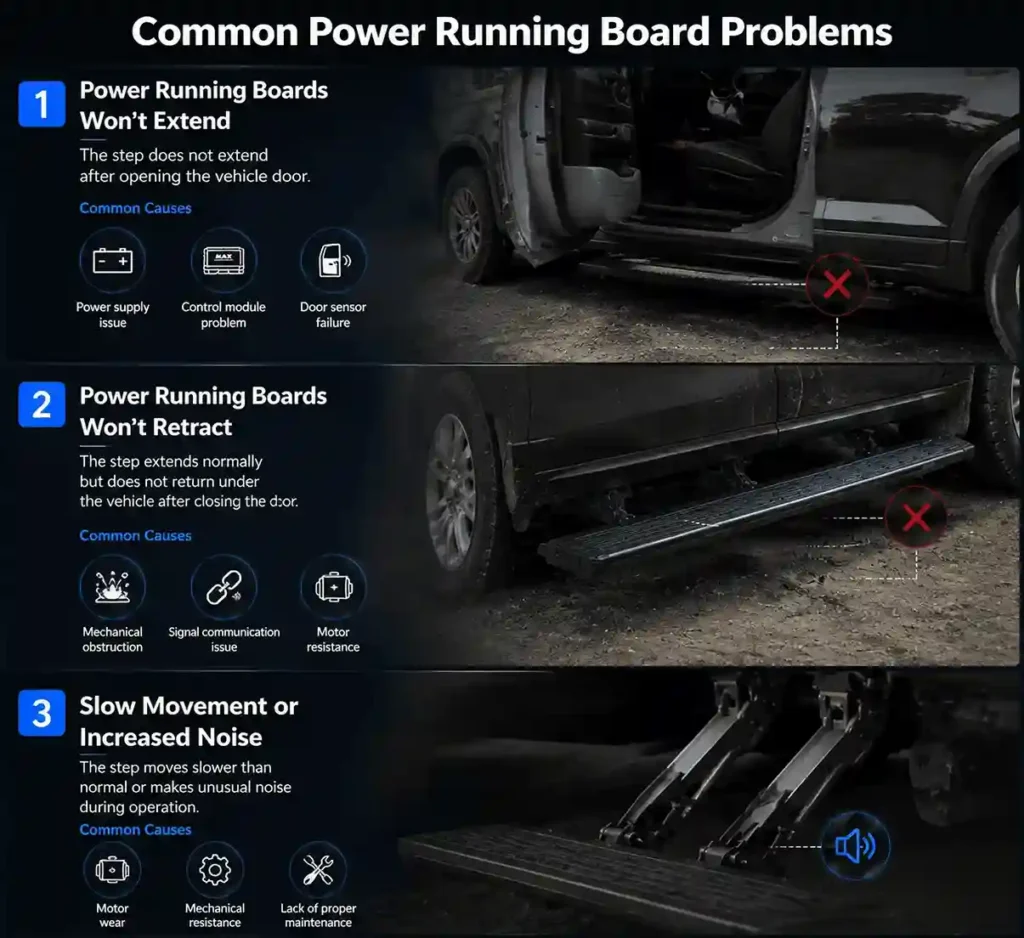
Power running boards use electrical components and moving mechanical parts to operate automatically. Like other vehicle accessories, they may experience problems after long-term use or under harsh driving conditions.
Most issues come from power supply problems, signal communication errors, sensor issues, or mechanical resistance. Understanding the common causes can help vehicle owners identify problems and find suitable solutions.
Problem 1: Power Running Boards Won’t Extend
When a power running board does not extend after opening the vehicle door, the system may have a problem with power supply, controller communication, or sensor detection.
Common causes include:
- Power supply issue
- Control module problem
- Door sensor failure
Possible solutions:
- Check the vehicle power connection and fuse
- Inspect the controller connection
- Check whether the door signal reaches the control system
- Verify sensor operation
The control module needs a correct signal before it activates the motor. If the system does not receive the door opening signal, the running board will stay in the retracted position.
Problem 2: Power Running Boards Won’t Retract
Sometimes the running board extends normally but does not return under the vehicle after closing the door.
Common causes include:
- Mechanical obstruction
- Signal communication issue
- Motor resistance
Possible solutions:
- Check for mud, ice, or objects blocking the movement path
- Inspect the linkage arms and brackets
- Check the door signal and controller operation
Because power running boards use moving mechanical parts, dirt and debris under the vehicle can affect smooth movement, especially in off-road environments.
Problem 3: Slow Movement or Increased Noise
A power running board may become slower or louder after extended use. This usually relates to motor performance or increased mechanical resistance.
Common causes include:
- Motor wear
- Mechanical resistance
- Lack of proper maintenance
Possible solutions:
- Check the motor condition
- Inspect moving joints and linkage parts
- Clean dirt or debris from the mechanism
- Check for unusual mechanical friction
A quality electric running board system should maintain stable movement after many operating cycles. At MAX Running Boards, durability testing helps identify potential issues before products reach customers, including repeated extension and retraction tests to check motor and mechanical performance.
Regular inspection and correct installation can help power running boards maintain reliable operation in different environments, including daily driving, off-road use, and changing weather conditions.
Finding the Right Power Running Boards for Your Truck
Choosing the right power running boards depends on your vehicle model, installation requirements, and electronic system. Different trucks and SUVs have different frame designs and signal systems, so a vehicle-specific running board solution helps achieve better fitment and stable operation.
At MAX Running Boards, we provide electric running board solutions for popular truck and SUV brands, including:
- บันไดข้าง Toyota Power — For models such as Toyota Land Cruiser, Tundra, Tacoma, Hilux, and 4Runner
- บันไดข้าง Nissan Power — For models such as Nissan Patrol, Navara, Frontier, and Armada
- บันไดข้าง Jeep Power — For models such as Jeep Wrangler, Gladiator, Grand Cherokee, and other Jeep SUVs
- บันไดข้าง RAM Power — For models such as RAM 1500, RAM 2500, and RAM 3500
- บันไดข้าง Ford Power — For models such as Ford F-150, F-250, F-350, Ranger, and Bronco
- บันไดข้าง GMC Power — For models such as GMC Sierra 1500, Sierra HD, Yukon, and other GMC SUVs
- บันไดข้าง Chevrolet Power — For models such as Chevrolet Silverado 1500, Silverado HD, Tahoe, and Suburban
- บันไดข้าง Mitsubishi Power — For models such as Mitsubishi Triton, Pajero, and other Mitsubishi SUVs
Finding the correct power running boards for your vehicle helps ensure proper installation, smooth automatic operation, and reliable performance.
สรุป
Power running boards work through a combination of sensors, control modules, motors, and mechanical structures. The system detects vehicle signals, controls the motor, and automatically extends or retracts the step.
A reliable power running board needs proper vehicle fitment, durable materials, waterproof protection, and strict testing. These factors help ensure stable performance for trucks and SUVs in daily driving and off-road conditions.
MAX Running Boards provides electric running board solutions for different vehicle models with OEM/ODM manufacturing support. ติดต่อเราวันนี้เลย to discuss your requirements.
