

Electric running boards profit can provide an extra source of income for car and pickup truck dealers. These accessories improve vehicle access and create additional sales opportunities. However, actual profit depends on purchase costs, local retail prices, installation expenses, and after-sales support costs.
This guide explains how to calculate gross profit per set, compare OEM and aftermarket electric running boards, and select vehicle models based on local demand. You will also learn how smart purchasing decisions, competitive pricing, and effective sales strategies can help improve your profit margins.
What Is the Profit Margin on Electric Running Boards?
There is no fixed electric running boards profit margin for every dealer. Actual margins depend on vehicle models, product styles, shipping methods, and local market prices. Dealers need to compare their total purchase costs with realistic selling prices before estimating profit.
How Do Wholesale Costs and Retail Prices Affect Profit?
The factory wholesale price is only part of the total cost. Dealers must also include international shipping, import duties, taxes, and local delivery fees. These expenses determine the landed cost of each set.
Retail prices vary by country, vehicle type, and product features. Electric running boards for premium SUVs may have different pricing from those for standard pickup trucks. Dealers should research local competitors and customer demand instead of using retail prices from another country.
How Do Dealers Calculate Gross Profit Margin and Markup?
Gross profit margin measures how much of the selling price remains after product costs. Markup measures how much a dealer adds above the landed cost. Understanding the difference between gross margin and markup helps dealers set more accurate retail prices.
- Gross Profit = Retail Price − Landed Cost
- Gross Margin = Gross Profit ÷ Retail Price × 100%
- Markup = Gross Profit ÷ Landed Cost × 100%
For example, if a dealer’s landed cost is $650 and the retail price is $950, the gross profit is $300. The gross margin is 31.6%, while the markup is 46.2%.
These figures represent product sales profit before operating expenses. They do not include marketing, administration, rent, or other business costs. Gross profit is not the same as net profit.
Electric Side Steps Profit Calculator for Dealers
Use the calculator below to estimate your profit based on actual purchase costs and selling prices.
MAX Running Boards factory prices are generally around USD 550–650 per set, depending on the vehicle model and running board style. This is a reference range, not a fixed quotation.
Electric Running Boards Profit Calculator
Estimate your gross profit, profit margin, and markup per set. Enter your actual wholesale costs and retail selling price to calculate your potential dealer profit. All amounts are in USD.
This calculator provides estimates only. Gross profit excludes operating expenses, marketing costs, and warranty expenses. Combined profit includes installation revenue but does not deduct installation labor or related expenses. Results do not represent net profit. Factory prices are for reference only. Actual wholesale prices depend on vehicle models, product styles, and order details.
Request an actual wholesale quote from MAX Running Boards to calculate your dealer profit.
Why Are Electric Running Boards a Sales Opportunity for Car and Pickup Truck Dealers?
Electric running boards give car and pickup truck dealers an opportunity to earn additional revenue from vehicle accessories and installation services. They also help dealers meet customer demand for easier vehicle access and a cleaner exterior appearance.
Additional Revenue From New and Used Vehicle Sales
Dealers can offer electric running boards as optional upgrades for new and compatible used SUVs and pickup trucks.
Common sales opportunities include:
- New vehicle upgrades: Offer running boards during the vehicle purchase process.
- Used vehicle upgrades: Add compatible running boards before resale or at customer request.
- Accessory packages: Include running boards in SUV and pickup truck upgrade packages.
These options can increase accessory revenue per vehicle without requiring dealers to expand their vehicle inventory.
Customer Demand for Convenience and Vehicle Appearance
Customers often choose electric running boards for two main reasons:
| Customer Need | Benefit |
|---|---|
| Easier vehicle access | A lower stepping surface helps passengers enter and exit high-clearance SUVs and pickup trucks. |
| Cleaner exterior appearance | Retractable steps fold beneath the vehicle when not in use, reducing visible side-step exposure. |
These benefits give sales teams clear product features to explain during vehicle demonstrations.
Additional Revenue From Installation Services
Dealers can offer installation through two service models:
- In-house installation: Dealers with service departments can use their own technicians.
- Third-party installation: Dealers without installation facilities can partner with local automotive accessory installers.
Installation fees provide additional revenue. However, dealers must deduct technician labor, installation supplies, and other direct costs to determine their actual service profit.
Which Vehicles Should Dealers Prioritize for Electric Running Board Sales?
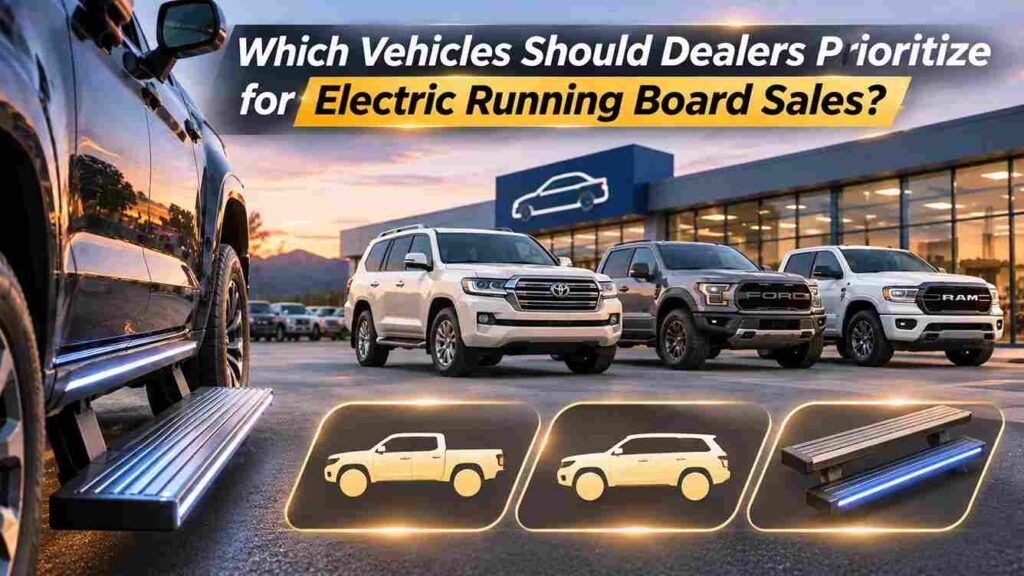
Dealers should prioritize vehicles with strong local demand, confirmed product fitment, and clear accessory sales opportunities. Popular pickup trucks and SUVs are good starting points, but high vehicle sales do not always mean higher electric running boards profit.
Pickup Truck Models by Regional Market
Pickup truck preferences vary across countries. Dealers can use the following models as a starting point for local market research.
| Target Market | Vehicle Models to Research |
|---|---|
| North America | Ford F-150, RAM 1500, Chevrolet Silverado, GMC Sierra, Toyota Tacoma |
| Australia & New Zealand | Toyota Hilux, Ford Ranger, Isuzu D-MAX, Mazda BT-50 |
| Europe | Ford Ranger, Volkswagen Amarok, Toyota Hilux, Isuzu D-MAX |
| South America | Toyota Hilux, Ford Ranger, Chevrolet S10, Volkswagen Amarok, Nissan Frontier |
| Middle East | Toyota Hilux, Ford F-150, RAM 1500, Ford Ranger, Nissan Navara |
| Russia | Toyota Hilux, GWM Poer, JAC T9, Changan Hunter Plus |
| South Africa | Toyota Hilux, Ford Ranger, Isuzu D-MAX, Land Cruiser 79 |
| Southeast Asia | Toyota Hilux, Isuzu D-MAX, Ford Ranger, Mitsubishi Triton |
These models are regional research candidates, not vehicle sales rankings or confirmed MAX Running Boards fitment applications.
Before placing orders, dealers should review local vehicle sales, customer inquiries, product compatibility, and expected demand. For more guidance, explore popular 4×4 models in different markets.
Electric Running Boards for SUVs and Luxury Vehicles
SUVs and luxury vehicles also offer accessory sales opportunities. Models worth evaluating include:
- Toyota: Land Cruiser and Prado
- Lexus: GX and LX
- Nissan: Patrol
- Land Rover: Defender
- Mercedes-Benz: G-Class
These vehicles may attract customers who value easier access and a cleaner exterior appearance. Dealers should confirm model years, trim levels, and mounting requirements before offering installation.
Standard vs. LED Electric Running Boards: Cost and Sales Potential
Standard electric running boards suit customers who want practical vehicle access at a lower purchase cost. LED versions may appeal to customers who prefer additional lighting features and are willing to pay more.
However, a higher retail price does not guarantee a higher profit margin. Dealers should compare actual wholesale costs, local selling prices, and customer demand before deciding which styles to stock.
What Costs Can Reduce Electric Running Boards Profit?
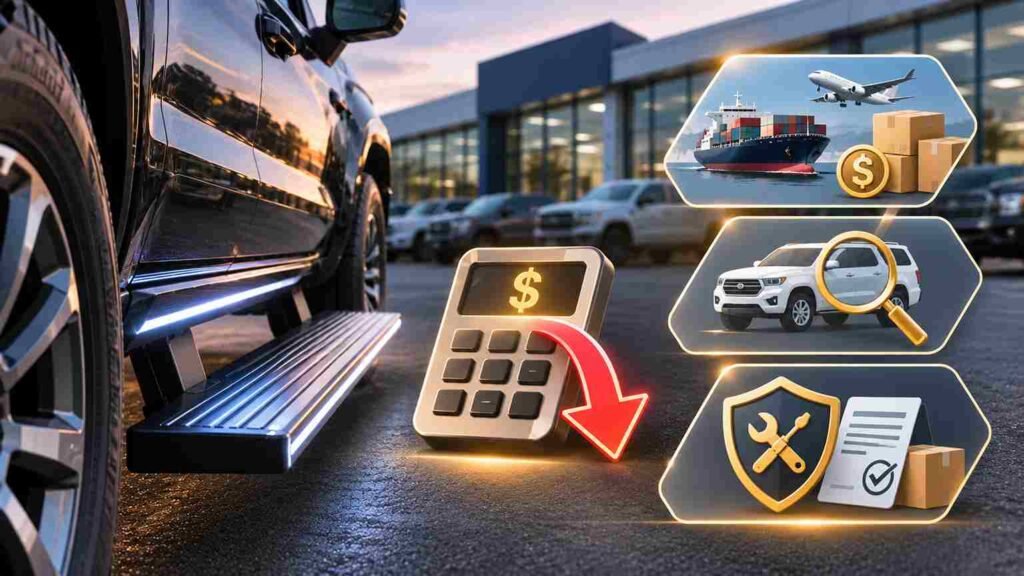
A competitive wholesale price does not always guarantee a good profit margin. Shipping changes, vehicle fitment errors, and warranty claims can create unexpected expenses. Dealers should identify these risks before placing orders to protect their electric running boards profit.
Shipping and Import Costs That Affect Landed Prices
International shipping rates can change based on shipment size, destination, and transport method. Import duties, customs clearance fees, and local delivery charges may also increase the final purchase cost.
Dealers should pay attention to shipping terms:
- EXW: Buyers arrange transportation and take responsibility for most shipping costs from the factory.
- FOB: Sellers deliver goods on board the vessel at the agreed port, while buyers handle the main freight and later costs.
- DDP: Sellers handle delivery and agreed import-related costs under DDP terms.
Dealers should confirm all shipping charges before comparing supplier quotations.
Vehicle Fitment Errors and Installation Costs
Incorrect vehicle fitment can lead to installation delays, additional labor, and product returns. Differences in model years, body styles, mounting brackets, or control systems may prevent proper installation.
To reduce these risks, dealers should:
- Confirm the vehicle model, year, and body configuration.
- Request installation guides and verify mounting requirements.
- Test samples before introducing new vehicle applications.
Warranty Claims and Long-Term Profit
Warranty claims can create costs beyond replacement parts. Dealers may need to cover fault diagnosis, technician labor, return shipping, or replacement installation.
Before purchasing, dealers should confirm warranty coverage, replacement parts availability, and responsibility for shipping and labor costs.
MAX Running Boards offers a 2-year warranty on its electric running boards, providing dealers with defined product warranty coverage. However, dealers should still confirm the specific warranty terms and how claims are handled before ordering.
Clear after-sales terms help dealers manage warranty costs, protect long-term profit, and maintain customer confidence.
How Can Dealers Increase Power Running Boards Profit?
Improving electric running boards profit requires more than increasing retail prices. Dealers can improve profitability by choosing suitable suppliers, controlling inventory, and offering accessories that match customer demand.
OEM vs. Aftermarket Electric Running Boards: Costs and Profit Potential
OEM running boards are supplied through vehicle manufacturers’ approved parts channels, while aftermarket products come from independent brands and suppliers.
These options may differ in purchase prices, vehicle compatibility, installation support, and warranty coverage.
Aftermarket products are not always more profitable. Dealers should compare total landed costs, achievable retail prices, installation requirements, and after-sales responsibilities before selecting a supplier.
Retail Pricing Based on Costs and Local Demand
Dealers should set retail prices using four factors:
- Landed cost: Include product, shipping, and import expenses.
- Local competition: Compare prices for similar products and services.
- Customer demand: Consider vehicle type and product features.
- Target gross margin: Set a margin that supports business expenses and profit goals.
Review prices regularly as supplier and shipping costs change.
Pre-Delivery Accessory Packages for Higher Sales
Dealers can offer electric running boards as optional upgrades before vehicle delivery, with product and installation costs included in one quotation.
Running boards can also be sold alongside wheels, suspension upgrades, or other accessories. However, excessive package discounts can reduce overall profit.
Stocking Popular Models vs. Ordering on Demand
A balanced inventory strategy helps dealers control costs.
- Stock popular models: Keep limited inventory for vehicles with consistent local demand to shorten customer waiting times.
- Order less common models on demand: Purchase after customer confirmation to reduce unsold stock and tied-up capital.
Break-Even Sales Volume for New Dealers
Dealers should estimate how many sets they need to sell to cover additional operating expenses.
Consider this hypothetical example:
| Item | Amount |
|---|---|
| Additional fixed operating costs | $1,200 |
| Contribution per set after variable costs | $200 |
| Break-even sales volume | 6 sets |
Dividing $1,200 by $200 gives a break-even target of six sets.
This calculation helps dealers set sales targets and evaluate trial orders. Inventory purchases require working capital, but unsold inventory is not automatically an operating expense. Dealers should plan inventory funding separately from break-even operating costs.
How Can MAX Running Boards Support Car and Pickup Truck Dealers?
MAX Running Boards helps car and pickup truck dealers expand accessory sales, reduce inventory risks, and manage after-sales costs through flexible wholesale supply and vehicle-specific support.
Factory-Direct Wholesale Supply and Flexible MOQ
MAX works directly with its manufacturing partner to offer competitive wholesale pricing. With MOQ From 1 Set, dealers can test customer demand without investing heavily in inventory. Bulk orders are also supported as sales grow.
Vehicle Coverage and Installation Support
With 500+ vehicle applications, MAX helps dealers offer electric running boards for popular SUVs and pickup trucks. Vehicle-specific installation guides and OEM/ODM development support help dealers expand their accessory options and reduce fitment-related risks.
Product Testing and After-Sales Support
Reliable products help dealers reduce potential repair costs and customer complaints. MAX electric running boards undergo 80,000-cycle durability testing, feature IP67 motor protection, and come with a 2-year warranty to support long-term sales and after-sales service.
Conclusion
Electric running boards can be a profitable accessory for car and pickup truck dealers. However, success depends on local vehicle demand, competitive purchasing costs, manageable warranty risks, and consistent sales opportunities. Dealers should evaluate these factors before investing in inventory.
MAX Running Boards supports dealers with flexible wholesale purchasing and vehicle-specific solutions. Contact MAX Running Boards with your target vehicle models, estimated order quantity, and sales market to receive a wholesale quotation and product information.
