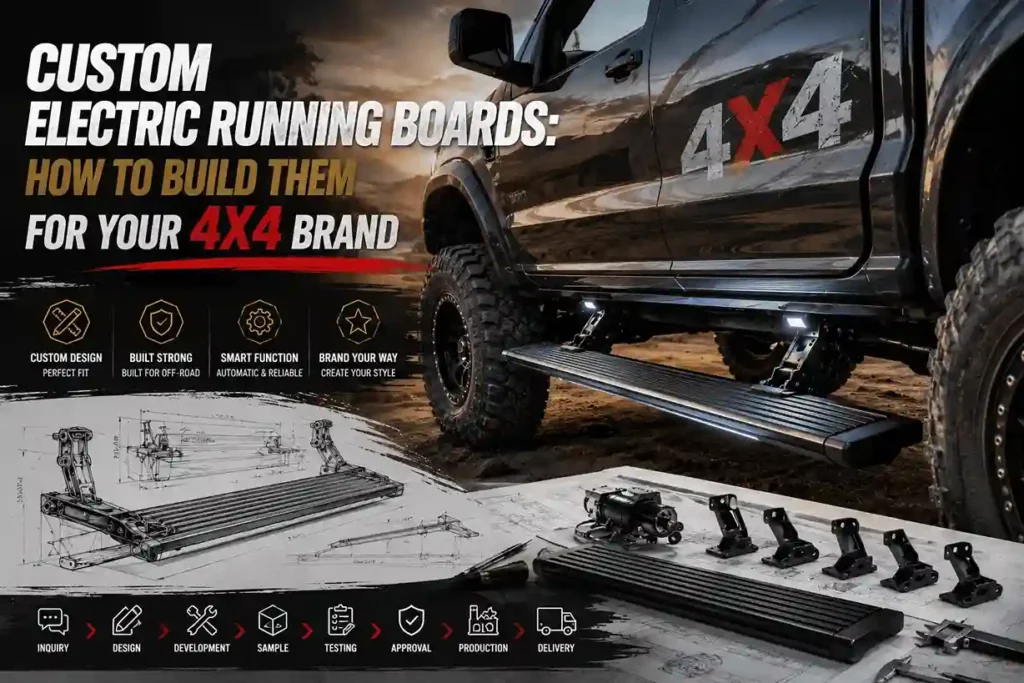
You already sell electric running boards. But are you building your own brand with custom electric running boards?
Many 4×4 and auto accessory shops sell products from different suppliers. The products may carry the supplier’s logo, brand name, and packaging. Even the product pages on your website may focus on the supplier’s brand.
This can make customers remember the supplier instead of your company. It can also limit your control over product design, pricing, and brand image.
Custom electric running boards with private label production give you another option. You can sell the product under your own brand, add your logo, choose your packaging, and develop products for the vehicles in your market.
In this guide, we will explain why businesses choose customization, what you can customize, how OEM and ODM work, and how the customization process works. We will also cover what to prepare, how customization affects cost, and how to choose the right manufacturer for your brand.
Why Customize Electric Running Boards for Your Brand?
You may already sell electric running boards, but the products may still belong to another brand. Your supplier controls the product name, logo, packaging, and product presentation. Your customers may remember the manufacturer instead of your company.
This can become a problem as your business grows. You may want to set your own prices, target specific vehicle models, or build a product range that fits your market. But if you only resell supplier-branded products, your options can be limited.
Custom electric running boards give you more control. You can build products under your own brand, choose how they look and how they are presented, and develop a product line for the vehicles your customers actually drive.
Create a Consistent Electric Running Boards Brand
A strong brand needs a consistent product experience. If your electric running boards carry another supplier’s logo while your website, packaging, and sales materials use your own brand, customers may not know who they are buying from.
Private-label customization lets you create a consistent brand across the entire product.
You can customize key brand elements such as:
- Logo and brand name
- Product name and model number
- Product labels
- Packaging and cartons
- Product images
- Installation manuals
- Website product presentation
For example, instead of telling a customer, “We sell Brand A electric running boards,” you can present the product as your own. Your logo appears on the product and packaging, while your website and sales materials use the same product name and brand identity.
The change is simple but important. You move from reselling another company’s product to offering your own electric running boards.
Build Your Electric Running Boards Brand on Your Own Website
Your website can become the main place where customers learn about your electric running boards brand.
Instead of listing products under another supplier’s name, you can build the entire product experience around your own brand. This can include:
- Product pages for each electric running board model
- Category pages for different product types
- Vehicle fitment pages for specific models
- Installation guides
- Product blog content
- Customer case studies
- Frequently asked questions
For example, if you offer electric running boards for Toyota Hilux, you can create a dedicated Hilux product page under your own brand. Customers can see the product, check vehicle compatibility, review key features, and find installation information in one place.
This also gives your sales team a consistent resource to share with dealers, installers, and end customers.
Over time, your website becomes more than a product catalog. It becomes a central place where customers understand your products, your vehicle coverage, and your brand.
Develop Your Own Custom Electric Running Boards Product Line
Selling several supplier products does not always create a clear product range. One model may come from one supplier, while another model comes from a different manufacturer. The product design, naming, packaging, and specifications may also differ.
With customization, you can build a more organized electric running boards product line under one brand.
For example, your range could include:
| Product Type | Main Positioning |
|---|---|
| Standard Electric Running Boards | Practical option for everyday SUV and pickup applications |
| Premium Electric Running Boards | Higher-end design and finish for premium vehicles |
| LED Electric Running Boards | Adds illuminated styling and a stronger visual identity |
| Heavy-Duty Electric Running Boards | Focuses on strength and demanding off-road use |
| Vehicle-Specific Electric Running Boards | Developed for selected vehicle models and fitment requirements |
You do not need to develop every product from zero. A manufacturer can start from an existing platform and adjust the design, specifications, brackets, finish, branding, or other details based on your requirements.
This gives you a clearer product structure and makes it easier to expand your range as your business grows.
The goal is to move from selling other companies’ products to owning your own electric running boards product line.
Reduce Dependence on Supplier Brands
Relying on supplier-branded products can create problems when your business depends on a product that you do not control.
For example, a supplier may change its pricing, discontinue a model, change its product positioning, or have limited stock during a busy season. Dealer policies can also affect how you sell the product in your market.
Private-label electric running boards give you more control over the product you sell.
You can work with a manufacturer to define your own:
- Product models
- Specifications
- Branding
- Packaging
- Target vehicles
- Pricing strategy
This creates a clearer business structure: the manufacturer produces the product, your company owns the brand and product presentation, and your customers buy from your brand.
For growing distributors, dealers, and 4×4 shops, this can reduce dependence on supplier brands and make the product line easier to manage.
Adapt Custom Electric Running Boards to Your Target Market
Different markets can have different expectations for electric running boards. A product that works well for one market may need changes for another.
For example, buyers in the Australian off-road market may place more focus on durability, corrosion resistance, and heavy-duty use. A business targeting premium SUV customers in the Middle East may place more focus on appearance, LED options, finish, and applications for luxury SUVs.
Customization can help you adapt the product without starting a completely new project.
Depending on the manufacturer and project requirements, you may customize:
- Product design
- Surface finish
- LED options
- Board specifications
- Mounting brackets
- Branding
- Packaging
This approach allows you to create products that match your market instead of simply selling the same supplier product to every customer.
For example, a distributor serving the Australian market may want a heavy-duty version for popular off-road vehicles, while a premium SUV dealer may prefer a cleaner design with LED lighting and upgraded branding.
Control Your Electric Running Board Product Positioning
When you sell a supplier’s branded electric running boards, many parts of the sales strategy are already defined for you. The product has an existing name, image, packaging, and market position.
With your own electric running boards, you can decide how the product should be presented and who it should target.
You can control:
- Product name
- Product positioning
- Retail price
- Dealer price
- Packaging
- Target vehicles
- Target customers
- Promotion strategy
For example, you can position one model as an affordable daily-use product and another as a premium electric running board for high-end SUVs. You can also create different product models for different vehicle segments while keeping the same brand identity.
This gives you more room to build a long-term product strategy instead of simply choosing from a supplier’s existing catalog.
You are no longer simply reselling electric running boards. You are building your own electric running board product.
What Can You Customize on Electric Running Boards?
Not every custom electric running board project requires a completely new product design. In many cases, you can start with an existing electric running board platform and customize the parts that matter most to your brand and target market.
This makes electric running boards customization more practical for distributors, 4×4 shops, auto accessory dealers, and brand owners. You can choose how much to customize based on your target vehicles, product positioning, and budget.
Logo & Brand Identity for Electric Running Boards
Your brand is one of the easiest parts to customize. Instead of selling a supplier’s branded product, you can put your own brand identity on the electric running boards and related materials.
Common options include:
- Brand logo
- Product name and model number
- Logo placement
- Product identification
- Product labels
For example, your logo can appear on the running board, product labels, installation manuals, and other product materials. The exact placement depends on the product design and production method.
If you want private label electric running boards for your brand, it is important to confirm the logo size, location, printing or marking method, and other branding details before production.
This gives your product a consistent identity from the running board itself to the materials your customers receive.
Custom Packaging for Electric Running Boards
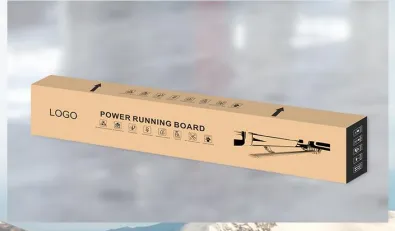
Packaging is another practical part of custom electric running boards. Your product can arrive at the customer with your brand name on the carton, labels, and product documents.
You can customize:
- Custom carton
- Brand logo
- Product labels
- Packaging design
- Installation instructions
Custom packaging is especially useful for distributors and dealers that want a consistent presentation across their electric running boards product line.
It also makes the product easier for your sales team and dealers to identify. Instead of receiving a generic supplier carton, customers receive a product package that represents your own brand.
Vehicle-Specific Brackets for Custom Electric Running Boards
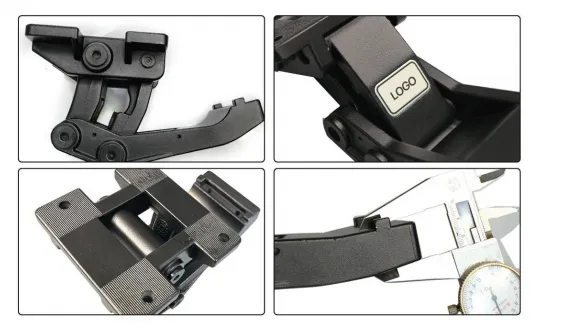
The mounting bracket plays an important role in vehicle fitment. Different vehicles can have different chassis structures, mounting points, and space requirements.
Depending on the project, you can customize:
- Bracket design
- Bracket position
- Extension length
- Vehicle fitment
For vehicle-specific projects, the manufacturer may use CAD data, STL chassis scans, or existing vehicle measurements to develop the bracket and confirm fitment.
This type of customization is useful when you want to offer electric running boards for a specific vehicle model or model year.
For a deeper look at vehicle-specific development, see our guide to Vehicle-Specific Electric Running Boards.
Board Thickness for Custom Electric Running Boards
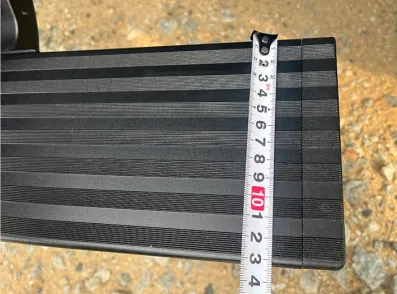
Board thickness can also be adjusted based on project requirements. The right specification depends on the intended use, product structure, expected load, and market positioning.
You may need to consider:
- Board thickness
- Project requirements
- Load requirements
- Product positioning
- Vehicle application
For example, a heavy-duty product for off-road use may require different board specifications from a standard product for daily driving.
The manufacturer should confirm the material, thickness, structure, and load requirements together. This helps ensure that the final product matches its intended application.
Custom Electric Running Board Design
You can also customize the appearance of the running board without developing a completely new product.
Possible adjustments include:
- Board shape
- Surface appearance
- Visual style
- Edge design
- Overall product look
These changes can help your electric running boards match your brand positioning. A premium SUV product may use a cleaner appearance, while an off-road product may use a stronger and more rugged design.
This is where a Customize Electric Running Boards project can be kept practical. You can adjust the existing product design instead of developing every component from scratch.
LED Options
LED lighting is another customization option. However, it does not always require a completely new LED system.
For many projects, you can choose from existing LED configurations offered by the manufacturer, such as:
- Single LED
- Dual LED
- Available LED lighting configurations
The goal is usually to select an existing LED option that fits your product and market requirements. You do not necessarily need to develop a completely new LED system.
Before production, confirm the available LED configurations, lighting position, wiring, and compatibility with the selected running board model.
Customization Table
| Customization | What Can Be Customized |
|---|---|
| Logo & Branding | Brand logo and product identification |
| Packaging | Custom carton, labels, and packaging design |
| Brackets | Vehicle-specific bracket design and extension length |
| Board Thickness | Board thickness based on project requirements |
| Board Design | Shape and appearance adjustments |
| LED Options | Choose from available LED configurations, such as single or dual LED |
The key point is that customization can be flexible. You do not need to customize every part of an electric running board.
For many businesses, a combination of branding, packaging, vehicle-specific brackets, board design, and available LED options is enough to create custom electric running boards for your brand.
The right manufacturer can also help you decide which parts should be customized and which parts can remain as existing production solutions. This can reduce development work while still giving your product a clear brand identity.
OEM vs ODM Electric Running Boards: What Is the Difference?
When you work with an electric running board manufacturer, you usually choose between OEM and ODM cooperation. The main difference is who provides the product design and who takes the lead in product development.
For businesses planning custom electric running boards, this difference matters. Your cooperation model affects the development process, engineering support, prototype requirements, and how much input you have over the final product.
What Is OEM for Electric Running Boards?
OEM stands for Original Equipment Manufacturer. In an OEM project, the customer usually provides the product design or specifications, while the manufacturer handles production and quality control.
OEM means the customer usually has an existing product design, specifications, drawings, or other technical requirements. The manufacturer produces the electric running boards according to these requirements.
The typical OEM process includes:
- Customer provides product design or specifications
- Factory reviews the design and production requirements
- Engineering team confirms manufacturing details
- Factory produces the product
- Quality control checks the finished products
- Customer’s brand and packaging are applied
For example, you may already have a running board design, board dimensions, material requirements, bracket drawings, and branding specifications. The manufacturer reviews your requirements and then produces the product according to the approved design.
OEM is often suitable for businesses that already have a defined product and need a manufacturing partner to produce it.
What Is ODM for Electric Running Boards?
ODM stands for Original Design Manufacturer. In an ODM project, the manufacturer can provide product design and development support in addition to manufacturing.
ODM is different because the customer may not have a complete product design. Instead, you provide the market requirements, target vehicles, product positioning, and key specifications. The manufacturer supports the design and development process.
A typical ODM project may include:
- Customer provides market and product requirements
- Factory supports product design and development
- Engineering team develops the product
- Prototype is produced
- Prototype is tested and adjusted
- Final product enters production
- Customer’s branding and packaging are applied
For example, you may want to develop custom electric running boards for a specific SUV or pickup but do not have the complete bracket design or product drawings. The manufacturer can support vehicle-specific development, prototype production, testing, and production based on your requirements.
ODM is often suitable for businesses that have a product idea or market demand but need engineering support to turn that idea into a finished product.
OEM vs ODM Table
| OEM | ODM | |
|---|---|---|
| Customer has product design | Usually yes | Not always |
| Factory design support | Limited | Yes |
| Product customization | Yes | Yes |
| Branding | Yes | Yes |
| Prototype | Possible | Usually needed |
| Best for | Established products or brands | New product development |
In simple terms, OEM works best when you already know what product you want to manufacture. ODM works better when you know what you want to achieve but need the manufacturer’s engineering team to help develop the product.
Both models can support electric running board customization. The right choice depends on how complete your product design is and how much development support you need from the manufacturer.
How Does the Custom Electric Running Board Process Work?
How does the custom electric running board process work after you contact a manufacturer? A typical project starts with product requirements and ends with sample approval, mass production, and delivery. The exact process depends on the customization level, vehicle application, and whether you choose OEM or ODM cooperation.
Custom Electric Running Board Process at a Glance
| Step | Process | Main Work |
|---|---|---|
| 1 | Define Requirements | Confirm brand, logo, vehicle applications, board, brackets, LED, and packaging |
| 2 | Project Review | Check customization scope, vehicle fitment, compatibility, and feasibility |
| 3 | Design & Engineering | Complete OEM, ODM, engineering modification, or vehicle-specific development |
| 4 | Prototype & Sample | Develop prototypes, brackets, board design, branding, and samples |
| 5 | Testing & Approval | Check fitment, operation, structure, appearance, and electrical system |
| 6 | Mass Production | Prepare materials, manufacture, assemble, inspect, and complete QC |
| 7 | Packaging & Delivery | Complete custom packaging, labeling, final inspection, and shipment |
1. Define Your Custom Electric Running Board Requirements
Start by confirming the basic requirements for your project. These may include your brand, logo, target vehicles, board design, brackets, LED options, product specifications, and packaging.
If you already have drawings, CAD/STL files, or reference samples, you can provide them to the manufacturer. Clear requirements help the factory understand your project and prepare the right development plan.
2. Review the Project Requirements
The manufacturer then reviews the project based on customization scope, vehicle fitment, existing product compatibility, engineering requirements, and production feasibility.
Most projects fall into three levels:
- Standard Customization: Logo, packaging, labels, and available product options
- Engineering Modification: Changes to brackets, board design, or other components
- New Development: A new product or vehicle-specific design
This step helps both sides understand the development work before production begins.
3. Product Design and Engineering
The engineering process depends on the project type. For OEM projects, the manufacturer works from your existing drawings and specifications. For ODM projects, the manufacturer can support product design and development based on your market requirements and target vehicles.
For vehicle-specific electric running boards, engineering work may include bracket development, CAD/STL design, mounting checks, and product modifications.
4. Custom Electric Running Board Prototype Development
After the design is confirmed, the manufacturer develops a prototype or sample. Depending on the project, this may include the board, vehicle-specific brackets, LED configuration, branding, and packaging.
The sample gives you a physical product to review before mass production.
5. Testing and Approval for Custom Electric Running Boards
The sample is checked against the agreed requirements. Key checks include vehicle fitment, operation, structure, appearance, electrical functions, and installation.
Once the sample meets the required specifications, you can approve the final version for production.
6. Mass Production
After sample approval, the manufacturer starts mass production. The main stages include material preparation, manufacturing, assembly, quality control, and final inspection.
Production follows the approved sample, product specifications, branding, and packaging requirements.
7. Packaging and Delivery
The final stage covers custom packaging, brand labels, installation instructions, carton packing, and final inspection.
After inspection, the finished products are packed and prepared for shipment. For businesses developing custom electric running boards for your brand, the packaging and product presentation should match the approved brand identity.
How Much Does It Cost to Customize Electric Running Boards?
There is no fixed price for custom electric running boards. The total cost depends on the customization and development scope. Simple branding projects usually cost less than projects that require new product development.
What Affects the Cost?
| Cost Factor | What May Affect the Price |
|---|---|
| Product Customization | Board design, thickness, brackets, LED options, and engineering changes |
| Branding & Packaging | Logo, labels, custom cartons, and packaging artwork |
| Prototype & Development | New vehicle fitment, brackets, board design, engineering, and prototypes |
| Order Quantity | Initial quantity, MOQ, production volume, and development requirements |
Product Customization
Product changes can affect the cost, including board design, board thickness, brackets, LED options, and engineering changes. Using an existing product platform can help reduce development costs.
Branding and Packaging
Branding requirements may include logos, labels, custom cartons, and packaging artwork. The cost usually depends on the branding requirements and order quantity.
Prototype and Development
New vehicle fitment, new brackets, board design, engineering work, and prototype development can add to the project cost. Existing products usually require less development work.
Order Quantity
Order quantity also affects the unit cost. MOQ depends on the customization scope, product development requirements, and production plan. For an accurate quote, provide your product requirements and expected order quantity to the manufacturer.
How to Choose a Custom Electric Running Board Manufacturer?
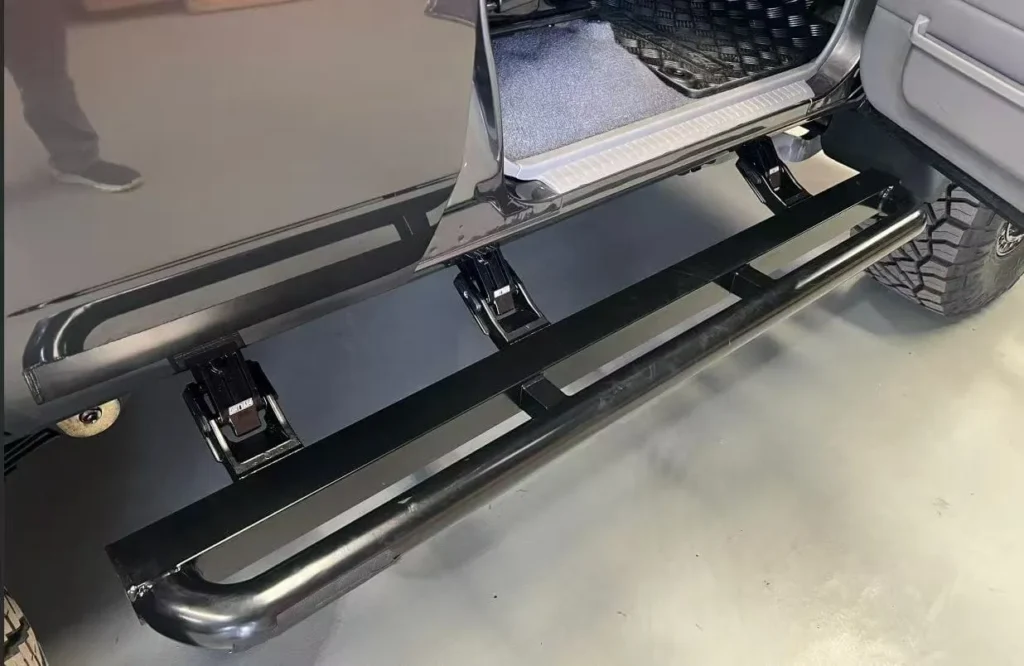
Choosing the right custom electric running board manufacturer is important for businesses developing their own branded products. MAX Running Boards supports OEM, ODM, and private-label electric running board projects, from product development and manufacturing to testing and brand customization.
OEM & ODM Capability
MAX Running Boards supports different project types, whether you have an existing design or need development support through MAX OEM & ODM electric running board services.
- OEM and ODM electric running boards
- Product customization
- Engineering support
- Vehicle-specific applications
- OEM and ODM project support
Manufacturing Capability
Established in 2012, MAX Running Boards operates a 25,000㎡ factory focused on electric and power running boards.
- In-house production and assembly
- Quality control
- Standard and customized projects
- Small initial orders and mass production
- Global automotive aftermarket experience
Development & Testing
MAX Running Boards supports vehicle-specific development and product testing before mass production.
- Custom bracket development
- Product engineering
- Prototype and sample development
- Vehicle fitment testing
- Durability and functional testing
- Electrical system testing
- Sample approval before mass production
Private Label Support
MAX Running Boards can help businesses build their own branded electric running board products with private label electric running board services.
- Brand logo and product identification
- Custom labels and packaging
- Private-label electric running boards
- Brand-specific product presentation
- Own electric running board product line support
Instead of simply reselling another supplier’s products, you can develop and sell electric running boards under your own brand with MAX Running Boards.
Conclusion
Choosing a custom electric running board manufacturer is an important step for distributors, dealers, 4×4 shops, and automotive brands that want to develop their own products.
From OEM and ODM development to vehicle-specific engineering, product customization, testing, packaging, and private labeling, the right manufacturer can help turn your product idea into a market-ready electric running board.
With MAX Running Boards, you can develop electric running boards under your own brand instead of simply reselling another supplier’s products.
Ready to Build Your Own Electric Running Board Brand?
Contact MAX Running Boards to discuss your project, vehicle applications, product requirements, and branding needs. Our team can help you develop custom electric running boards for your brand from the initial concept to production.
