
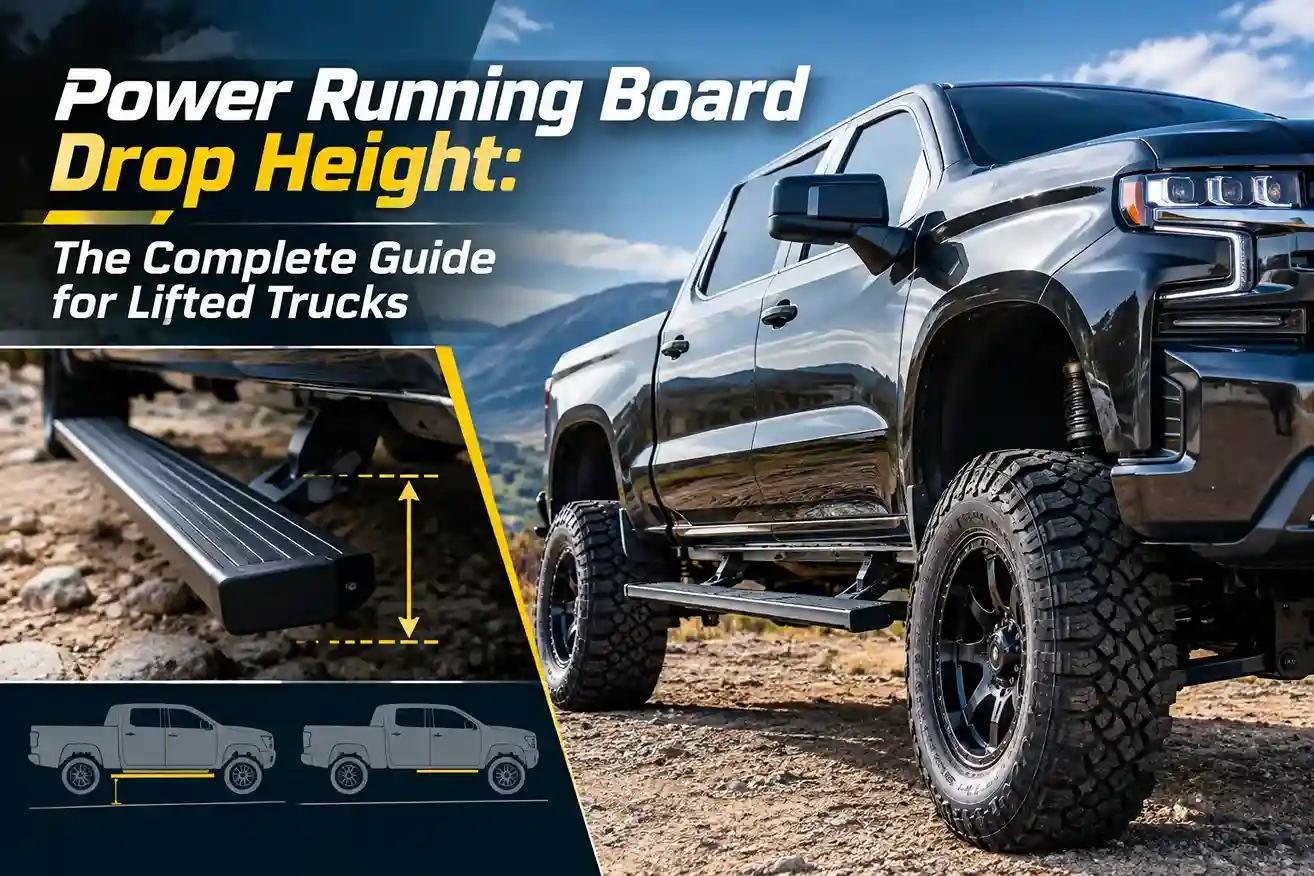
A Power Running Board Drop Height can make a big difference in how easily you enter and exit a truck. A lifted truck can improve ground clearance and off-road capability, but it also raises the entry point. For shorter drivers, children, or family members, a standard running board may still leave too much distance between the ground and the cab.
How far should a power running board drop? The answer depends on the truck height, lift kit, tire size, and step height you need for daily use. A larger drop can make a lifted truck easier to access, but the advertised drop number does not always show the actual step height from the ground.
This guide explains what power running board drop height means, why advertised numbers can be misleading, how much drop a lifted truck may need, how to measure the right step height, and how different power running boards compare. Whether you drive a stock truck or a 6-inch lifted build, the goal is simple: choose a running board based on actual step height, not just a marketing number.
What Is Power Running Board Drop Height?
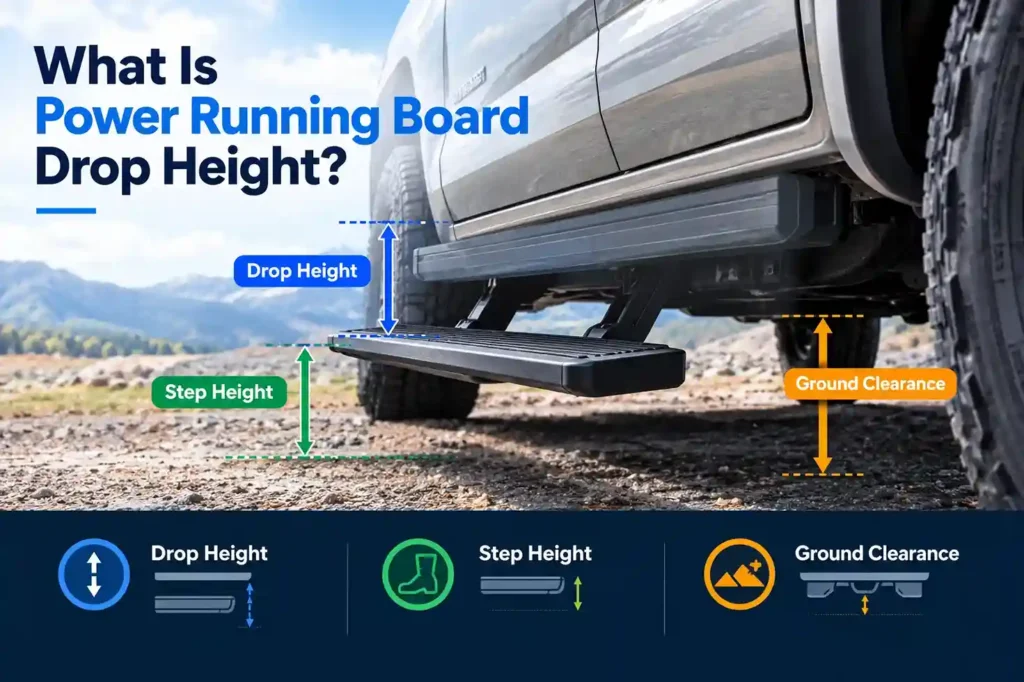
Power running board drop height describes how far the running board moves down when it deploys. However, this number does not tell you the actual height of the step from the ground. That is why buyers often compare the wrong measurement when choosing running boards for a lifted truck.
Drop Height
Drop height is the vertical distance that a power running board moves from its retracted position to its deployed position. For example, if a running board moves down 8 inches when it opens, its advertised drop height is 8 inches. This number shows how far the board moves, but it does not show how high the step sits above the ground.
Step Height
Step height is the distance from the ground to the top surface of the deployed running board. This is the height you actually use when stepping into the truck. A lower step height can make a lifted truck easier to enter, especially for shorter drivers, children, and family members. Step height can vary between vehicles and running board designs, even when the advertised drop height is the same.
Ground Clearance
Ground clearance is the distance from the ground to the vehicle’s lowest point. It shows how much space the truck has under the chassis. Ground clearance is important for off-road driving because a higher clearance can help the truck pass over rocks, ruts, and other obstacles. It does not tell you the height of the deployed running board.
| Measurement | What It Measures | Why It Matters |
|---|---|---|
| Drop Height | How far the running board moves down | Helps you compare how deeply the board deploys |
| Step Height | Distance from the ground to the top of the deployed step | Shows how high you actually need to step |
| Ground Clearance | Distance from the ground to the vehicle’s lowest point | Shows the space available under the truck for off-road use |
The key point is simple: drop height, step height, and ground clearance are three different measurements. When choosing power running boards, especially for a lifted truck, check the actual deployed step height instead of relying on the advertised drop number alone.
Why Power Running Board Drop Height Matters
Power running board drop height affects both truck access and ground clearance. The right drop depends on the vehicle’s height, suspension lift, tire size, and how the truck is used. A deeper drop can make a lifted truck easier to enter, but a board that sits too low can create clearance problems.
Too Little Drop Can Leave the Step Too High
A small drop may leave the running board too high for a lifted truck. A lift kit raises the body and door sill, which increases the distance from the ground to the truck’s entry point. Shorter drivers, children, and family members may find this height harder to use. If the deployed step remains too high, the running board may not provide the access improvement the owner expected.
More Drop Can Improve Access on Lifted Trucks
A lifted truck often needs a deeper drop to bring the step closer to a comfortable height. A truck with a 4-inch or larger lift may benefit from a deeper-deploying power running board. However, lift height alone does not determine the right drop. Tire size, suspension setup, factory step height, and mounting position also affect the final step height. The goal is to place the deployed step at a comfortable height without putting it too close to the ground.
Too Much Drop Can Reduce Ground Clearance
A very deep drop can place the deployed running board close to the ground. This can increase the chance of contact with rocks, curbs, steep driveways, or other obstacles. The risk becomes more important for trucks used for off-road driving. A lower deployed step may improve access, but it can also reduce the available clearance around the board. Buyers should check both the deployed step height and the vehicle’s ground clearance before choosing a deeper drop.
Choose the Right Step Height, Not the Biggest Drop
The largest advertised drop is not always the best choice. The better option is a power running board that provides a comfortable step height for the driver and passengers while keeping enough clearance for the truck’s intended use. For a lifted truck, measure the current entry height first, then choose a running board that brings the deployed step to the height you actually need.
How Much Power Running Board Drop Height Do You Need?
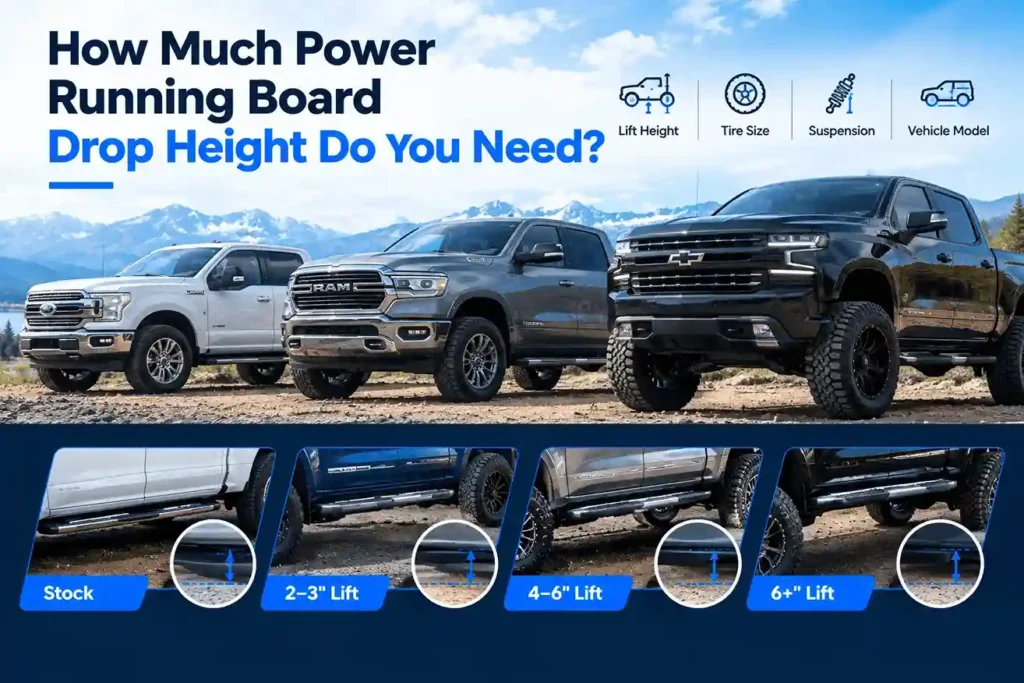
The right Power Running Board Drop Height depends on the truck’s actual entry height, not just the size of the lift kit. A stock truck may work well with a standard-drop board, while a 4-inch or 6-inch lifted truck may need a deeper drop. Tire size, suspension setup, rocker height, and vehicle model also change the final step height. The best approach is simple: measure the deployed step height first, then choose a running board that brings the step to a comfortable height.
Stock Trucks
Standard-drop power running boards may be enough for many stock trucks. However, stock trucks do not all have the same cab or rocker panel height. An F-150, F-250, and Ram 2500 can have different entry heights even when they have no suspension lift.
The difference becomes more noticeable when shorter drivers, children, or other family members use the truck often. A step that feels comfortable for one person may feel high for another. Before choosing a deeper-drop system, measure the distance from the ground to the deployed step. This measurement gives you a better starting point than the vehicle’s factory ride height.
2–3 Inch Lift
A 2–3 inch lift does not always require a deeper power running board. Start by checking the actual step-in height after the lift and larger tires are installed. The deployed step may sit several inches higher than it did before the modification, but the change depends on the vehicle and suspension setup.
This is the point where many owners can decide based on actual use. Measure the current deployed step height and let the people who regularly ride in the truck try it. If the step still feels comfortable, a standard-drop board may work well. If the step feels noticeably higher than before, an aftermarket board with more drop may provide easier access.
4–6 Inch Lift
A 4–6 inch lift can make the entry point much higher. On some lifted trucks, the rocker panel and cab can sit high enough that a standard-drop power running board no longer provides the step height the owner wants. An extended-drop design can bring the step closer to the ground and make entry easier.
Some products use a deeper drop to address this problem. For example, AMP PowerStep XL provides more drop than the standard PowerStep design, while ARIES ActionTrac Extended offers an extended step position below the doorsill. MAX Power Running Boards can also provide a deeper drop for lifted applications, with a current design measurement of about 270 mm (10.6 inches) of drop.
However, these numbers should not be treated as a universal recommendation. A 4-inch lift does not automatically mean that every truck needs a specific drop. The vehicle’s actual step height should determine the final choice.
6+ Inch Lift
A truck with a 6-inch or larger lift needs more careful measurement before you choose a running board. The entry point can become high enough that a standard-drop board may leave too much distance between the ground and the step.
An extended-drop running board may work for some builds. Other trucks may benefit from a multi-step design that creates two smaller steps instead of one large step. Custom mounting solutions may also be useful when the truck has unusual suspension, tire, or rocker panel configurations.
Start with the current deployed step height. Then decide the target step height that feels comfortable for the people who use the truck. Subtract the target height from the current height to estimate how much additional drop you need. This gives you a practical starting point for product selection or a custom solution.
Lift Height Alone Doesn’t Tell You How Much Drop You Need
A 4-inch suspension lift does not mean you need exactly 4 inches of additional running board drop. The lift height describes the suspension change, while the running board drop describes the movement of the board. These are different measurements.
Tire size also affects the final vehicle height. A truck with 35-inch tires can have a different entry height from the same truck with 37-inch or 40-inch tires. Suspension geometry can also change the height of the rocker panel. The vehicle model matters as well. An F-150, F-250, and Ram 2500 can have different factory cab heights before any lift is installed.
For this reason, the most reliable method is to measure the actual step height on the finished truck. Choose by actual step height, not lift height alone.
| Truck Setup | What to Consider |
|---|---|
| Stock | Standard-drop power running boards may be sufficient |
| 2–3″ Lift | Measure and compare the actual step height |
| 4–6″ Lift | Consider extended-drop power running boards |
| 6″+ Lift | Measure first; extended, multi-step, or custom solutions may be appropriate |
The table provides a starting point, not a fixed rule. The right Power Running Board Drop Height depends on the finished vehicle and the people who use it. Measure first, set a target step height, and then choose the drop that meets both access and clearance needs.
How to Measure Your Power Running Board Drop Height
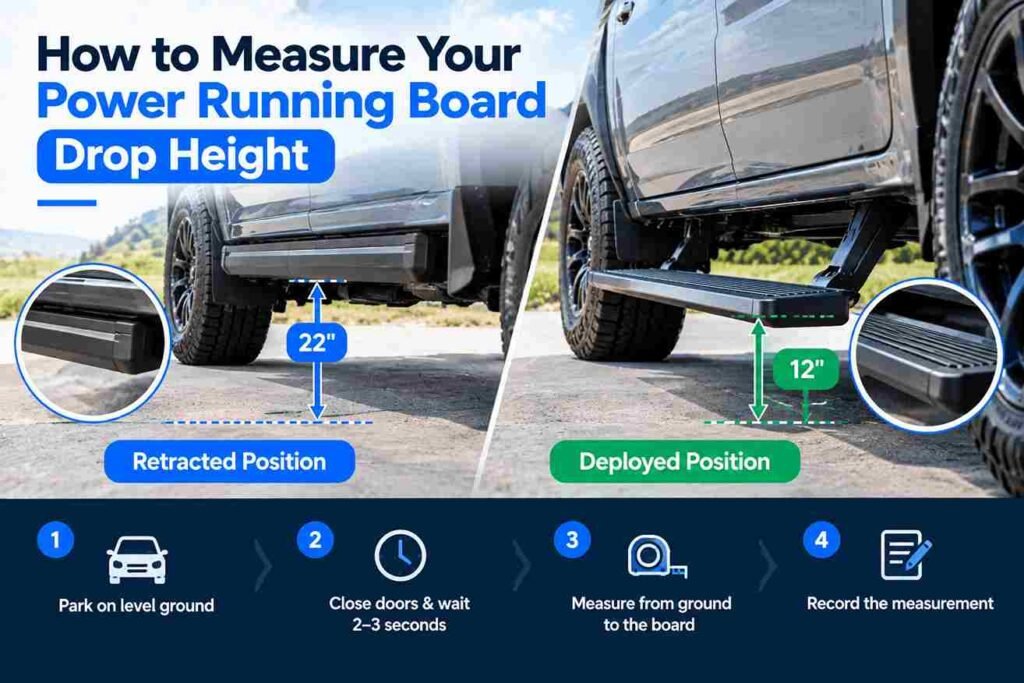
Measuring power running board drop height is simple if you use the same reference points in both positions. The key is to measure the board after it fully retracts and after it fully deploys. You should also measure the top surface of the deployed step because this is the surface you actually use.
Before comparing different power running boards, record the measurements on your truck. This helps you understand how much the board moves and how high the step sits from the ground.
Measure the Retracted Position
Start with the board in its fully retracted position.
- Park the vehicle on level ground.
- Close the doors and wait 2–3 seconds for the board to fully retract.
- Measure from the ground to the lowest point of the retracted board.
- Record the measurement. For example, the measurement may be 22 inches.
For a more complete record, measure these three points:
| Reference Point | What to Measure | Why It Matters |
|---|---|---|
| Ground → bottom of board | Lowest point of the retracted board | Shows the board’s lowest retracted position |
| Ground → top of board | Highest point of the retracted board | Helps compare the board’s overall position |
| Ground → mounting bracket | Lowest or fixed reference point on the bracket | Helps when comparing mounting locations |
The lowest point is useful for checking the board’s position under the vehicle. The mounting bracket can also help when you compare different designs because bracket locations can change the final board position.
Measure the Deployed Position
Next, open the door and let the power running board fully deploy.
- Open the vehicle door.
- Wait until the board reaches its full deployed position.
- Measure from the ground to the top surface of the deployed step.
- Record the measurement. For example, the step surface may sit 14 inches above the ground.
The top surface matters because this is where your foot lands. Measuring the bottom of the board can give you a different number, but that number does not represent the actual step height.
For example, if the top surface sits 14 inches above the ground, your foot steps onto a 14-inch-high surface. The board thickness below that surface does not change the height of the step itself.
Calculate the Actual Drop
You can calculate the vertical movement by subtracting the deployed measurement from the retracted measurement.
Actual Drop = Retracted Position − Deployed Position
For example:
- Retracted reference point = 22 inches
- Deployed reference point = 14 inches
- Actual vertical movement = 8 inches
This calculation works only when you use the same reference point in both positions. If you measure the bottom of the board when retracted and the top of the step when deployed, the result will not represent the true vertical movement of the board.
When you compare power running boards, always check how the manufacturer defines its drop measurement. Different manufacturers may measure from different points, so two products listed with the same drop height may not place the step at the same height from the ground.
Common measurement errors include:
- Uneven ground: Sloped or uneven ground can change the measurement.
- Different reference points: Measuring the step surface in one position and the underside in another creates an inaccurate comparison.
- Incomplete deployment: Measuring before the board reaches its full deployed position can produce a shorter drop measurement.
- Different manufacturer standards: One manufacturer may measure from the mounting point, while another may measure from the board itself.
A consistent measurement method gives you a much better basis for comparing power running board drop height. This becomes especially important on lifted trucks, where a few inches of additional step height can make a noticeable difference when getting into the vehicle.
Power Running Board Drop Height Comparison
Power running board drop height can vary widely between products. However, the published number does not always tell you how low the step will sit on your truck.
Different brands can use different measurement points. Some measure from the rocker panel or doorsill. Others measure the movement of the board itself. This difference can make an 8-inch drop and a 15-inch drop look very different on paper, even when the actual step position is closer than expected.
Best Electric Running Boards Drop Height Comparison Table
| Product | Published Measurement | Measurement Reference | Typical Application |
|---|---|---|---|
| AMP Research PowerStep | 13.5″ | Product/application specific | Stock / mild lift |
| AMP PowerStep XL | ~3–4″ lower than standard | Compared with standard PowerStep | Lifted trucks |
| ARIES ActionTrac | 8″ | From top step | Stock / lifted |
| ARIES ActionTrac | Up to 15″ | Below doorsill | Lifted applications |
| Rough Country Power Steps | Model dependent | Vehicle/application specific | Stock / lifted |
| MAX Power Running Boards | 8.27″ standard / 10.63″ custom | Standardized measurement | Lifted / custom builds |
The MAX standard version uses a 210 mm drop, or about 8.27 inches. The custom version can reach 270 mm, or about 10.63 inches.
These numbers should be treated as product reference measurements rather than a guaranteed step height for every vehicle. The final position can change based on the truck model, rocker panel height, mounting location, bracket design, and suspension setup.
For example, a power running board installed on a stock F-150 may sit at a different height from the same board installed on an F-250 with a lift kit. The product may have the same mechanical drop, but the vehicle’s starting height is different.
This is why we recommend checking the actual vehicle measurements before choosing a drop height. A tape measure can tell you more about your specific truck than a single number in a product listing.
Why 8″, 12″, and 15″ Drops Are Not Always Comparable
The main problem is the measurement reference.
Manufacturers may use different points when they publish a power running board drop height. Common reference points include:
- Top surface of the deployed step
- Bottom of the rocker panel
- Rocker panel or mounting area
- Bottom of the doorsill
- Ground reference
These measurements describe different parts of the installation. They should not be treated as the same measurement.
For example, Brand A may advertise a 15-inch drop from the doorsill. Brand B may advertise an 8-inch drop from the top of the step. The numbers look far apart, but the actual deployed step height from the ground may be much closer.
An advertised 15-inch drop is not automatically better than an 8-inch drop.
The same point applies when comparing power running boards for lifted trucks. A larger advertised drop does not always mean a lower step. The actual step height depends on the vehicle and the measurement method.
When comparing products, ask three simple questions:
- Where does the manufacturer measure the drop from?
- Where does the measurement end?
- Is the measurement based on the actual installed vehicle?
If possible, measure your own truck before making a decision. Measure the relevant points with the board fully retracted and fully deployed. Then compare products using the same reference points.
This method gives you a more useful comparison of power running board drop height and helps you choose the right setup for a stock, lifted, or custom truck.
How to Choose the Right Power Running Board Drop Height
The right power running board drop height depends on your truck and how you use it. A stock truck may work well with a standard drop. A lifted truck may need a deeper drop to keep the step at a comfortable height.
Your lift height is only one part of the decision. Tire size, rocker panel height, passenger needs, and driving conditions also affect the final step height.
Use the table below as a starting point:
| Truck Setup / Use | Typical Vehicle Condition | Main Priority | Recommended Approach |
|---|---|---|---|
| Stock Truck | Factory suspension and tire size | Easy daily access | A standard drop may be enough |
| Mild Lift | 2–3″ lift with larger tires | Lower deployed step height | Consider a deeper drop |
| Lifted Truck | 4–6″ lift | Access and clearance | Choose an extended-drop board |
| High-Lift Truck | 6″+ lift with 37–40″ tires | Comfortable step height | Consider a custom drop |
| Family / Daily Use | Frequent passenger use | Easy and stable entry | Prioritize a comfortable deployed step |
| Frequent Off-Road | Rocks, ruts, and uneven terrain | Retracted clearance | Balance drop height with ground clearance |
| Mixed Use | Daily driving and off-road use | Access and clearance | Choose a balanced drop configuration |
These are general guidelines, not fixed rules. Two trucks with the same lift height can still need different running board positions. Measure your truck before choosing a specific drop height.
Consider Your Vehicle
Your vehicle setup is the first factor to check. A lifted truck usually needs more drop than a stock truck because the cab sits higher from the ground.
Several measurements can affect the result:
- Stock vs. lifted: A lift kit raises the vehicle and can increase the step height.
- Vehicle model: An F-150, F-250, and Ram 2500 can have different cab and rocker panel heights.
- Rocker height: The distance from the ground to the rocker panel affects where the deployed step will sit.
- Tire size: Larger tires can raise the vehicle. A truck with 37-inch or 40-inch tires can sit much higher than a truck with 35-inch tires.
The best way to choose a drop is to start with your current measurements.
How to Choose the Right Power Running Board Drop Height
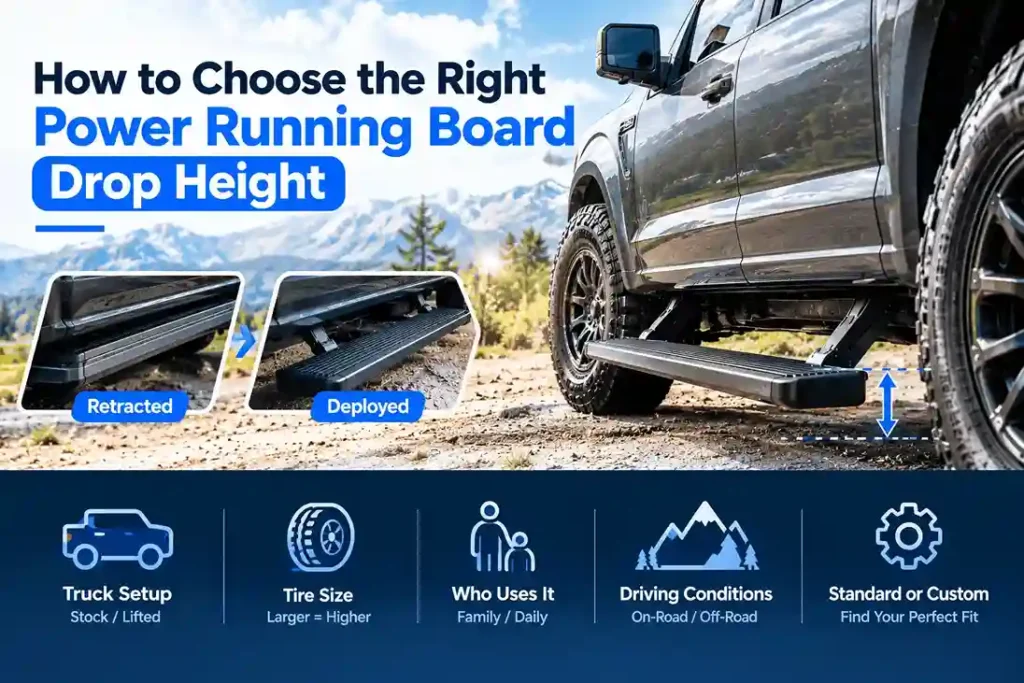
The right power running board drop height depends on your truck and how you use it. A stock truck may work well with a standard drop. A lifted truck may need a deeper drop to keep the step at a comfortable height.
Your lift height is only one part of the decision. Tire size, rocker panel height, passenger needs, and driving conditions also affect the final step height.
Use the table below as a starting point:
| Truck Setup / Use | Typical Vehicle Condition | Main Priority | Recommended Approach |
|---|---|---|---|
| Stock Truck | Factory suspension and tire size | Easy daily access | A standard drop may be enough |
| Mild Lift | 2–3″ lift with larger tires | Lower deployed step height | Consider a deeper drop |
| Lifted Truck | 4–6″ lift | Access and clearance | Choose an extended-drop board |
| High-Lift Truck | 6″+ lift with 37–40″ tires | Comfortable step height | Consider a custom drop |
| Family / Daily Use | Frequent passenger use | Easy and stable entry | Prioritize a comfortable deployed step |
| Frequent Off-Road | Rocks, ruts, and uneven terrain | Retracted clearance | Balance drop height with ground clearance |
| Mixed Use | Daily driving and off-road use | Access and clearance | Choose a balanced drop configuration |
These are general guidelines, not fixed rules. Two trucks with the same lift height can still need different running board positions. Measure your truck before choosing a specific drop height.
Consider Your Vehicle
Your vehicle setup is the first factor to check. A lifted truck usually needs more drop than a stock truck because the cab sits higher from the ground.
Several measurements can affect the result:
- Stock vs. lifted: A lift kit raises the vehicle and can increase the step height.
- Vehicle model: An F-150, F-250, and Ram 2500 can have different cab and rocker panel heights.
- Rocker height: The distance from the ground to the rocker panel affects where the deployed step will sit.
- Tire size: Larger tires can raise the vehicle. A truck with 37-inch or 40-inch tires can sit much higher than a truck with 35-inch tires.
The best way to choose a drop is to start with your current measurements.
- Measure the current deployed step height.
- Decide your target step height for comfortable access.
- Calculate how much additional drop you need.
For example, if your current step sits 18 inches above the ground and your target is 14 inches, you need about 4 inches of additional vertical movement. The final result still depends on the running board design and mounting position.
Consider Who Uses the Truck
The people who use your truck also matter. A running board that works well for one driver may not provide the same level of access for every passenger.
Shorter Passengers
Shorter passengers may benefit from a lower deployed step. However, passenger height alone should not determine the correct drop.
Measure the actual step height and check the size of the stepping surface. A single-step design may work well for some trucks. A two-step design may provide easier access for others.
Children
Children need a stable stepping surface with good traction. A wider step can give them more room for their feet.
A two-step design can also make the distance between the ground and the vehicle floor smaller. Parents should still supervise children when they enter or exit a lifted truck.
Elderly Family Members
Older passengers may prefer a lower deployed step. A lower step can reduce the height of each step and make entry easier.
A two-step setup can also help because it breaks one large step into two smaller steps. This can be useful for family vehicles that carry passengers with limited mobility.
Daily-Use Vehicles
For a daily-use truck, access should be a major priority. You may accept a slightly lower retracted position if the truck mainly travels on paved roads.
The goal is simple: keep the deployed step low enough for comfortable entry while maintaining enough clearance when the board retracts.
Consider Your Driving Conditions
Your driving environment changes the balance between step height and clearance.
Daily Driving
Prioritize a comfortable deployed step height and easy access. If the truck mainly travels on streets and highways, passenger access may matter more than maximum underbody clearance.
Frequent Off-Road Use
Pay closer attention to the retracted position and the vehicle’s lowest point. The running board should stay high enough when retracted to reduce the chance of contact with rocks, deep ruts, and other obstacles.
Mixed Use
Many truck owners use their vehicles for both daily driving and off-road trips. In this case, look for a balance between deployed step height and retracted clearance.
A deeper drop can make a lifted truck easier to enter. However, the board must still retract to a safe position when you leave the pavement.
When Standard Options Aren’t Enough
Standard power running boards can work well for many trucks. However, a lifted or modified truck may need a specific step height that a standard product cannot provide.
This is common with trucks that have 6-inch or larger lifts, 37-inch or 40-inch tires, or additional components under the vehicle. Air tanks, suspension parts, exhaust components, and other modifications can also affect the available mounting space.
A custom power running board can provide more flexibility in these situations. Instead of choosing a product based only on its advertised drop, you can start with the actual vehicle measurements and the step height you want.
A custom solution can help you:
- Match a specific deployed step height
- Support trucks with large lift kits
- Work around suspension and underbody components
- Maintain suitable retracted clearance
- Avoid replacing a standard product that does not provide enough drop
At MAX Running Boards, manufacturer experience helps solve these fitment challenges. MAX Running Boards work with different truck models, lift heights, tire sizes, and mounting requirements. When a standard drop does not provide the right step height, MAX Running Boards can review the vehicle measurements and determine a suitable configuration.
For example, a customer with a 6-inch lift may find that a standard running board still leaves the step too high. Instead of simply choosing the largest available drop, MAX Running Boards can evaluate the truck’s rocker height, mounting position, and target deployed step height. This provides a better starting point for a custom solution.
MAX standard power running boards use an 8.27-inch drop, while MAX custom configurations can reach 10.63 inches. The actual deployed step height still depends on the vehicle and installation position.
For a lifted or custom truck, provide the vehicle model, year, lift height, tire size, and current step height. These measurements allow MAX Running Boards to recommend a configuration based on the actual truck rather than a general drop-height number. If a build requires a specific drop, bracket position, or other product changes, the MAX OEM and custom running board services can provide additional options.
The goal is simple: achieve a comfortable deployed step height while keeping suitable clearance when the board retracts.
Conclusion
The right power running board drop height depends on your truck, lift height, tire size, and how the vehicle is used. A deeper drop can make a lifted truck easier to access, while proper retracted clearance helps protect the boards during daily driving and off-road use.
Measure your actual step height before choosing a running board, and focus on the deployed step position rather than the advertised drop alone.
Need a power running board made for your truck? Contact MAX Running Boards for a dedicated electric running board solution tailored to your vehicle and build.
